🔊 Acoustic Treatment Calculator
Calculate exactly how much acoustic absorption material you need for any room or recording space
Safe n Sound
Board 703
Board
Foam
Cellulose
Batt
Batt R-11
Vinyl (MLV)
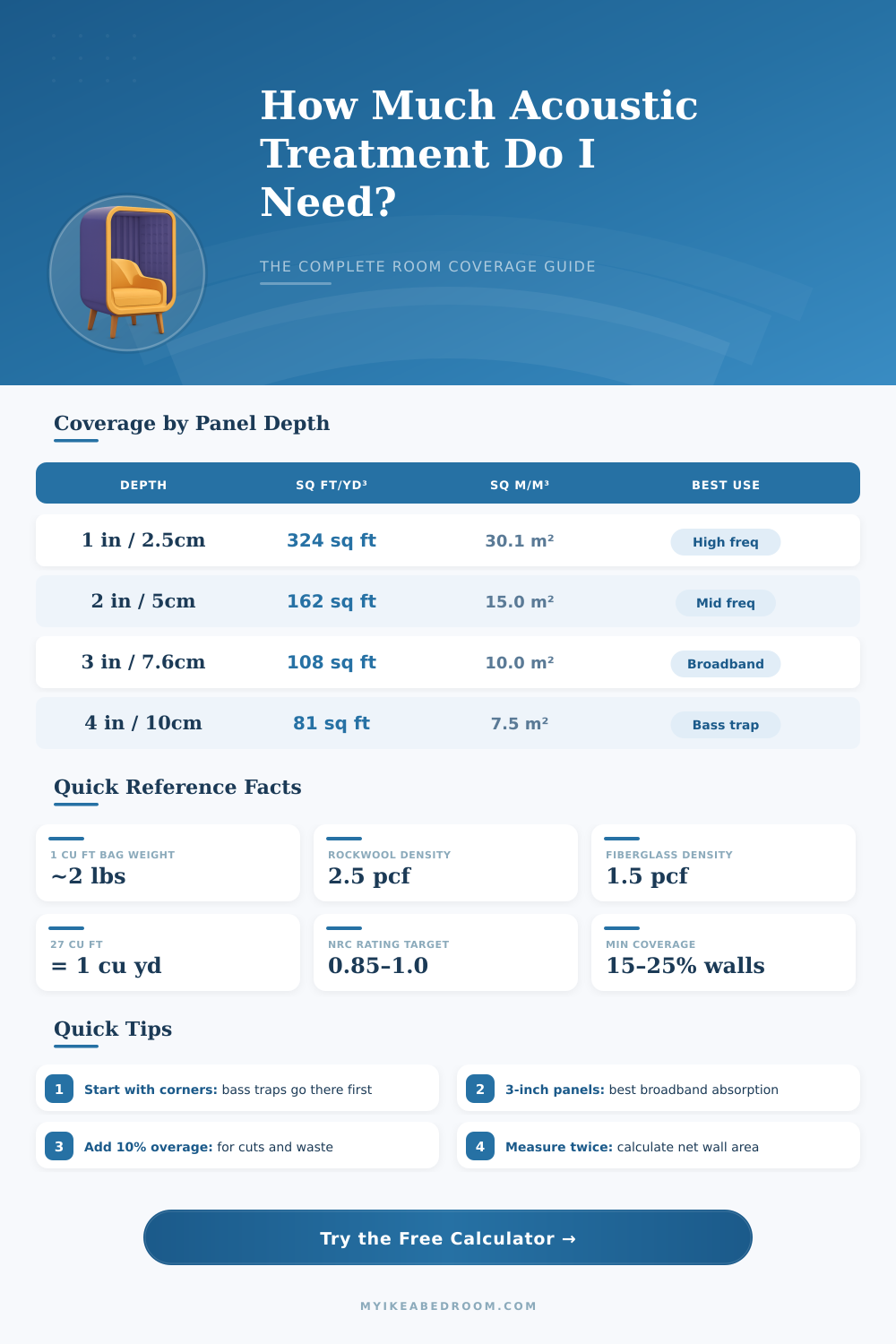
| Panel Depth | Cu Ft per Sq Ft | Sq Ft per Cu Yd | Sq M per M³ | Best Application |
|---|---|---|---|---|
| 1 in (2.5 cm) | 0.083 cu ft | 324 sq ft | 30.1 m² | High frequency, foam tiles |
| 2 in (5 cm) | 0.167 cu ft | 162 sq ft | 15.0 m² | Mid-frequency panels |
| 3 in (7.6 cm) | 0.250 cu ft | 108 sq ft | 10.0 m² | Broadband absorption |
| 4 in (10 cm) | 0.333 cu ft | 81 sq ft | 7.5 m² | Bass traps (corners) |
| 6 in (15.2 cm) | 0.500 cu ft | 54 sq ft | 5.0 m² | Deep bass traps |
| Package Type | Volume | Covers at 2 in | Covers at 3 in | Covers at 4 in |
|---|---|---|---|---|
| 2 cu ft bag | 2 cu ft | 12 sq ft | 8 sq ft | 6 sq ft |
| 3 cu ft bag | 3 cu ft | 18 sq ft | 12 sq ft | 9 sq ft |
| 1 cu yd bale | 27 cu ft | 162 sq ft | 108 sq ft | 81 sq ft |
| 24x48x2 in board | 0.667 cu ft | 8 sq ft | — | — |
| 24x48x3 in board | 1.0 cu ft | — | 8 sq ft | — |
| 24x48x4 in board | 1.333 cu ft | — | — | 8 sq ft |
| Room Type | Area (sq ft) | 25% Coverage | Cu Yds (3 in) | Bags (3 cu ft) |
|---|---|---|---|---|
| Vocal Booth 6x8 | 48 sq ft | 12 sq ft | 0.11 yd³ | 1 bag |
| Home Studio 10x12 | 120 sq ft | 30 sq ft | 0.28 yd³ | 3 bags |
| Recording Studio 15x20 | 300 sq ft | 75 sq ft | 0.69 yd³ | 7 bags |
| Home Theater 12x16 | 192 sq ft | 48 sq ft | 0.44 yd³ | 5 bags |
| Conference Room 15x25 | 375 sq ft | 94 sq ft | 0.87 yd³ | 9 bags |
| Band Rehearsal 20x30 | 600 sq ft | 150 sq ft | 1.39 yd³ | 14 bags |
| Audiophile Listening 12x18 | 216 sq ft | 54 sq ft | 0.50 yd³ | 5 bags |
A bedroom is a challenging environment to listen to music because bedrooms is typically designed for sleeping. Many bedrooms have parallel wall that cause sound reflections to bounce from one wall to the next. Many bedrooms have corners where low-frequency sound accumulate because of the corner resonance phenomenon.
This phenomenon cause bass frequencies to build up in these corner of the bedroom. One way to treat a bedroom to improve the sound that is heard is to use acoustic treatment in the room. Acoustic treatment includes acoustic panel, corner bass traps, and ceiling cloud.
How to improve music sound in a bedroom
Finding the correct amount of acoustic treatment to place in a bedroom can be challenging. Using too little acoustic treatment will not stop the flutter echo that sound reflections on the walls cause. Using too much acoustic treatment will make the room sound dead.
A sound dead room is one where the acoustic treatment has removed all energy from the vocals and the drums in the room. The amount of acoustic treatment to use in a bedroom should take into account the surface area of the walls, the floor, and the ceiling of the bedroom. For example, placing acoustic treatment on one side of the bedroom will affect the reflections of sound off the walls in the same way that placing it on the other side of the bedroom will affect those sounds.
Placing bass trap in the corners of the bedroom will help to treat the standing wave that build up in those corners. Additionally, the ceiling of the bedroom should be treated as sound reflections off the ceiling will affect instrument such as cymbals in a music mix. Acoustic treatment should be used to treat a specific percentage of the available surfaces within the bedroom.
Many people calculate that using acoustic treatment on between 12 and 30 percent of the total available surface area of the bedroom will provide the best acoustic performance in that space. If acoustic treatment is used on less than 12 percent of the available surface area in the bedroom, it will stop the flutter echoes created by reflections on the walls but will not treat the bass frequencies that accumulate in the corners of the bedroom. If acoustic treatment is used on more than 30 percent of the available area in the bedroom, the mid-range frequencies of the music will lose strength in a smaller room than 200 square feet.
The different type of acoustic treatment should be used in a combination so that each type of reflection is treated. For instance, broadband acoustic panels will reflect the mid-range and high frequencies of the sound while deep bass traps will treat the low frequencies that build up in the corners of the bedroom. Additionally, ceiling clouds will treat reflections from the ceiling of the bedroom.
Additionally, the depth of the acoustic panel is important as is the air gap behind the panel. An acoustic panel that is deeper with an air gap behind it will absorb more low frequencies of the sound in the bedroom. The material that is used in the acoustic treatment will affect the performance of the acoustic treatment.
For instance, lightweight felt board are useful for acoustic treatment that is also decorative in the bedroom. Felt boards will reflect speech-range echoes. More dense material such as mineral wool have a higher absorption coefficient for the frequencies between 160 hertz and up.
For instance, if the mineral wool is four inches deep and there is an air gap behind the panel, it will reflect these frequencies. Additionally, foam is a material that will reflect flutter echoes but will not reflect bass frequencies. Each material has a different absorption coefficient.
Felt panels will absorb less of the low frequencies of music than mineral wool panels of the same size. Many room have obstacles that take up the surface area of the room. For instance, windows, wardrobes, and furnitures will take up some of the surface area of the bedroom.
Therefore, acoustic treatment must be adjusted to account for these obstacle in the room. For instance, acoustic treatment should be placed in a way that is symmetrical to the position of the listening spot in the bedroom. This ensures that sound does not reflect differently off of one side of the walls than the other.
Bass traps should be placed in the corners of the room, especially in the front corners of the bedroom. Additionally, if the ceilings in the bedroom are high, it is a good idea to use ceiling clouds to treat the reflections from the ceiling. A common mistake that many people make when treating a bedroom is to simply place acoustic panels in the bedroom in a tidy fashion rather than an effective fashion.
For instance, the best place to place acoustic panels in the room is at the first reflection point in the bedroom. These points can be found using a mirror to see where the sound will reflect off the walls of the bedroom. Additionally, acoustic panels should not be mounted flush against the wall.
Instead, there should be a two-inch air gap behind the acoustic panel so that the acoustic panel will reflect the low frequencies of the sound in the bedroom. Finally, instead of trying to place acoustic panels in the bedroom to create perfect acoustic treatment immediately, it is a good idea to place acoustic panels on each of the side walls of the bedroom and in each of the front corner of the bedroom. Depending on the type of living situation in which an individual lives, the acoustic treatment of a bedroom will be different from another individual in another living situation.
For instance, an individual who lives in a rental might use relatively light acoustic treatment in the bedroom so that the percentage of the total surface area of the bedroom that is treated is under 12 percent. An individual who mixes music on a desk in the bedroom will require more intensive acoustic treatment of the room. Additionally, if an individual lives in a loft whose bedrooms has high ceilings, deep bass traps should be stacked against the corners of the bedroom so that the high ceilings of the bedroom can be treated.
Comparison grids of goals for acoustic treatment and the percentage of the available area of the bedroom that will be treated can help to make decisions about acoustic treatment. Finally, acoustic treatment will not silence the bedroom but will treat the sound that emanates from the listening position in the bedroom so that the individual can hear the music that is playing in the room most clearly.