Deck Beam Size Calculator
Inputs row comes first and results row stays below it. Screen beam size, reaction, and final depth requirement from real framing assumptions.
| Package | Dead load | Use case | Beam impact |
|---|---|---|---|
| Cedar | 8 psf | Light deck | Shallower |
| PT | 10 psf | Base deck | Typical |
| Composite | 13 psf | Dense boards | Deeper |
| Tile | 18 psf | Rigid finish | Much deeper |
| Span band | Line load | Starter beam | Depth note |
|---|---|---|---|
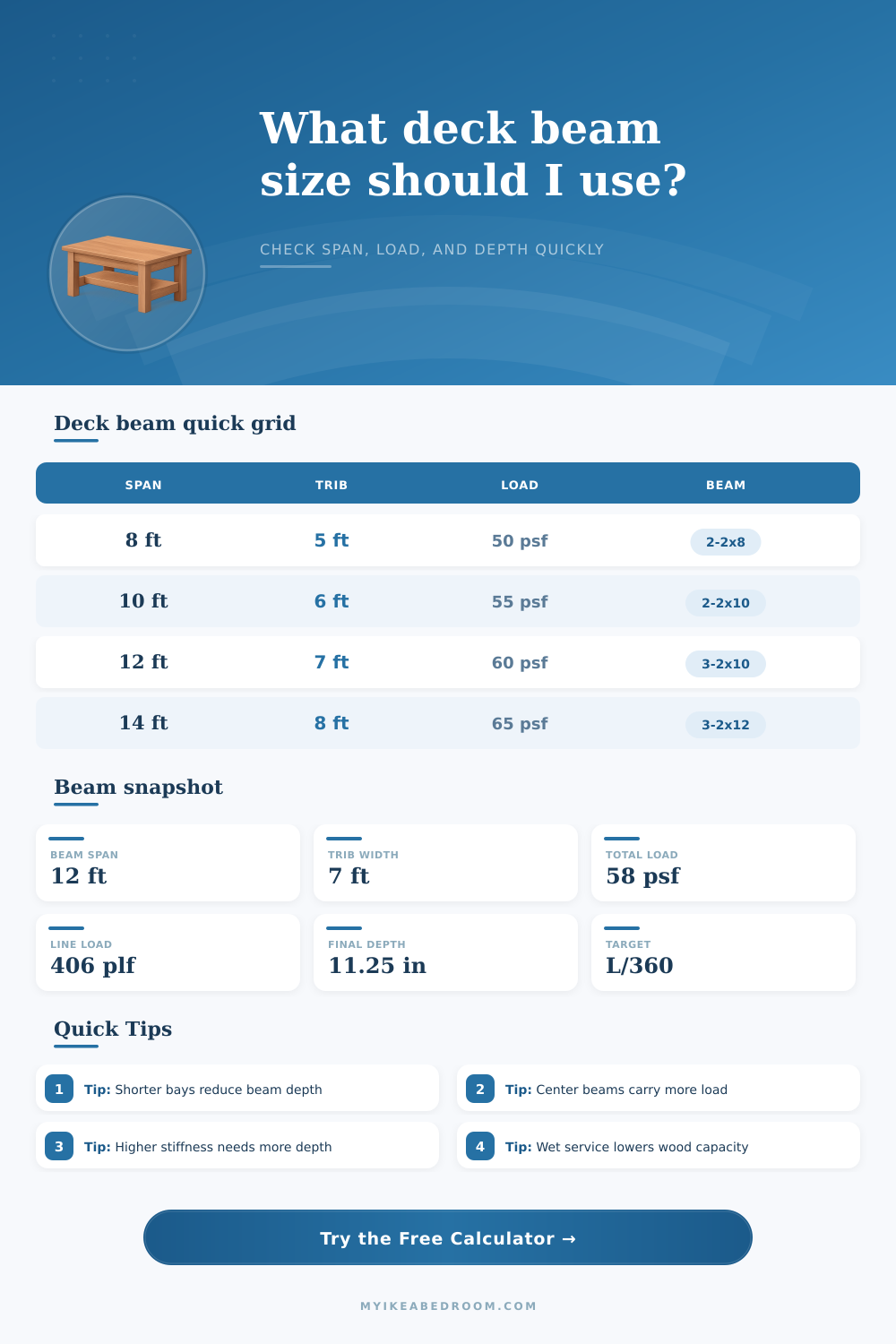
| 8-9 ft | 200-320 plf | 2-2x8 | Light |
| 10-11 ft | 280-420 plf | 2-2x10 | Common |
| 12-13 ft | 360-520 plf | 3-2x10 | Mid |
| 14-15 ft | 440-620 plf | 3-2x12 | Deep |
| Target | Feel | Finish fit | Typical use |
|---|---|---|---|
| L/240 | Soft | Wood | Utility |
| L/300 | Medium | Trim | General |
| L/360 | Firm | Composite | Primary |
| L/480 | Very firm | Tile | Rigid |
A deck beam carry the weight from the deck joists to the deck posts. The size of the deck beam must be correctly calculate because if the size of the deck beam are incorrect, the beam will sag or fail under the weight of the deck. To size the deck beam correctly, a persons must consider several factor.
These factors includes the species of the wood, the load requirements, and the deflection limits of the beam. A deck beam must be able to support the live loads and the dead loads of the deck. Live loads is the temporary weights on the deck such as individuals and furnitures.
How to Size a Deck Beam
Dead loads are the permanent load such as the weight of the wood planks or tile. If a heavy form of decking are use for the deck, such as tile, the dead load will be higher. The more higher dead load will require a deeper deck beam.
Additionally, the deck beam must be able to support the weight of the deck planks that are within the area that transfers the weight to the beam. The width of this area is called the tributary width. The tributary width of an interior beam will be more wider than an edge beam.
Therefore, the interior beam will have to exert more strength to carry the weight of the deck planks. The species of the wood will determine the strength and stiffness of the beam. Different species of wood has different bending stress ratings as well as a different modulus of elasticity value.
The bending stress of the wood is a measurement of the wood’s ability to resist snapping. The modulus of elasticity of the wood is a measurement of the wood’s ability to resist bending. For instance, the species of wood known as Southern Pine has a higher bending stress and a higher modulus of elasticity then spruce-pine-fir.
Because the bending stress and the modulus of elasticity of Southern Pine is higher, it means that the wood is stronger and can bend more before snapping. However, another consideration is the service condition for the wood. If the wood will be in a wet environment, the bending stress and the modulus of elasticity will be reduce.
In this case, the wood should be pressure-treated to increase its resistance to the water. Another specification for the beam is the deflection limits. The deflection limits control the sagging of the beam when under load.
A person measures the deflection limits by dividing the length of the beam by a certain number such as 360. A deflection limit of L/360 mean that the beam will sag no more than the length of the beam divided by 360. A deflection limit of L/240 will mean that the deck will feel more bouncy because the beam will sag more under the load.
A deflection limit of L/480 will mean that the deck will be very stiff and will not sag. In cases where composite decking is use or tile is placed on the deck, a higher stiffness is required because composite decking and tile will exhibit more movement if the beam deflect. In this case, a deflection limit of L/480 may be required.
Another consideration is the line load of the beam. The line load is measured in pounds per linear foot. One way to calculate the line load is to calculate the span of the deck joists.
If the span of the joists is reduce, the tributary width will be reduce and the line load on the deck beam will be reduce. Finally, another consideration is the connections between the beam and the posts. In this case, bolt should be used instead of nails to attach the beam to the posts.
This will allow for the beam connections to have more strength. Additionally, each joist must be attached to the beam. The beams should be attached to each joist using deck beam hanger or deck beam seats.
Additionally, local building code must also be followed for the construction of the deck. In some area, the codes may require that an engineer approve the design of the deck beam.