Deck Post Size Calculator
Screen post size, axial load, max safe height, and footing diameter from deck layout, spacing, bracing, and soil bearing.
| Spec | Actual | Allowable | Limit |
|---|
| Spacing | Posts/line | Load/post | Hint |
|---|
| Soil | Area | Dia | Flag |
|---|
| Brace | K | Slenderness | Effect |
|---|
When you build a deck, you must choose the correct size for the deck posts. The deck posts will have to support the weight of the deck, including the weights of the joists, the weight of the railings, the weight of the peoples that will stand on the deck, and the weight of any other objects that are placed upon the deck. If the deck posts is too small, they can bow or bend under the weight of the people that stand on the deck.
Additionally, if the deck posts are too large, you will spend more money than necessary on the deck build. Deck posts are the vertical supports for the deck. In order to determine the size of the deck posts that you will need for your planned deck design, you must understand the load that your deck posts will have to carry.
How to Pick the Right Deck Post Size
Each component of the deck will exert a load upon the deck posts. Additionally, each deck post will have to support a certain area of the deck. If your deck is very widely, or if the spacing between the deck posts is very small, then each of the posts will have to carry more of the load of the deck.
This will result in an increase in the axial compression load upon the posts. Bracing can help to manage these loads. Additionally, the soil upon which the footings for the posts will be placed will have an effect upon the posts; the soil must be capable of supporting the weight of the deck posts without the footings sink into the ground.
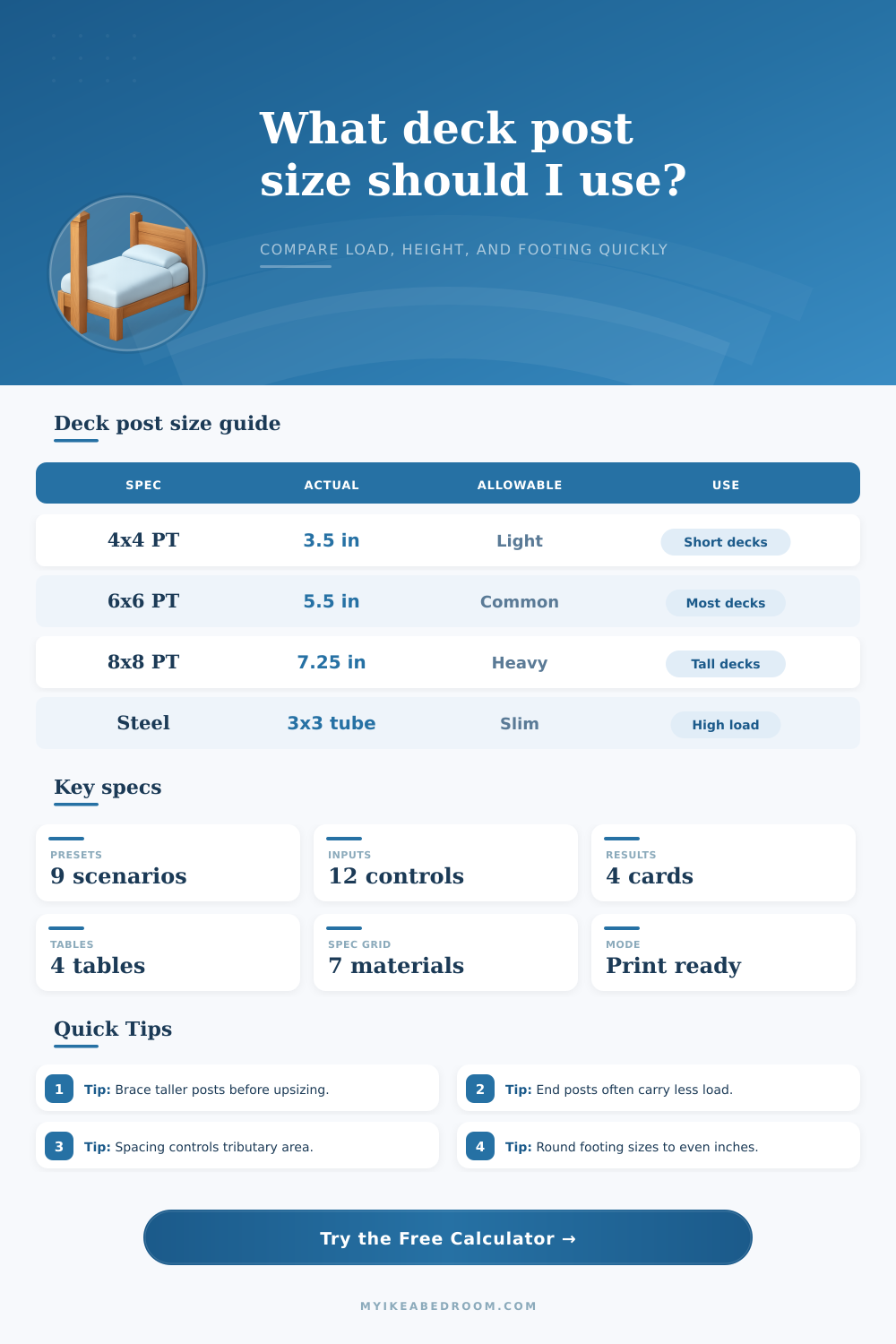
Many people choose 6×6 deck posts for standard decks. 6×6 deck posts are often strong enough for decks that are approximately eight feet in height. However, 6×6 deck posts dont actually measure six inches by six inches; instead, they measure 5.5 inches by 5.5 inches.
Other types of wood can also be used for deck posts; wood with more crush strength is better for decks than wood with less crush strength. Examples of wood with more crush strength include southern yellow pine, while wood with less crush strength includes spruce-pine-fir and cedar. Additionally, you can use other types of material for the deck posts, such as engineered wood and steel tube.
The size of the posts must match the unbraced height of the posts; the taller the posts are, the more likely they are to buckle. Buckling is the failure of a structural component under axial compression to maintain its shape, and you can prevent it by bracing the posts. Because end deck posts will have to support less of the decks total width than the middle posts, end posts will often have less of a load than the other posts; therefore, it is possible to use different size of posts for the same deck.
However, you will have to use a safety factor in the calculations for the size of the end posts. A safety factor may require the engineer to increase the calculated load by 15% or more. This safety factor accounts for any additional loads that may be placed upon the deck beyond the expected loads.
Furthermore, the size of the footings upon which the deck posts will rest also have to be calculated. If the soil upon which the footings will be placed is poor in strength, such as clay soil, then the footings have to be larger than would of needed upon good soil, such as gravel soil. In order to determine the specific needs for the deck and its posts, a calculation can be performed.
For instance, if the deck is 16 feet in length by 14 feet in width, and there are three lines of posts to be placed for the deck, you can input the spacing of the posts and the loads upon the posts into a formula. The formula can account for the live load and the dead load of the deck. Based off these inputs, the formula will provide the required size for the posts, the maximum safe height for the posts, and the requirements for the footing for the deck.
These calculations will also provide information regarding the utilization percentage for the posts. The utilization percentage will indicate the percentage of the total strength of the posts that is being utilize. If the percentage is near 100%, the posts will be straining to support the weight of the deck; if the percentage is lower, then the posts will be operating within their safe range.
Bracing is often used in the construction of a deck. Bracing can allow for taller deck posts and smaller pieces of timber to be used in the construction plan. Prior to the addition of deck posts of a larger size, you should consider bracing; it is more cost-effective than using larger amount of timber for the posts.
You should consider the slenderness ratio for the posts prior to building the deck. The slenderness ratio is the height of the post divided by the radius of gyration of the cross-section of the post. If the slenderness ratio is too great, buckling of the posts may occur prior to the maximum crushing strength of the wood posts.
There are some mistake that you should avoid when building your deck. One mistake to avoid is undersizing the deck posts if you live in an area that receives a significant amount of snow. The snow will increase the dead load upon the posts.
Additionally, you should not forget that the end posts will carry less of the total load of the deck; people often avoid the cost of buying additional amounts of wood for the end posts of the deck. Using 4×4 posts for a deck that is very tall may lead to instability of the 4×4 posts when individuals walk upon the deck. You should also ensure that you check local building codes prior to the construction of the deck.
Depending upon the location of your deck, the building codes may state certain safety factor to be used for the deck, as well as the way that the deck posts should be embedded into the ground. Finally, you should remember that the wood will begin wet when it is delivered from the lumber yard, but it will dry out over time. During this drying period, the stiffness of the wood may change.