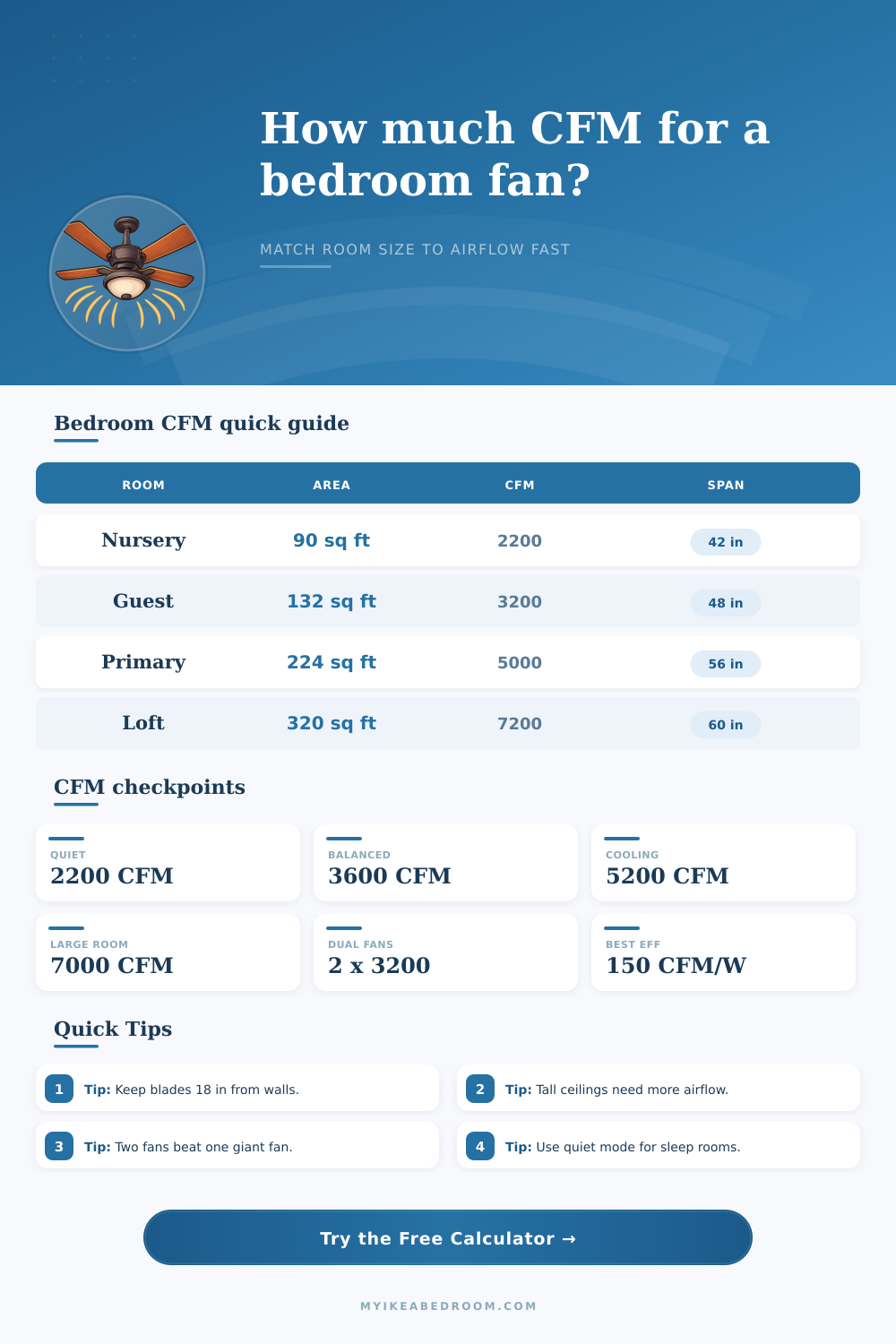
Bedroom airflow planner with clear CFM targets
Ceiling Fan CFM Calculator
Estimate room airflow targets, per-fan CFM, air changes per hour, and blade span guidance for bedroom layouts without mixing in energy pricing.
Each preset rewires room size, ceiling height, climate load, occupancy, slope, fan count, and efficiency so you can start close to real bedroom conditions.
Calculation Breakdown
Results update as you change room geometry, height, climate load, and fan layout.
| Adj Area | Target CFM | Span Range | Fan Plan |
|---|---|---|---|
| Up to 110 | 1800-2800 | 36-42 in | Single |
| 111-170 | 2800-4200 | 44-52 in | Single |
| 171-240 | 4200-5600 | 52-56 in | Single |
| 241-340 | 5600-7600 | 56-60 in | Single or 2 |
| 341+ | 7600-9800 | 2 x 52-56 | Dual |
| Span | Quiet CFM | Boost CFM | Best Use |
|---|---|---|---|
| 42 in | 1800 | 3000 | Nursery |
| 48 in | 2600 | 4100 | Guest room |
| 52 in | 3400 | 5200 | Bedroom |
| 56 in | 4200 | 6400 | Suite |
| 60 in | 5000 | 7600 | Loft |
| Ceiling | Mount Type | Rod Range | Blade Height |
|---|---|---|---|
| 8.0 ft | Flush | 0-4 in | 7.0-7.5 ft |
| 8.5-9 ft | Short rod | 4-12 in | 7.5-8.2 ft |
| 9-10 ft | Standard | 12-18 in | 8.0-8.8 ft |
| 10-12 ft | Long rod | 24-36 in | 8.5-9.0 ft |
| 12+ ft | Extended | 36-60 in | 9.0-9.5 ft |
CFM, which stand for cubic feet per minute, is an unit of measurement that is used to determine the volume of air that a ceiling fan move every sixty seconds. CFM is used to determine the amount of air that a ceiling fan deliver into the room. The correct CFM for a bedroom ceiling fan are required to allow the room to feel cool and comfortable.
A ceiling fan with too low CFM wont be able to provide enough air to the bedroom to make the room feel cool. A ceiling fan with the correct CFM, however, will make the room feel more cooler and more comfortable. There are many different factor that can contribute to the amount of CFM that is required in a bedroom.
How to choose the right CFM for your bedroom fan
One factor is the size of the bedroom. A larger bedroom contain more air than a smaller bedroom, so it will require a higher CFM to effective circulate the air. Another of these factors is the shape of the bedrooms ceiling.
Flat ceiling allow for the even distribution of air from a ceiling fan; sloped ceilings may prevent the air from distributing even. The height of the bedrooms ceiling is another factor in the CFM determination. A bedroom with ten-foot ceiling will require more CFM than a bedroom with eight-foot ceiling.
Another of these factors is the climate in which the bedroom is located. Areas with hot climate will require more CFM than areas with cooler climates. Finally, another of these factors include the amount of occupants in the bedroom.
If there are two people in the bedroom, there will be more heat to dissipate then if there was only one person in the bedroom. In addition to the factors related to the bedroom itself, another of the factors to consider is the noise level of the ceiling fan. Since bedrooms are where people sleep, it is possible that a person will want the bedrooms ceiling fan to be very quiet.
Some ceiling fans use DC motor instead of AC motors. These types of motors tend to be more efficient with use less electricity to move the same amount of air. Because of the efficiency of these motors, a ceiling fan that use these motors can save a person money on there electricity bills.
Another of the factors to consider is the placement of the ceiling fan in the bedroom. A ceiling fan can be placed in the center of a square room. However, if the bedroom is rectangular in shape, it is recommended to use two ceiling fans.
These two fans should be twelve feet apart from each other. Additionally, the blade of the ceiling fan should not be too close to the walls in the bedroom. If they are too close, they may prevent the air from circulating through the bedroom.
If the bedroom contain a vaulted ceiling, then a downrod will have to be utilize to hang the ceiling fan. This will ensure that the blades of the ceiling fan are position in the breathing zone of the bedroom, which is around eight feet from the floor. One of the factors that determine how cool people may feel in their bedrooms is that a ceiling fan does not lower the temperature of the air in the room.
Instead, the moving air from the fan lead to the evaporation of the persons perspiration. This evaporation make the person feel cooler due to what is referred to as the wind chill effect. Using the fan will make a person feel four to eight degrees cooler than the actual air temperature in the bedroom.
Therefore, fans dont have to be used in conjunction with an air conditioner in order to feel comfortable in ones bedroom. By using a calculation to determine the CFM that is required for the bedroom, many of the factors that contribute to the CFM for that bedroom can be accounted for. Many people make the mistake of choosing a ceiling fan based off only on the size of the fan.
However, size does not necessarily indicate the CFM of the fan. Another of the mistake that people make is to base the selection of a ceiling fan only upon the speed at which the fan will rotate. The speed of the fan do not equal the CFM of the fan.
By calculating the square footage of the bedroom, the height of the bedrooms ceiling, and how hot or cold the climate is in which the bedroom is located, it is possible to determine a target CFM that will provide the bedroom with the amount of air circulation that it require. If the fan that is selected has the correct CFM, blade span, and placement in the bedroom, it will ensure that the bedroom feel comfortable to the individual that sleep in that bedroom.