Drywall seam, fastener, corner, and skim planning
Joint Compound Calculator
Estimate drywall mud by net surface area, sheet module, finish level, corner footage, fastener density, skim-coat share, compound shrink, and waste so bucket planning matches real finishing work better than a simple area-only rule.
Each preset loads a realistic drywall finishing condition with different seam density, corner footage, fastener load, and skim demand so you can compare patching, bedrooms, ceilings, hallways, and smooth-wall Level 5 work quickly.
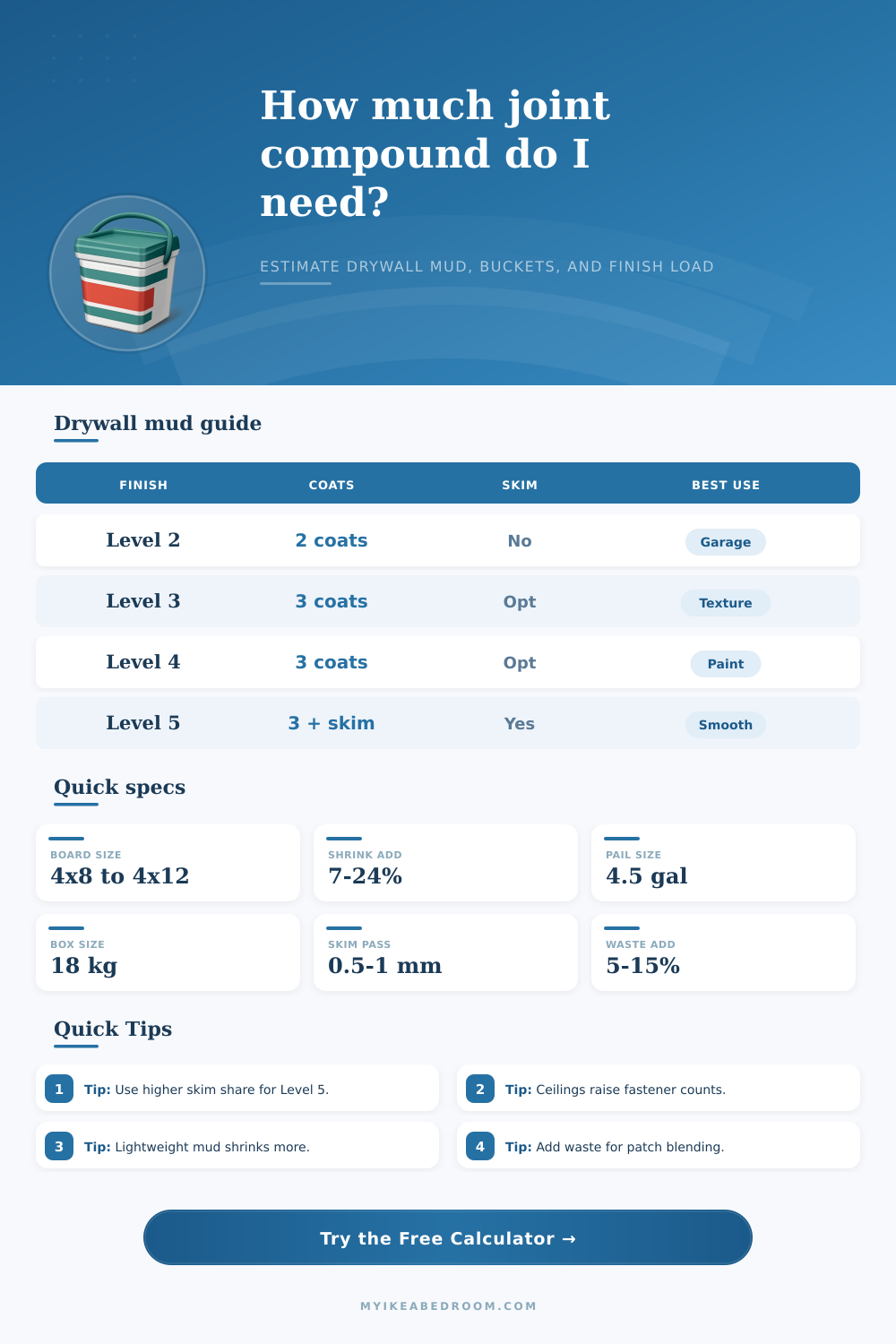
Use this quick comparison grid when you are balancing sanding feel, shrink, weight, and recoat speed across a bedroom refresh, full-room remodel, or short repair day.
| Finish | Taper band | Butt band | Skim target | Typical output |
|---|---|---|---|---|
| Level 2 | 3.5 in + 6 in | 5.5 in + 8.5 in | None | Utility rooms and garages |
| Level 3 | 4 in + 7 in + 9 in | 6 in + 9 in + 11 in | Spot blend only | Walls that will receive heavier texture |
| Level 4 | 4.5 in + 8 in + 10.5 in | 7 in + 10.5 in + 13 in | 10-25% blend | Standard paint-ready drywall |
| Level 5 | Level 4 bands | Level 4 bands | 50-100% full skim | Strong light and smooth wall finish |
| Compound | Density | Shrink | Typical role | Notes |
|---|---|---|---|---|
| All-purpose | 11.2 lb/gal | 18% | Tape + finish | Versatile for mixed rooms and general finishing |
| Lightweight | 8.9 lb/gal | 24% | Top coats | Sands easily but needs more wet volume |
| Topping | 10.4 lb/gal | 14% | Final passes | Smooth face for Level 4 and Level 5 work |
| Setting 45 | 12.3 lb/gal | 8% | Repair coats | Stable around bead and patch transitions |
| Setting 90 | 12.7 lb/gal | 7% | Large patch base | Longer working time with low shrink |
| Dust-control | 10.8 lb/gal | 17% | Occupied homes | Useful where cleanup matters after sanding |
| Board size | Seam factor | Boards per 400 sq ft | Use case | Impact on mud |
|---|---|---|---|---|
| 4 x 8 | 0.375 lf/sq ft | 12.5 boards | Repairs and small rooms | Highest seam density |
| 4 x 10 | 0.350 lf/sq ft | 10 boards | Closets and medium rooms | Moderate seam reduction |
| 4 x 12 | 0.333 lf/sq ft | 8.3 boards | Bedrooms and ceilings | Common balance of handling and coverage |
| 4 x 16 | 0.313 lf/sq ft | 6.3 boards | Long runs and open rooms | Lowest seam load per square foot |
| Scenario | Net area | Finish | Wet mud | Planning note |
|---|---|---|---|---|
| 10 x 12 bedroom walls | 300-340 sq ft | Level 4 | 3.5-4.8 gal | Mostly seams and corners, minimal skim |
| 12 x 14 bedroom + ceiling | 500-560 sq ft | Level 4 | 5.8-7.5 gal | Ceiling area raises butt seams and screws |
| Small office smooth finish | 330-390 sq ft | Level 5 | 5.5-7.0 gal | Skim share becomes the swing factor |
| Large living room remodel | 760-860 sq ft | Level 4 | 8.5-11.5 gal | Long boards cut seams but corners still add load |
When you are finishing drywall, you must determine how much joint compound you will need to purchase for a job. Drywall compound is used to fill the seam and corners in your drywall installation. If you buy too little joint compound, you will have to stop your work to purchase more drywall compound.
However, if you buy too much drywall compound, you will have some leftover that will eventualy harden. To determine how much drywall joint compound you will need to purchase, you must consider a few things beyond the size of the rooms that you will be installing drywall in. The number of seam that will exist in the drywall installation will dictate how much drywall joint compound you need.
How Much Drywall Compound to Buy
If you use 4×8 foot drywall sheets instead of 4×12 foot sheets, you will create more seams in your drywall installation. Thus, the size of the drywall sheets will be a critical factor in determining how much joint compound you will need. If you use smaller drywall sheets, you will need to use more joint compound to fill in the seams.
You will also have to consider the types of drywall joints that you will use in your drywall installation. For instance, if you use tapered drywall edges, you will need wide band of joint compound. Butt joints may require extra joint compound if you butt the drywall boards together at the edges instead of tapered edges.
Ceilings will require more joint compound than the walls in a room. This is because there will be more butt joints on ceilings, and there will be more fasteners on ceilings. You must apply drywall joint compound to the screw heads on the ceiling.
Additionally, you have to apply compound to the seams in the drywall sheets on the ceiling. Corners require extra drywall joint compound to fill them. Both inside and outside corner require drywall joint compound.
Inside corners can absorbs a large amount of drywall joint compound. Outside corners require drywall joint compound to stabilize the corner bead. If you are doing a level 5 drywall compound finish, you will use even more drywall compound to apply a skim coat of compound to the drywall installation.
The type of drywall compound that you use will change the amount of drywall compound that you need to purchase. If you use all-purpose drywall compound, it has a shrinkage rate of 18%. Thus, you will have to apply more drywall compound to the seams because some of the drywall compound will dissapear as it dries.
If you use lightweight drywall compound, it is easier to sand. However, lightweight drywall compound has a higher shrinkage rate of up to 24%. Thus, you will have to buy more lightweight drywall compound so that you have a flat drywall compound surface after it dries.
Topping compound is used for the final coats of drywall compound because it has less shrinkage than other drywall compounds. Lastly, setting-type drywall compound is used for fast repairs in the drywall installation because it only shrinks 7 to 8%. You must also buy extra drywall joint compound to account for waste.
Some of the drywall joint compound will get spilled during the installation process. Additionally, you may use some drywall compound when you are blending the seams in the drywall to the existing surfaces in the room. It is common for drywall compound contractors to purchase 10 to 15% extra drywall joint compound for this purpose.
You can also lose some drywall joint compound when you fill the dimples that the drywall screws leave in the drywall sheets. Thus, the more drywall screws you use per drywall sheet, the more drywall compound you will need. When you are estimating how much drywall compound you will need, you can also consider the layout of the drywall sheets.
If you use long drywall sheets for your drywall compound installation, you will create fewer seams. Fewer seams will require less drywall compound. Consider the environment where your drywall installation will occur.
If the area in which you are installing the drywall sheets is damp, you may need to use setting-type drywall compound that will dry through a chemical reaction instead of evaporation. Finally, consider the number of gallons or drywall compound buckets you will need to purchase for your drywall compound installation project.