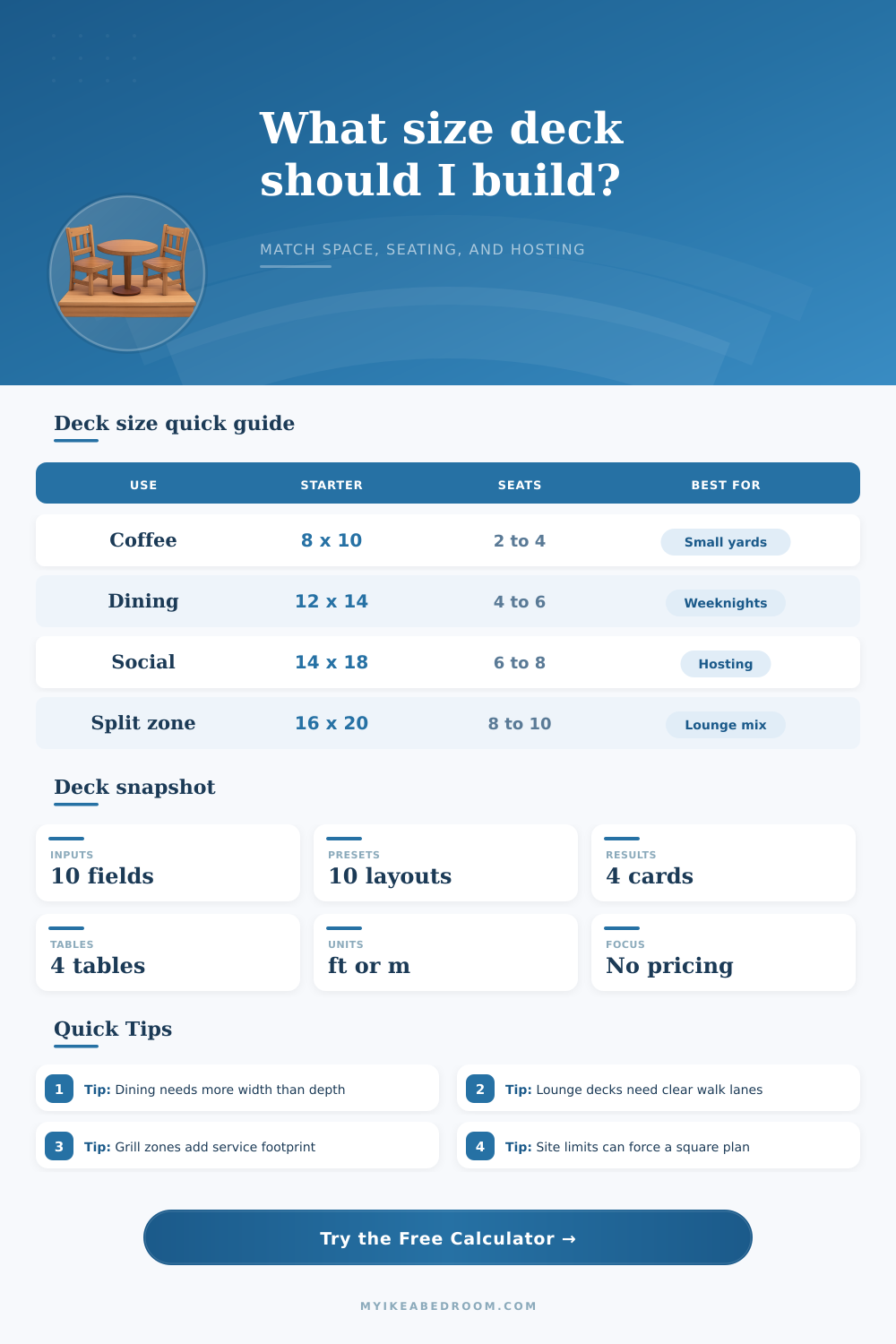
Deck footprint planner for real hosting patterns
Deck Size Calculator
Build a smarter deck program from site width, site depth, seating mix, cooking zones, comfort goals, and hosting style. Results appear below the inputs in their own full-width section.
Load a realistic starting point, then tune the footprint around your furniture mix and site limits.
This planner builds a footprint from usable activity zones first, then checks whether the recommendation fits your available width and depth.
Planning breakdown
These cards summarize what is driving the recommendation so you can see whether width, depth, hosting, or circulation is the main control.
Use the first table to compare size options around your target. The other tables show zone mix, furniture fit, and depth-band reads.
| Option | Suggested size | Area | Fit on site | Best for |
|---|
| Zone | Area share | Typical footprint | Read on it |
|---|
| Furniture set | Minimum zone | In your plan | Read on fit |
|---|
| Depth band | Typical feel | Works for | Watch-out |
|---|
These alternates keep your same program area but redistribute it into different deck personalities.
Planning your deck require you to determine its size and shapes prior to beginning construction. Many people make the mistake of constructing a deck that is more smaller for there needs. If your deck is too small, it may not accommodate the furnitures that you wish to place on the deck, or it may not be able to accommodate the number of guests that you would like to have on your deck.
Therefore, you must consider how that deck are to be used, and how its size should reflect those intended activity. For instance, decks may be used for dining, for lounging, or for grilling. Each of these activities require different amount of space.
Plan Your Deck Size and Shape
Dining area will require specific dimensions to ensure that individuals can pull the chairs backward when individuals are seated on the chairs. If space is not provided for this movement, the chairs may become entangled with other deck railing. Lounge areas will also require significant amount of space to accommodate the furnishings that is often placed in these areas.
In addition to the areas that must be allocated to the different zones for dining and lounging, some area must also be provided for circulation of the individual who are using the deck. Circulation areas are those required for individuals to walk from one area of the deck to another. Circulation areas should be provided for approximately 12 to 30% of the total area of the deck.
The physical constraint of your property will also impact the size of your deck. For instance, there are limits to the distance between your house and fence, and there are limits to the width of the area that is available for constructing your deck on your property. These limits will place constraints upon the dimension of the deck.
If you plan on constructing cooking zone on the deck, such as a grill, you will need to provide extra space for those cooking zones. In addition to providing space for the grill itself, you will need to provide extra space for an aisle to walk around the grill while cooking. Finally, if you plan on constructing a hot tub or fire pit on the deck, it will require some of the area of the deck to be assign to that feature.
Beyond the size of the deck, the shape of the deck is also another important factor. For instance, if you plan to entertain guests at your deck, a wide deck may be beneficial in allowing for both dining and lounging areas to be established side-by-side. Alternatively, if your yard is relatively narrow, a deep deck may be beneficial in allowing for different areas to be established from the area in the most prominent part of the yard to the area in the back of the yard.
Overall, however, you should choose a deck shape that fits the specific feature of your yard. The shape of the deck will also dictate how much space is available for each of the different area of the deck. For instance, a rectangular deck may be more beneficial than a square deck if your yard feature one set of longer dimension.
In addition to avoiding mistakes with the size and shape of your deck, there are specific guideline for measurements for different area. For instance, it is common for individuals to make the mistake of not providing space for the chairs to be pulled backward when individuals are being use by individuals who are dining on the deck. Additionally, individuals may not account for the walking paths that must be provided for those guest who are using the deck.
Walking paths must be at least three feet in width, but should be three and a half feet in width if you plan on entertaining guests at your deck. Additionally, you should account for any setback and stairs that may be constructed to the deck. Setbacks and stairs will reduce the area of your deck that can be used for other feature of the deck.
Therefore, if you plan for each of the zone for your deck to be constructed first, those zones will dictate the total size of your deck, and the deck itself will function as a successful extension of your home.