Attic airflow target, intake and exhaust split, and fill depth planning
Attic Ventilation Calculator
Switch units, pick attic shape, set vent ratio and fill depth, then compare vent target, bag counts, and weight output in one stacked layout built for bedroom renovation planning.
Calculation breakdown
| Depth | Sq Ft Per Cu Yd | M2 Per M3 | Use Case |
|---|---|---|---|
| 1 in | 324 sq ft | 10.76 m2 | Light top-up |
| 2 in | 162 sq ft | 5.38 m2 | Air channel assist |
| 3 in | 108 sq ft | 3.59 m2 | Default planning |
| 4 in | 81 sq ft | 2.69 m2 | Deep top-up |
| 6 in | 54 sq ft | 1.79 m2 | Major refill |
| Bag Size | Volume Per Bag | Bags Per Cu Yd | Coverage At 3 in |
|---|---|---|---|
| 2 cu ft | 0.074 cu yd | 13.5 bags | 8 sq ft per bag |
| 3 cu ft | 0.111 cu yd | 9.0 bags | 12 sq ft per bag |
| Half pallet | 30 cu ft | 10.0 bags 3 cu ft | 120 sq ft at 3 in |
| Full pallet | 60 cu ft | 20.0 bags 3 cu ft | 240 sq ft at 3 in |
| Project | Area | Vent NFA | Bags At 3 in |
|---|---|---|---|
| Bedroom 12 x 14 | 168 sq ft | 1.12 sq ft | 7 / 5 bags |
| Living 15 x 20 | 300 sq ft | 2.00 sq ft | 13 / 9 bags |
| Office 10 x 10 | 100 sq ft | 0.67 sq ft | 5 / 4 bags |
| Suite 16 x 20 | 320 sq ft | 2.13 sq ft | 14 / 10 bags |
Attic ventilation are essential for attics that dont allow for proper ventilation. Trapped heat and moisture in the attic will cause damage to the roof shingles, as well as allow for mold to grow on the rafters. In order to prevent these problems at the roof of the house, a person must ensure that the attic has proper airflow.
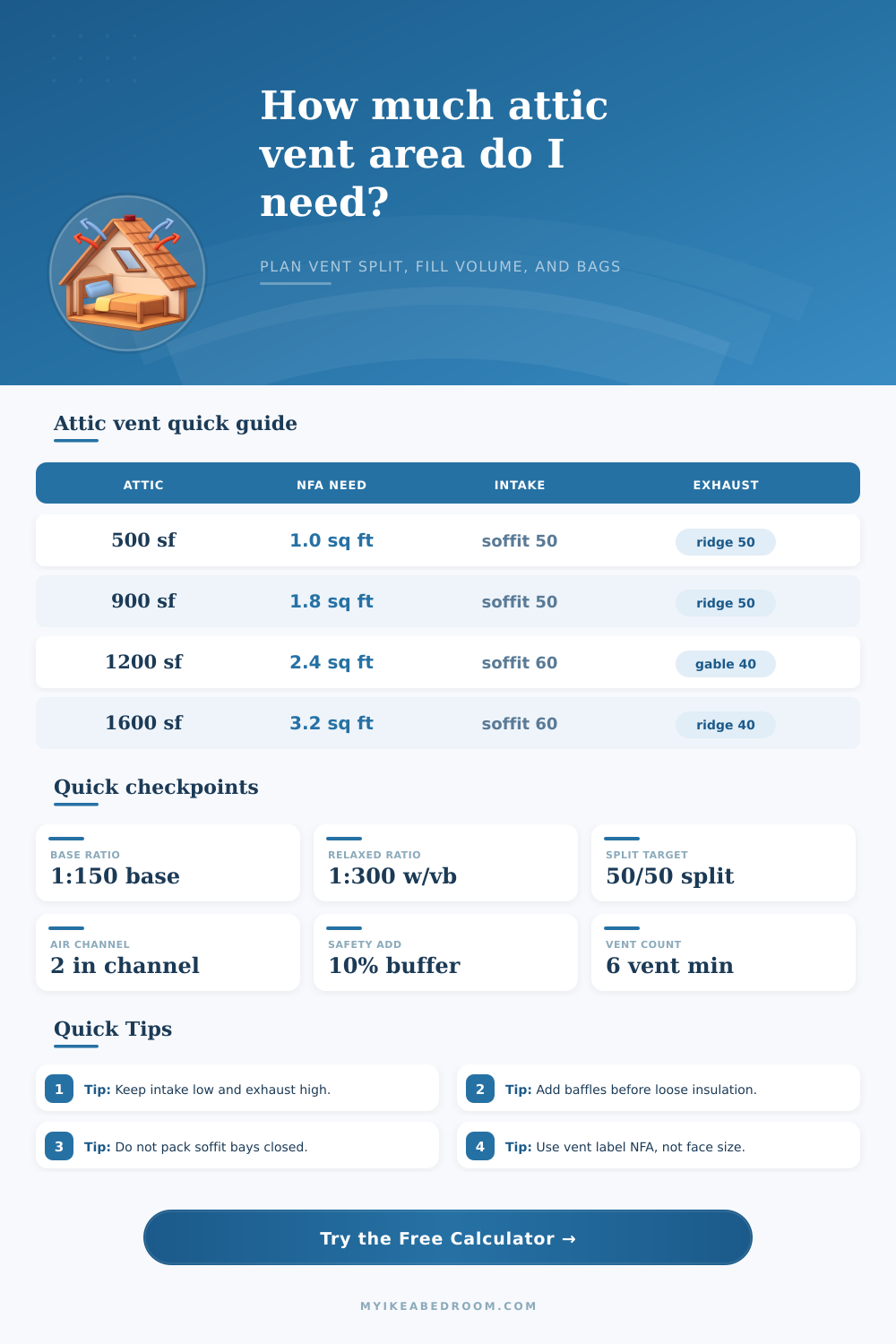
To provide proper airflow in the attic, you must balance the vent in the attic to allow cool air to enter through the low vents, and hot air to exit the attic through the high vents. The measurement of net free area, or NFA, is used to determine the amount of ventilation that are needed for the attic. The net free area is the amount of open space in the vent after the screen is installed in the attic vents.
Attic Ventilation and Insulation
Most attic vents will have screens that will only allow 50 or 60 percent of the attic vents to be clear for the air to pass through. Thus, a person must calculate the net free area of the attic vents instead of simply using the size of the vent panels to determine the amount of vents that are needed. Most building codes require that the ratio of 1:150 be use for the net free area.
This means that for every 150 square feet of attic space, a square foot of net free area are required. A person should attempt to ensure that the intake and exhaust vents for the attic is balanced. Intake vents are typically installed low in the attic, while exhaust vents are installed high in the attic.
By ensuring that these two type of vents are provided and balanced in the attic, the heat will not begin to pool in specific areas of the attic. Additionally, a person should install baffles along the edges of the rafters. These baffles will create a two-inch channel in which air can enter the attic, before the installation of the insulation.
If the insulation is installed without these baffles, the insulation may prevent air from the soffit vents from enter the attic. By preventing air from entering the attic, the attic will begin to trap heat and moisture. The type and depth of the insulation will impact the weight of the insulation, as well as it’s coverage within the attic.
One of the most common form of insulation is cellulose insulation. The cellulose insulation is denser than the fiberglass insulation that is also often used in attics. The density of cellulose insulation is approximately 30 pounds per cubic foot.
Thus, before the installation of the insulation into the attic, a person must ensure that the roof trusses can support this much weight. Additionally, a person should calculate the amount of cellulose insulation that will be used with a 10 percent overage of the necessary amount. This overage of 10 percent is needed due to the fact that cellulose insulation will settle after it is install into the attic.
A person will also need to use an vapor barrier in the attic. By using a perfect vapor barrier that does not allow moisture from the living space within the house to enter the attic, a person can use a ratio of 1:300 instead of 1:150. However, in the more humid climates, more ventilation will need to be provided in the attic to allow for the moisture to escape the attic space.
The depth of the insulation will impact the amount of insulation that will be needed to cover the attic spaces. Three inches of insulation will allow one cubic yard of insulation to cover 108 square feet of attic space. However, if the depth of the insulation is increased to six inches, the coverage of the insulation will be halved.
Thus, more bag of insulation will be needed to cover the same amount of attic space. Additionally, if more insulation is used in the attic, the total weight of the insulation will be increased. Finally, the requirements for attic ventilation will change with the changing of the seasons.
During the summer months, the attic will need to have its exhaust vents set to maximum to remove the heat from the asphalt shingles that cover the roof. During the winter months, however, the attic will need to have its intake vents set to maximum in order to allow dry air into the attic space, which will prevent condensation from forming on the rafters. These two components are needed to ensure the longevity of the roofing materials for the attic space.
Finally, a person should also consider the local building codes for attics, as building codes will differ from locality to locality.