Fence Post Depth Calculator
Estimate embed depth, hole diameter, post length, and concrete volume using fence height, soil condition, frost depth, wind exposure, and post role so your layout is stable before digging.
Fence presets
Depth inputs
Planning comparison grid
Reference tables
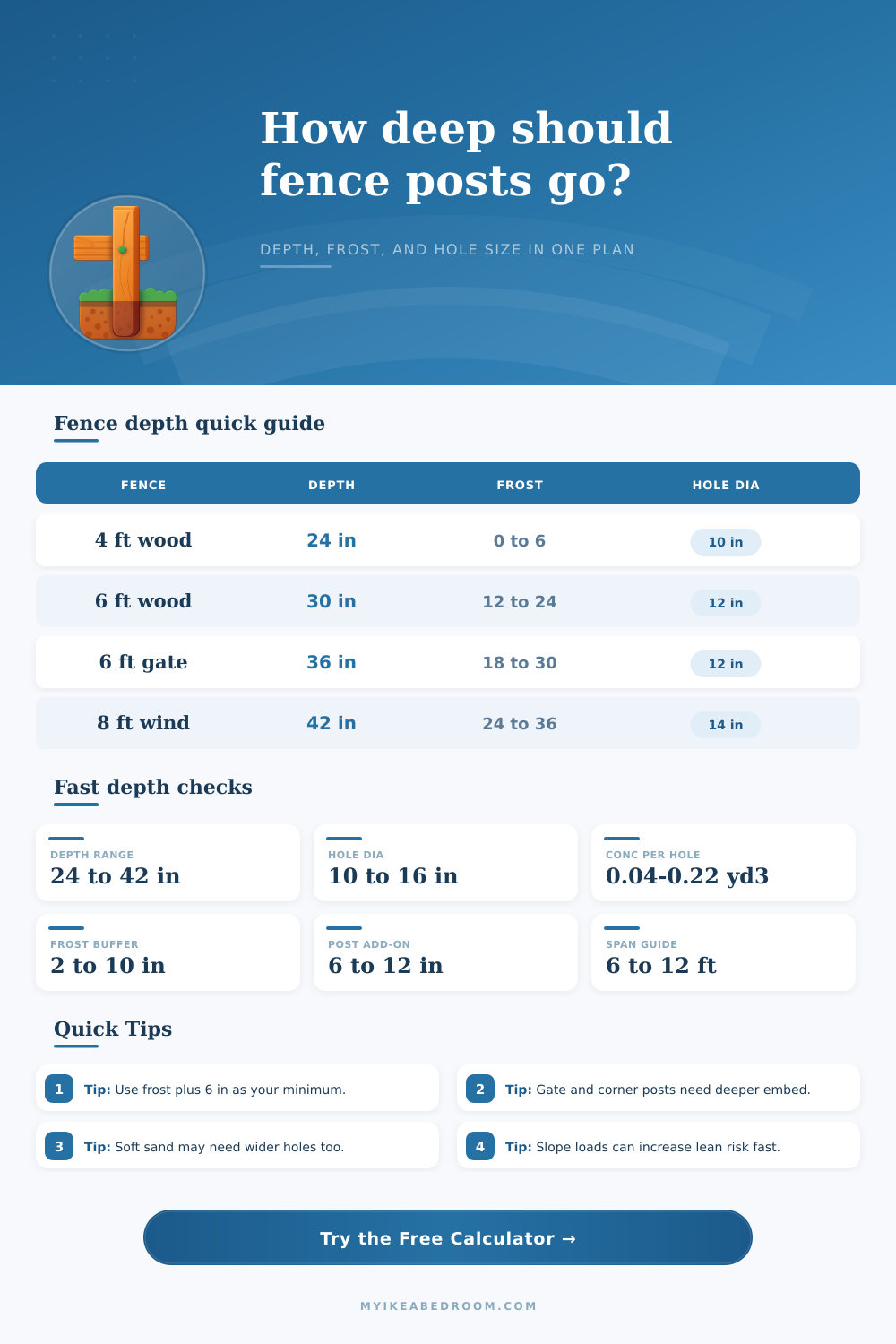
| Fence height | Base depth | Frost check | Hole dia |
|---|---|---|---|
| 4 ft | 24 in | frost + 6 in | 10 in |
| 5 ft | 27 in | frost + 6 in | 10 to 12 in |
| 6 ft | 30 in | frost + 6 in | 12 in |
| 8 ft | 36 in | frost + 6 in | 14 in |
| Condition | Depth add | Diameter add | Why it matters |
|---|---|---|---|
| Dense + shelter | 0 in | 0 in | Higher passive resistance |
| Loam + normal | 2 in | 0 in | Balanced default case |
| Sand + open | 7 in | 2 in | Lower lateral hold |
| Clay + coastal | 14 in | 2 in | Soft wet cycle and gust load |
| Use case | Depth | Total post | Concrete each |
|---|---|---|---|
| 4 ft line post | 24 in | 6.5 ft | 0.04 yd3 |
| 6 ft line post | 30 in | 8.8 ft | 0.08 yd3 |
| 6 ft gate post | 36 in | 9.5 ft | 0.12 yd3 |
| 8 ft corner post | 42 in | 11.8 ft | 0.18 yd3 |
Practical tips
A fence post must be installed at a proper depth to ensure the fence remain stable. Fence stability relate to the principle of leverage, where the fence post act as a lever. When wind push on a fence, the fence post must provide enough resistance from the soil to avoid rotate the fence posts out of the ground.
Fence posts that is installed too shallow will rotate out of the ground due to insufficient resistance from the soil. While many people uses the rule of burying one-third of the heights of the fence post into the ground, this rule are only a starting point and may not provide enough depth for adequate fence post stability in some environments. Various environmental factor will impact the requirements for fence post depth.
How Deep Should Fence Posts Be
In cold climates, frost heave can lift the fence post out of the ground if not installed below a frost line. Additionally, the type of soil will impact fence post stability. For instance, the installer will bury posts deeper in soil that has more grip on the fence post, such as compacted loam, relative to loose sand or wet clay.
Fence posts in open areas will experience more force from the wind then fence posts in a sheltered area. Fence posts at the corners of the fence or posts that supports the gates will require more stability than the line fence posts. A calculation tool can be used to calculate the depth and diameter requirements for the fence post.
The calculation tool take into account the height of the fence, the type of soil in which the fence will be installed, the exposure of the fence to the wind, and the role of the fence posts to determine the embedment depth of the fence post into the ground. Based on the parameters enter into the calculation tool, the calculation tool will provide the diameter of the hole into which the fence post will be embedded. Additionally, the calculation tool will provide the length of the fence post that will be required and the volume of concrete that are necessary to purchase to embed the fence post into the ground.
Prior to calculating the depth and diameter requirements for the fence post, there are a few variable that must be considered. The height of the fence will impact the depth of the fence post, as fence posts on taller fences will experience more force from the wind then fence posts on shorter fences. The width of the fence post will impact the diameter of the hole into which the fence post is to be embedded.
The frost line will impact the depth of the fence post, as the fence post must be buried beneath the frost line. The type of soil will impact the depth and diameter of the fence post hole; fence posts are installed into denser soil to greater depth and diameters relative to sandy soil. Finally, the exposure of the fence to the wind and the slope of the land will impact the depth of the fence posts.
There are a few common mistake when installing fence posts. One such mistake is adhering to the minimum building code without considering the environmental considerations of the site. This mistake will result in a fence that is exposed to the elements but placed in such a way that the fence may lean on one side relative to the other.
Another mistake is in the installation of the posts that support the gates. The gate posts experience more force than the line fence posts. To avoid these mistake, treat the installation of the gate and corner posts with the same consideration as the line fence posts; dig deeper hole for these fence posts.
The proper execution of fence installation will ensure the stability of the fence. Use an auger to dig the holes into the ground for the fence posts; if rocks are located in the installation area, dig the holes to be square in cross-section. Use vibration or a rod to remove air from the poured concrete into the holes; slope the poured concrete to allow the rain to run away from the fence.
Fill the area with gravel to allow the land to drain around the fence; tamp the soil to provide stability to the fence posts. Finally, if the fence is being installed on a slope, ensure the fence posts are stepped individually to account for the slope; do not tilt the fence posts. Actually, there is alot of ways to do this.
You’ll want to check your measurements first because the fence posts length matter. If your dont do this, teh fence might not be stable. You should of checked the soil type first too.
It is very importent to make sure the posts is deep enough. Dont forget to check the grounds slope as well. If the posts is too shallow, they will dissapears into the mud when it rains.
The installation should of been done more carefuly. It isnt always easy to do a moddern fence setup correctly, especially if the soil is too loose. One of the most common errors is when people dont realize that the height of the post affects how much wind it can take.
The posts stability is based off the diameter of the hole. It is a luxurius thing to have a perfect fence but its worth it. The fence posts depth will be determined by the worker.