🧹 Coverage planner for outdoor wood
Deck Stain Calculator
Estimate stain area, adjusted spread rate, gallons, and recoat timing from real deck geometry, wood type, and board condition.
| Stain family | Coverage | Typical use | Recoat |
|---|---|---|---|
| Clear penetrating | 275 sq ft/gal | Fresh grain | 12-18 hrs |
| Semi-transparent | 250 sq ft/gal | Balanced color | 18-24 hrs |
| Semi-solid | 220 sq ft/gal | More hide | 24-30 hrs |
| Solid color | 180 sq ft/gal | Highest hide | 30-36 hrs |
| Oil-modified blend | 240 sq ft/gal | Deep soak | 20-28 hrs |
| Waterborne acrylic | 260 sq ft/gal | Quick leveling | 14-20 hrs |
| Restorative coating | 160 sq ft/gal | Tired boards | 36-48 hrs |
| Wood | Factor | Absorption read | Best note |
|---|---|---|---|
| Pressure-treated pine | 1.00 | Moderate | Baseline choice |
| Cedar | 0.92 | Even grain | Good color hold |
| Redwood | 0.90 | Stable pull | Rich tone |
| Southern yellow pine | 1.05 | Thirsty | Watch first coat |
| Spruce-fir | 1.08 | Fast uptake | Test spot first |
| Hardwood | 0.84 | Dense grain | Thin coats only |
| Reclaimed boards | 1.12 | Uneven pull | Expect patches |
| Condition | Factor | Dry-time bias | Use case |
|---|---|---|---|
| New sanded boards | 0.96 | Faster | Fresh install |
| Lightly weathered | 1.00 | Neutral | Common deck |
| Gray weathered | 1.08 | Slightly slower | Sun-faded wood |
| Deeply oxidized | 1.15 | Slower | Older surface |
| Stripped and recoated | 1.02 | Neutral | After restore |
| Patchy repair zones | 1.12 | Slower | Mixed porosity |
| Unit | Equals | Metric | Planning note |
|---|---|---|---|
| 1 gallon | 4 quarts | 3.785 L | Common buy size |
| 1 quart | 0.25 gal | 0.946 L | Good for top-off |
| 1 sq ft | 0.0929 m² | 0.093 m² | Area conversion |
| 1 m² | 10.764 sq ft | 10.764 sq ft | Reverse area read |
| 1 sq ft/gal | 0.231 m²/L | 0.231 m²/L | Coverage swap |
| 1 hr | 0.042 day | 0.042 day | Quick timing read |
To determine how much wood stain is needed for a deck, there are a few factors that must first be considered. Wood absorption are one of the factors to consider because different types of wood will absorb different amounts of wood stain. If wood absorption is inconsistent, then the square footage of the decks will not provide an accurrate estimation of the amount of wood stain needed to adequately coat all of the wood plank.
To calculate how much wood stain is needed for the deck, you must calculate the total area of the deck. You can measure the length and width of the flat floor of the deck to calculate the total square footage of that area of the deck. However, it is also necessary to calculate the square footage of the rail and stairs of the deck.
How Much Wood Stain Do You Need for a Deck
Rails will require more wood stain then the flat floor of the deck due to the fact that there are multiple sides of the rail planks that must be stained. Stairs will also require more wood stain than the flat floor of the deck due to the fact that the treads and risers of the steps will require staining. Therefore, if you calculate only the area of the flat floor of the deck, it is possible that there would not be enough wood stain to cover the entire deck.
The type of wood from which the deck is construct will also affect the absorption of the wood stain. For instance, cedar planks will absorb wood stain differently than pressure treated pine planks. Additionally, the condition of the wood will also affect the absorption of the wood stain.
Weathered wood stains grey and will have open pores in its plank structure that will allow for the wood to absorb more stain than fresh wood that has not been exposed to the elements. Therefore, if the deck utilizes wood that is grey and weathered, more wood stain will be needed to ensure that all of the wood planks are adequately cover in stain. The type of wood stain that you will use on the deck will also affect how much stain is needed.
For instance, clear penetrating oils will stain the wood and spread easy to cover a large area with the stain. Solid stains require preparation of the wood prior to staining and the stain will cover the wood differently than other stains. Semi-transparent stains will even further allow the stain to absorb into the wood while still allowing the grain of the wood to be seen.
Semi-transparent stains are one of the more common choices for staining decks with wood stain. Additionally, the way that the stain is applied may also affect how much stain is needed for the project. For instance, if a sprayer is used to apply the stain to the deck, the stain will be applied in a thin layer to the wood.
However, if you use a brush to apply the stain to the deck, the brush will have to work the stain into the wood. Mopping or rolling the deck with the stain will require more of the stain to coat the wood planks. Another important factor to consider is the moisture content of the wood that will be stained.
A moisture meter will be used to measure the moisture content in the wood. If the moisture content of the wood is greater then 12%, the wood will hold water that will affect how the wood stain dries on the deck. High moisture within the wood will cause the wood stain to remain tacky for a longer period of time.
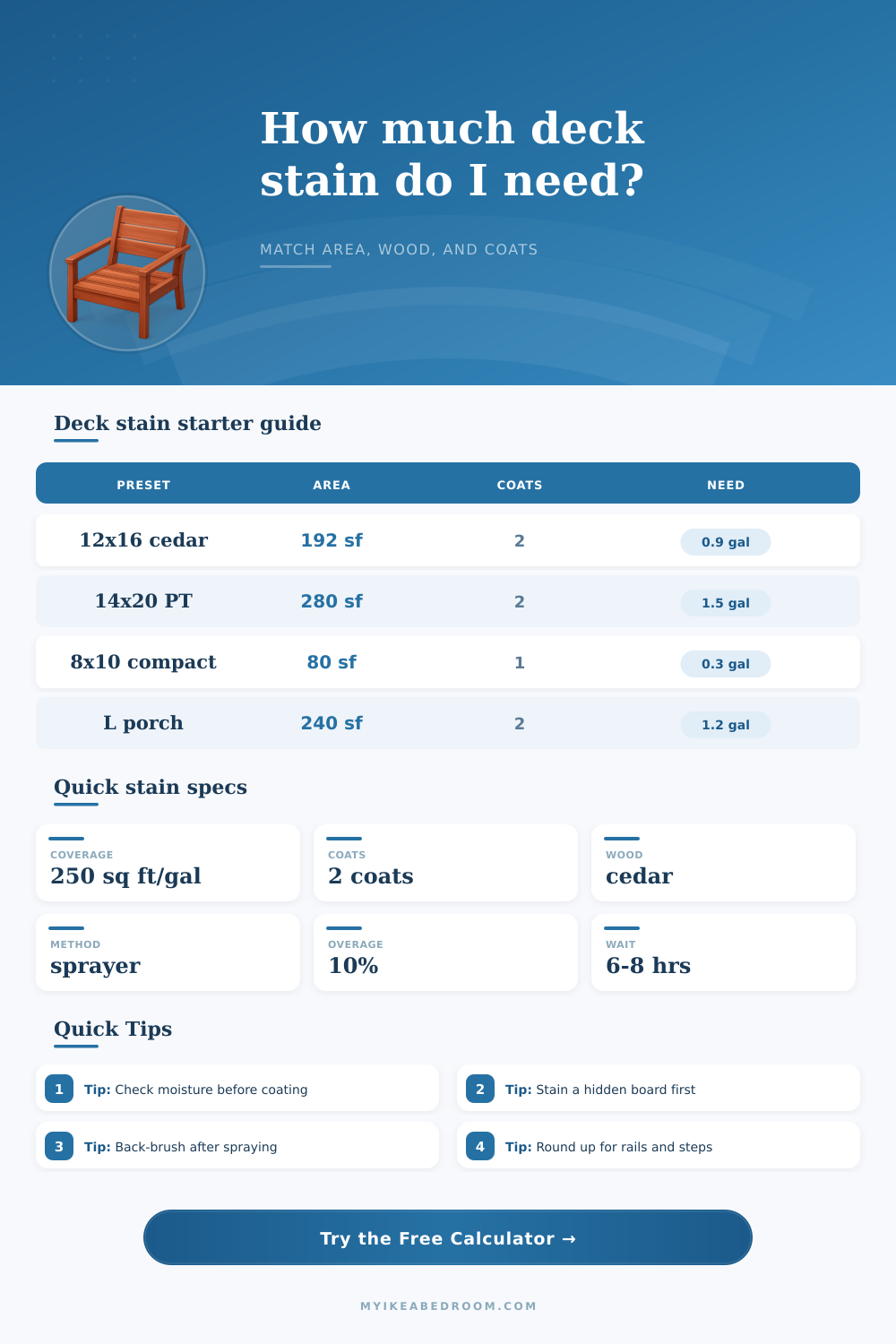
High moisture within the wood will also affect how much of the wood stain that the wood absorb. To ensure that there is enough wood stain for the entire deck, some extra wood stain should be purchased in addition to the calculated amount. Many people will add 10% to the total calculated amount to provide enough stain for any unexpected area of the deck that may require more stain than others.
It is always better to purchase a small amount of extra stain than to run out of stain in the middle of staining the entire deck. Another step that you should take prior to staining the entire deck with wood stain is to test the stain on a small and hidden area of the deck. Testing the stain on a small area will allow for the wood to absorb the stain to be seen.
If the wood absorbs the stain quickly, it will be known that more stain will be needed for staining the remainder of the deck. Additionally, staining a small area will also allow for the color of the stain to be seen once the stain has dried on the wood. Finally, another factor that you should consider when purchasing wood stain for a deck is the weather.
The humidity and the temperature of the environment will affect how the wood stain dries and how the wood absorbs the stain. It is best to avoid staining the deck if it is wet from rainfall. If these various factor are considered in addition to calculating the amount of stain needed for the total area of the deck, it is likely that the amount of stain that will be purchased will be the correct amount for staining the entire deck.