Task-light planning for counters, coffee bars, and desks
Under Cabinet Lighting Calculator
Estimate cut-to-length lit run, counter-depth beam coverage, task lux, and driver loading for tape lights, slim bars, and dual-row under-cabinet layouts.
These presets reflect real under-cabinet situations: short coffee bars, sink zones with blocked sections, deep prep counters, pantry workstations, and long kitchen walls that need cut-point planning.
Run length uses feet or meters. Counter depth, mount height, front setback, and blocked length switch between inches and centimeters when you change unit systems.
Full breakdown
Results appear after you set run length, depth, mounting position, and fixture family.
| Activity | Target Lux | Foot-candles | Typical need |
|---|---|---|---|
| Night snack or display | 150-200 lx | 14-19 fc | Soft guidance without glare |
| Coffee station and light prep | 250-300 lx | 23-28 fc | Comfortable everyday use |
| Daily prep and chopping | 350-450 lx | 33-42 fc | Main kitchen task brightness |
| Baking and recipe reading | 500-650 lx | 46-60 fc | Sharper color and detail |
| Craft desk under cabinets | 450-700 lx | 42-65 fc | Closer visual work |
| Family | Output | Beam | Cut step |
|---|---|---|---|
| Economy 24V tape | 220 lm/ft, 2.2 W/ft | 110 deg | 2 in |
| High-CRI task tape | 340 lm/ft, 3.4 W/ft | 105 deg | 2 in |
| High-output tape | 480 lm/ft, 4.8 W/ft | 100 deg | 2 in |
| Slim LED bar | 300 lm/ft, 3.0 W/ft | 95 deg | 12 in |
| Wide-beam bar | 420 lm/ft, 4.2 W/ft | 115 deg | 12 in |
| Diffuser channel kit | 390 lm/ft, 4.0 W/ft | 100 deg | 4 in |
| Counter depth | 95 deg bar | 105 deg tape | Layout note |
|---|---|---|---|
| 18 in | Full depth | Full depth | One row is usually enough |
| 24 in | Near full | Full depth | Front setback matters more |
| 25.5 in | Edge shadow risk | Near full | High output helps darker tops |
| 30 in | Back shadow risk | Partial | Dual row often performs best |
| Connected watts | Min driver at 80% | Comfort zone | Typical run |
|---|---|---|---|
| 9.6 W | 12 W | 9.6 W max | 4 ft eco tape |
| 16.8 W | 24 W | 19.2 W max | 4 ft wide bar |
| 28.8 W | 36 W | 28.8 W max | 6 ft high output |
| 48 W | 60 W | 48 W max | 10 ft dual task tape |
| 76.8 W | 96 W | 76.8 W max | 16 ft dual high output |
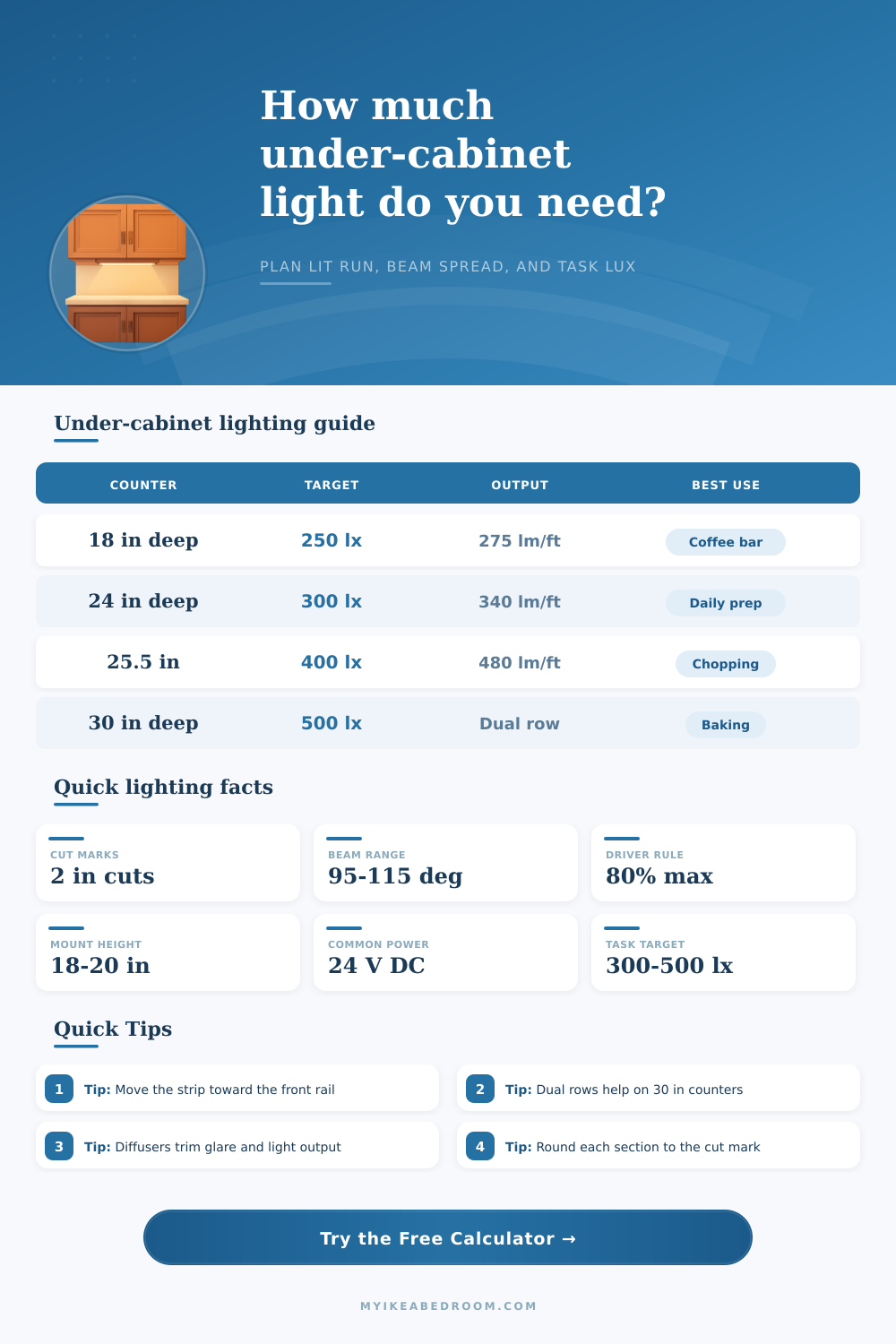
Under-cabinet lighting can be used to illuminate kitchen counters. Under-cabinet lighting is used to remove shadows from the countertops. Shadows can appear on the front edge of the countertop due to the overhead lights not being able to reach the front edge of the counter.
Under-cabinet lighting can be used to fix these shadow, but the depth of the counter will determine how much under-cabinet lighting is needed. If the counter is shallow, such as 18 inches in depth, a single row of under-cabinet lighting may be all that is need to illuminate the counter. However, for deep counters that are 30 inches in depth, shadows will appear on the back edge of the countertop if only one row of under-cabinet lighting is install.
How to Install Under-Cabinet Lights for Kitchen Counters
Counters that are darker in color, such as black granite, will absorb more of the under-cabinet lighting than light-colored countertops. Additionally, if the user mounts the under-cabinet lighting higher on the countertop, the light will spread over a wider area of the countertop but will be less intense. Finally, the lights should be installed with a small setback toward the front of the cabinet so that the countertop will be illuminated where the chefs hand will be.
Under-cabinet lighting come in different beam angles. For example, slim strip lights have narrow beam that will illuminate the countertop, while tape lights have wide beams that may illuminate the backsplash of the countertop. If the lighting is to be less glaring in the kitchen, a frosted diffuser can be added to the under-cabinet lighting fixtures.
However, adding a frosted diffuser will reduce amount of light that comes from the under-cabinet lighting. Countertops that has glossy quartz surfaces will reflect the under-cabinet lighting, while matte countertops will absorb most of the light. A lighting calculator can be used to determine the requirement for under-cabinet lighting.
The calculator will take into account the length of the under-cabinet lighting and the gaps on the countertop under the sink and range hoods. The user can determine the lighting driver that they will use for the under-cabinet lighting with the lighting calculator. Under-cabinet lighting drivers should not be loaded past 80 percent of the driver’s total capacity.
If the driver is loaded past 80 percent of its total capacity, the driver will not last as long as it should. Additionally, 20 percent of the lighting driver’s capacity should always be left for headroom in case the under-cabinet lighting is to be dimmed or additional light are to be added in the future. The density of the light that is installed under the cabinet can be measured in lux.
Lux is a more useful measurement for under-cabinet lighting than lumens. For example, the lux levels will be lower on the countertop for casual snacking but higher for food preparation. For a 24-inch deep countertop, a single row of under-cabinet lighting will be sufficient.
For deeper counters, dual row of under-cabinet lighting will be needed. Dual rows will allow one row to illuminate the front of the countertop and the other row will illuminate the rear of the countertop. However, dual rows will require more wiring and electrical power then single rows of under-cabinet lighting.
There are several common mistake when installing under-cabinet lighting. For example, it is a mistake to skip the under-cabinet lighting sections under the range hood. Additionally, it is a mistake to center the single row of under-cabinet lighting installation if the goal is to illuminate the front edge of the countertop.
Finally, if the cabinet have doors, it is important to recess the under-cabinet lighting slightly into the cabinet so that the lights are visible from within the cabinet. When the under-cabinet lighting is calculated according to the specifications of the kitchen, such as the length of the light runs, lux levels, and the lighting driver specifications, these detail should be provided to an electrician. The electrician will use these specifications to properly install the under-cabinet lighting.
Proper under-cabinet lighting will provide clarity on the countertop and allow chef to avoid hunching over there work.