Main beam screening for backyard pergolas
Pergola Beam Size Calculator
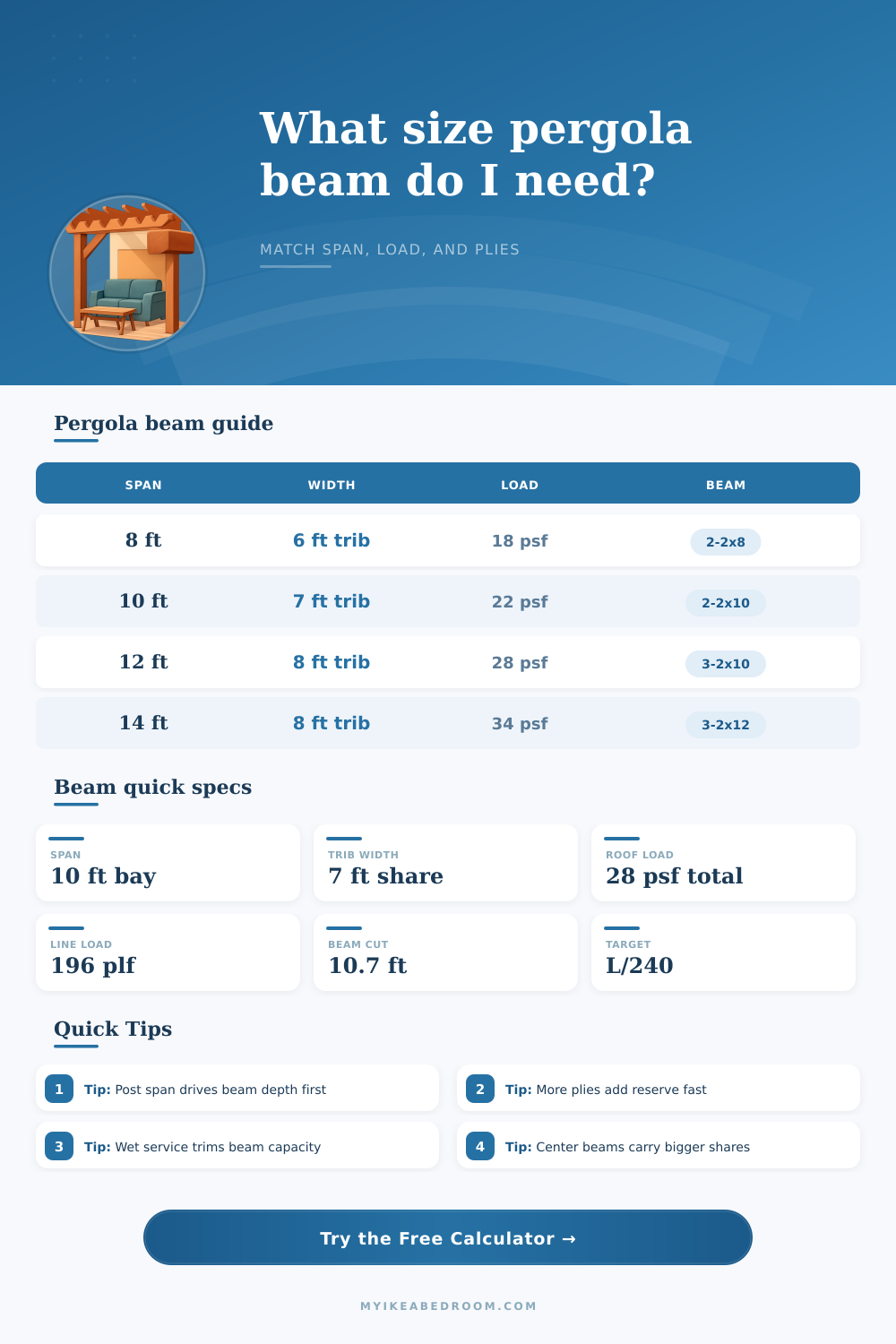
Compare common built-up and solid timber beam options using span between posts, pergola projection, beam role, roof load, wet service, and sag limits before final structural review.
These presets load real pergola beam situations so you can compare side beams, attached outer beams, and center beams without starting from a blank form.
Beam role changes tributary width automatically. Side or attached outer beams carry half the pergola projection, while center beams carry the full roof width between both sides.
Use the nearby candidates around your current recommendation to trade reserve, stiffness, and timber look without manually rebuilding the entire frame.
| Beam option | Actual size | Section modulus | Moment of inertia | Typical fit |
|---|---|---|---|---|
| 2-2x8 | 3 x 7.25 in | 26.28 in3 | 95.25 in4 | Short attached or garden pergolas |
| 2-2x10 | 3 x 9.25 in | 42.78 in3 | 197.86 in4 | Common 10 ft outer beam |
| 3-2x10 | 4.5 x 9.25 in | 64.17 in3 | 296.79 in4 | Heavier span or center beam work |
| 6x8 | 5.5 x 7.25 in | 48.17 in3 | 174.63 in4 | Solid timber look at moderate spans |
| 6x10 | 5.5 x 9.25 in | 78.43 in3 | 362.74 in4 | Chunkier exposed beam profile |
| 6x12 | 5.5 x 11.25 in | 116.02 in3 | 652.62 in4 | Long bays, snow, or heavy tops |
| Beam role | Share of projection | Best use | Why it changes the math |
|---|---|---|---|
| Attached outer beam | 50% | Ledger plus outer beam | The ledger carries the other half of the rafters. |
| Freestanding side beam | 50% | Two side beams | Each side beam supports half the roof width. |
| Center beam | 100% | Two bays framing into one beam | The beam carries the full projection from both sides. |
| Intermediate beam | 75% | Pavilion or offset framing | Useful when one beam supports more than an edge but less than a full center share. |
| Shade carrier beam | 60% | Fabric or screen tracks | Extra framing load lands on a partial-width support line. |
| Roof style | Built-in dead load | Typical spacing | Use note |
|---|---|---|---|
| Open slat roof | 5 psf | 16 to 24 in | Lightest standard pergola top. |
| Fabric shade panels | 7 psf | 12 to 16 in | Tracks, runners, and screen rails add moderate dead load. |
| Polycarbonate cover | 9 psf | 16 in | Light roof cover with purlins and trim. |
| Louvered roof | 12 psf | 12 to 16 in | Motorized or fixed blade systems want stiffer beams. |
| Light solid roof | 16 psf | 12 in | Treat it closer to a small roof than an open arbor. |
| Species | Base Fb | Base E | Use note |
|---|---|---|---|
| Western red cedar #2 | 850 psi | 1.10 Msi | Great exterior look but softer than fir or pine. |
| Pressure-treated SPF #2 | 875 psi | 1.30 Msi | Practical stock choice for many covered builds. |
| Douglas fir-larch #2 | 900 psi | 1.60 Msi | Reliable stiffness benchmark for visible beams. |
| Southern pine #2 | 1100 psi | 1.60 Msi | High strength stock option when available straight. |
| Construction heart redwood | 800 psi | 1.20 Msi | Appearance-first choice that often needs more depth. |
When designing pergola beams, you must choose the correct beam size to ensure that the beams can support the weight of the roof. If the pergola beams is too small, they will sag under the weight of the roof. If you choose beams that are to large, you will spend too much money on the lumber for the beams.
To avoid these issues, you must determine how much load will fall on each pergola beam. The number of beams and the position of the beams will affect the load on each beam. For example, side beams on a freestanding pergola will only have to carry half of the projection of the pergola.
How to Choose the Right Beam Size for a Pergola
The opposite beam will take up the other half of the projection. A beam in the center of a pergola that has two bays will have to carry the full width of the pergola. Additionally, if you attach one end of the pergola beam to a house using a ledger, the ledger will help to support the beam and the weight of the pergola roof.
The type of wood that you use for the pergola beams will impact the strength of the beams. For example, Douglas fir-larch beams are the best for providing the necessary stiffness for visible beams. However, cedar beams are popular used for there appearance.
Even though cedar is a popular wood for pergolas, it does not have the strength of Douglas fir-larch beams. In environments with moisture and wet conditions, the wood will lose some of its capacity. In these cases, the capacity of the wood will decrease by ten to fifteen percent.
In these cases, larger beams are necessary to compensate for the decrease in the woods capacity. Additionally, the type of roof that you will construct on the pergola will impact the weight of the beams. If slats are used for the roof, they will add very little weight to the pergola beams.
Polycarbonate panels and louvers will add significant weight to the pergolas, so stiffer beams will be necessary for these types of pergolas. Another important factor in determining the size of the beam is the span of the beams. The span of the pergola beams is the distance between the two posts on which the pergola rests.
The span is one of the primary factors that will impact the depth of the beams. If the span of the pergola beams are increased to beyond ten feet, then the depth of the beams must also be increased. This is to avoid deflection in the beams.
Deflection is the measurement of the sagging of pergola beams under the weight of the roof. You want to ensure that the deflection of the beams is within the limit for maximum sagging, such as the L/240 limit, which is a limit of the sagging of the beam to less than half an inch. To determine the necessary size of the beams, you must determine the tributary width of the beams.
These line loads will help you to determine whether you need a double-ply beam or a triple-ply beam. There are also some preset tools that will assist you in determining the appropriate beams for your pergola. These tools allow you to input several different variables for your pergola, such as the span of the pergola, the projection of the beams, and the load that the beams must support.
Based on these inputs, the tool will provide recommendations for beams of various sizes. The tools will automatically account for the fact that the side beams will experience a lesser share of the load than the center beam. Additionally, the tool can also account for service conditions, such as the fact that beams that will be exposed to wet environments will have a reduced capacity.
The results of these calculations will display the percentage of the capacity of the beams that will be utilized. A percentage between 70% and 90% indicates that the beams have enough reserve capacity to ensure their safety, but are not excessively large. In comparing beams, you may consider beams made of solid timber to be more visually appealing than beams made of built-up plywood.
However, built-up ply beams may be more efficient in relation to the spans that is to be constructed. Deep beams are stronger than wide beams. There are many mistakes that can be made in the planning of a pergola.
For example, if you plan the beams without considering the spacing of the rafters, the beams may experience heavy point loads. If you do not consider the overhangs of the roof in the building of the pergola, the measurements of the beams will be incorrect. The spacing of the posts must also be considered; if the beams are too far apart, the beams may sag in the middle due to the excessive load of the roof.
Finally, you must also consider the conditions at the building site when planning the pergola. For example, if the pergola is to be built in a location that receives a great deal of snow, the live loads of the snow must be accounted for in the beams design; in this case, triple-ply beams will be required. In coastal areas, wind loads will be more important than snow loads.
Additionally, local building codes may impact the construction of the pergola. For example, building codes may require certain limits on the deflection of the beams or certain types of wood to be used in the beams. Finally, by calculating the loads that will act upon the beams and by carefully selecting the sizes of the beams that will be used in the pergola, the pergola will remain stable and the beams wont sag over time.
You should of chosen larger beams if your planning for heavy snow. It is better to have alot of extra support than to have a structure that falls down.