Pergola rafter screening by span and load
Pergola Rafter Size Calculator
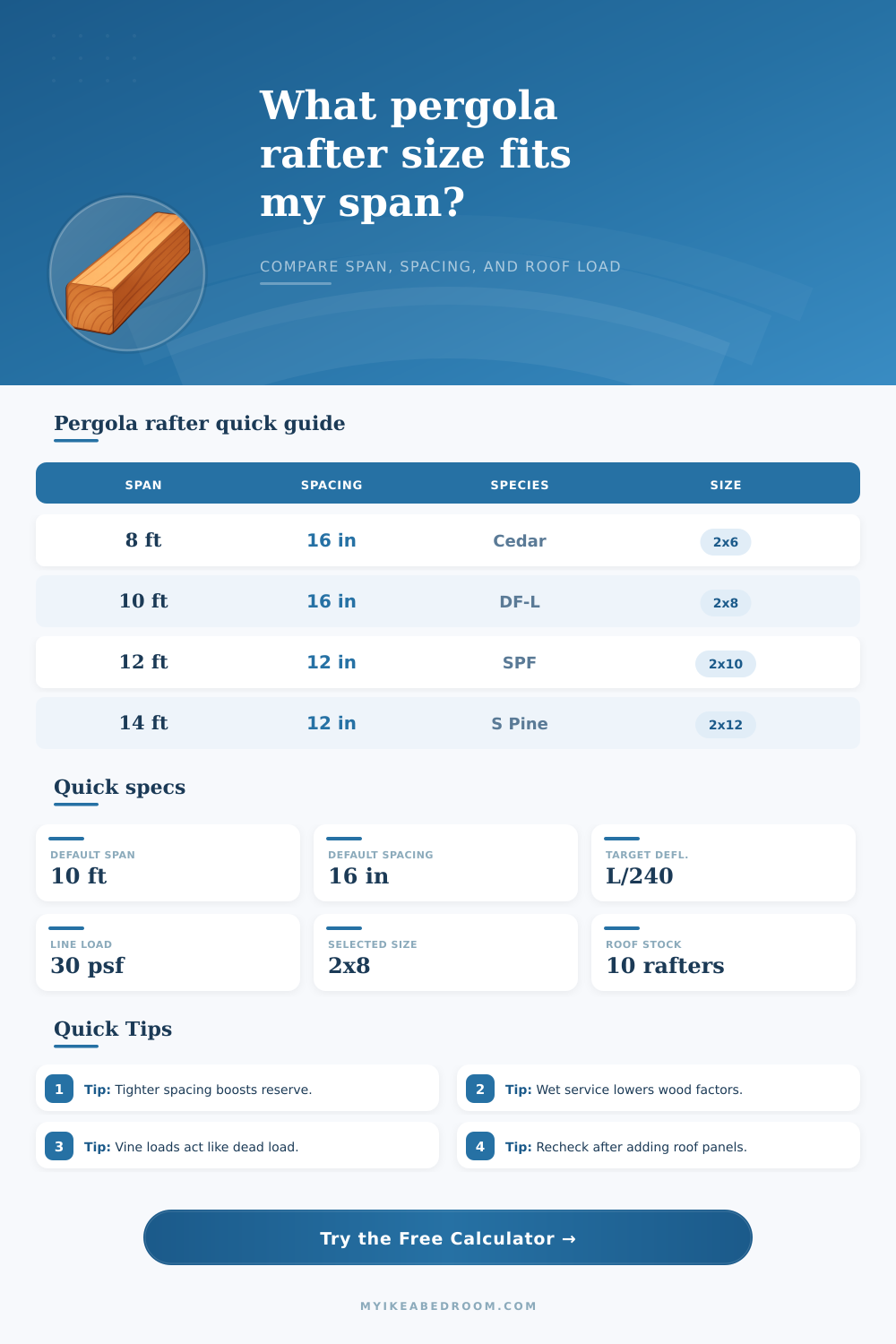
Compare clear span, spacing, load, species, and deflection target to screen real rafter sizes for open slat, vine, louvered, and panel-covered pergolas.
Start with a measured backyard case, then override the fields if your pergola uses a different span, spacing, load, or wood species.
| Nominal | Actual | Section modulus | Moment of inertia |
|---|---|---|---|
| 2x6 | 1.5 x 5.5 in | 7.56 in3 | 20.80 in4 |
| 2x8 | 1.5 x 7.25 in | 13.14 in3 | 47.65 in4 |
| 2x10 | 1.5 x 9.25 in | 21.39 in3 | 98.84 in4 |
| 2x12 | 1.5 x 11.25 in | 31.64 in3 | 178.30 in4 |
| 2x14 | 1.5 x 13.25 in | 43.89 in3 | 290.80 in4 |
| Species | Fb | E | Density |
|---|---|---|---|
| Western red cedar No.2 | 575 psi | 1.10E6 psi | 23 lb/ft3 |
| SPF No.2 | 875 psi | 1.20E6 psi | 28 lb/ft3 |
| Douglas fir-larch No.2 | 900 psi | 1.60E6 psi | 32 lb/ft3 |
| Southern pine No.2 | 1100 psi | 1.40E6 psi | 35 lb/ft3 |
| Redwood heart | 850 psi | 1.20E6 psi | 27 lb/ft3 |
| Hem-fir No.2 | 850 psi | 1.30E6 psi | 30 lb/ft3 |
| Engineered LVL 1.9E | 2850 psi | 1.90E6 psi | 37 lb/ft3 |
| Profile | Dead add | Live add | Deflection bias |
|---|---|---|---|
| Open slat roof | +2 psf | +0 psf | L/240 |
| Fabric shade | +3 psf | +0 psf | L/240 |
| Vine trellis | +5 psf | +2 psf | L/180 |
| Polycarbonate roof | +7 psf | +0 psf | L/240 |
| Louvered roof | +10 psf | +2 psf | L/300 |
| Light solid roof | +14 psf | +5 psf | L/360 |
| Snow-belt cover | +16 psf | +12 psf | L/360 |
| Coastal wind cover | +8 psf | +2 psf | L/300 |
| Layout | Span | Run | Likely size |
|---|---|---|---|
| Courtyard 8 x 10 | 8 ft | 10 ft | 2x6 or 2x8 |
| Dining 10 x 12 | 10 ft | 12 ft | 2x8 |
| Lounge 12 x 14 | 12 ft | 14 ft | 2x8 or 2x10 |
| Vine 10 x 16 | 10 ft | 16 ft | 2x10 |
| Snow 12 x 18 | 12 ft | 18 ft | 2x10 or 2x12 |
When building a pergola, it is essential to choose the correctly size for the pergola rafters. The size of the rafters will determine whether the rafters will sag or can hold the weight of the roof that will be placed upon them. If the rafters is too small, they will sag under the load of the vines that grow upon the pergola or the polycarbonate cover.
If the rafters are too large, you will spend more money then necessary on building the pergola. The weight that will act upon the pergola rafters can be categorized into dead loads and live loads. Dead loads are the weights that remains constant upon the rafters, such as the weight of the cedar slats or the polycarbonate cover.
Choose the Right Rafter Size for Your Pergola
Live loads are temporary weights that act upon the rafters, such as the weight of the snow that may fall upon the pergola or the force of the wind. A slatted roof may have a dead load of 2 pounds per square foot, but if the pergola features a polycarbonate cover, the dead load will be 7 pounds per square foot. The total load that will act upon the rafters will determine the size of the rafters that is needed for the pergola.
The species of wood that you choose for the pergola rafters will affect the rafters performance. For example, cedar is a common wood species for pergolas because it naturaly resists rot; however, cedar has lower stiffness than other wood species. Because of this, if you use cedar, the rafters for the pergola may have to be larger to span distances of more than ten feet.
Another common wood species is Southern yellow pine, which is less expensive than other wood species and strong enough to support the weight of vines that climb upon the pergola. The species of wood for the pergola rafters will determine the bending and stiffness of the rafters. The span of the pergola rafters is the distance that they will span between the two supports for the pergola.
To determine the maximum deflection of the pergola rafters, which is the amount that the rafters will bend under the load of the roof, you can use a formula to calculate the deflection of the rafters. If the deflection of the rafters is too great, the rafters will sag. The calculation of deflection will determine the maximum deflection that may occur in the pergola rafters.
For instance, if the pergola is to be used to shade a hot tub, the deflection limit of the rafters should be set to a lower number than if the pergola was to be used for another purpose. The rafters may also be spaced differently from the typical distance between rafters. Many pergola rafters are installed with a spacing of sixteen inches on center.
However, if the pergola rafters needs to span long distances or are located in an area that is often exposed to the force of the wind, the rafters may need to be spaced at twelve inches on center. Spacing the rafters more frequently will distribute the load of the roof more even upon the rafters, which will prevent the rafters from sagging. There are some mistakes that you should avoid when installing the pergola rafters.
One such mistake is to fail to inspect the crown of the wood. The crown of the wood is the natural curve of the lumber. To allow the roof to push on the rafters to keep them flat, the crown need to face upward.
Another mistake is to fail to account for the overhangs of the rafters. The overhangs of the rafters are the overextended portions of the rafters that extend beyond the pergolas edge; these overhangs will add to the total length of the rafters that is needed. Lastly, if the pergola is to be used for some additional project in the future, the rafters will need to be able to support the additional load.
For instance, if you place a heavy cover upon the pergola in the future, the rafters will have to be strong enough to support this additional dead load on the rafters. The rafters should be selected according to the additional load that may be placed upon the pergola in the future. By respecting the limits of the rafters in terms of the span and the load that they may recieve, the rafters will remain stable and not sag over time.
You should of considered the weight of the woods too.