Bedroom airflow and blade-span planner
Ceiling Fan Size for Room Calculator
Match blade span, target airflow, mounting height, and single or dual fan layouts for bedrooms, suites, lofts, nurseries, and open sleeping zones.
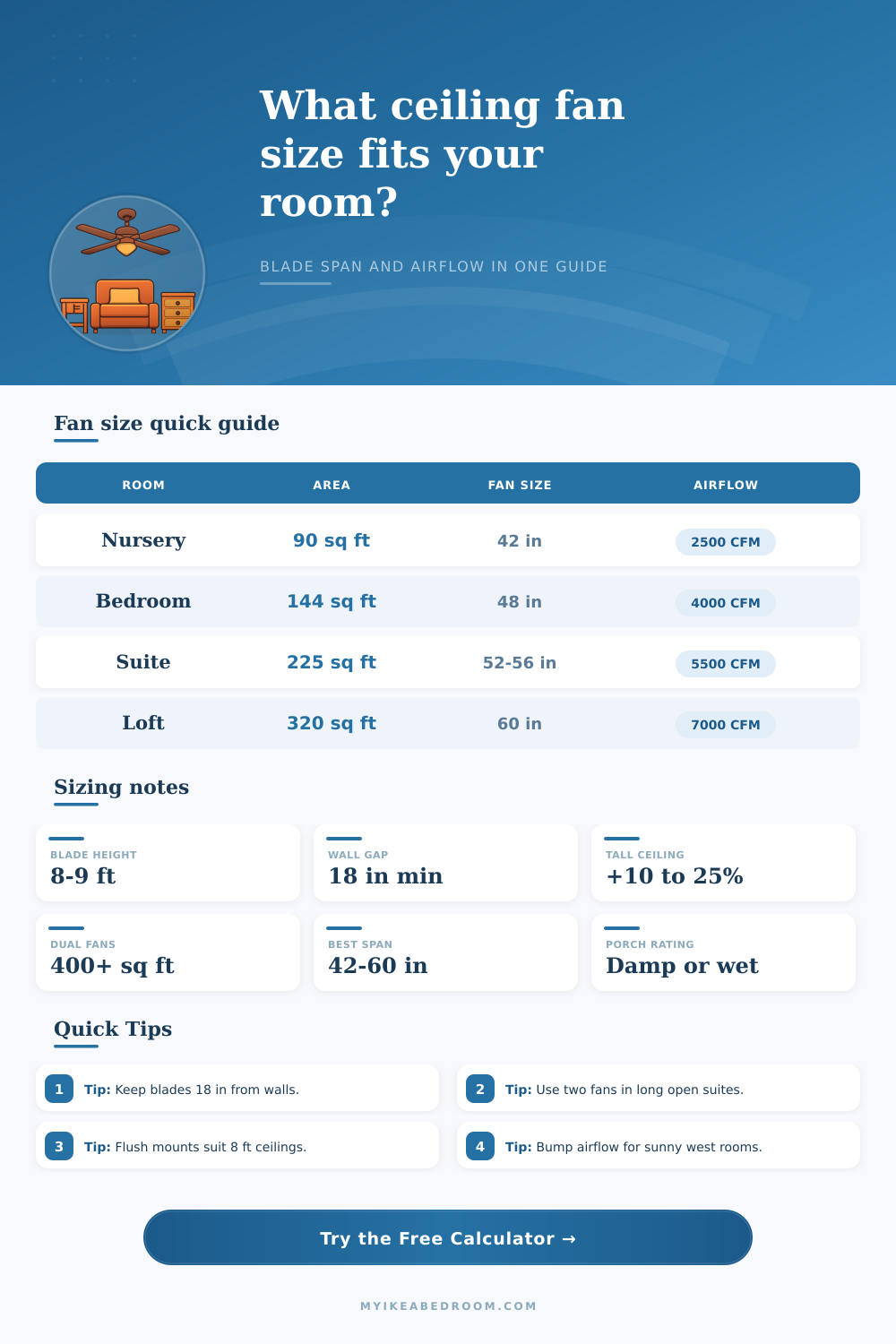
| Room area | Recommended span | Target airflow | Typical room |
|---|---|---|---|
| Up to 75 sq ft | 29-36 in | 1500-2500 CFM | Compact nursery, dressing room |
| 76-100 sq ft | 36-42 in | 2500-3200 CFM | Small guest room, study sleeper |
| 101-144 sq ft | 42-48 in | 3200-4200 CFM | Standard bedroom |
| 145-196 sq ft | 48-52 in | 4200-5000 CFM | Larger bedroom with queen bed |
| 197-256 sq ft | 52-56 in | 5000-6200 CFM | Primary suite sitting edge |
| 257-324 sq ft | 56-60 in | 6200-7200 CFM | Loft bedroom or wide suite |
| 325-400 sq ft | 60-72 in | 7200-9000 CFM | Open bedroom lounge |
| Over 400 sq ft | Two 52-60 in fans | 9000-12000 CFM | Long suites and multi-zone rooms |
| Ceiling height | Suggested mount | Blade height target | Airflow adjustment |
|---|---|---|---|
| 8 ft | Flush or short hugger | 7.5-8 ft above floor | Baseline sizing |
| 8.5-9 ft | 4-6 in downrod | 8-8.5 ft above floor | Baseline sizing |
| 9-10 ft | 6-12 in downrod | 8.5-9 ft above floor | Add about 8% |
| 10-12 ft | 12-24 in downrod | 9 ft above floor | Add about 16% |
| 12-14 ft | 24-36 in downrod | 9-10 ft above floor | Add about 24% |
| Over 14 ft | 36 in or custom | 10 ft above floor | Add about 32% |
| Layout rule | Minimum | Better target | Why it matters |
|---|---|---|---|
| Blade to wall | 18 in | 24-30 in | Prevents clipped circulation and awkward sightlines |
| Blade to tall furniture | 18 in | 24 in | Keeps airflow from slamming into wardrobes |
| Blade height above floor | 7 ft | 8-9 ft | Best mix of comfort and code-friendly clearance |
| Two-fan center spacing | 8 ft | 10-12 ft | Creates overlap without a dead center strip |
| Fan to bed centerline | Centered or offset equally | Symmetric with room axis | Helps the room feel balanced visually and physically |
| Open-plan trigger | 2 linked zones | 2 fans above 400 sq ft | One huge fan often leaves corners under-served |
| Preset | Area | Typical size | Why it lands there |
|---|---|---|---|
| Small nursery 9 x 10 | 90 sq ft | 42 in | Compact room with soft sleep airflow |
| Guest room 12 x 12 | 144 sq ft | 48 in | Balanced comfort and simple center layout |
| Standard bedroom 11 x 13 | 143 sq ft | 42-48 in | Classic one-fan bedroom footprint |
| Primary suite 14 x 16 | 224 sq ft | 52-56 in | Needs stronger sweep across bed and seating edge |
| Loft bedroom 15 x 18 | 270 sq ft | 56-60 in | Taller ceiling and broader air volume |
| Studio sleep zone 18 x 20 | 360 sq ft | 60 in | Open circulation and warmer load profile |
| Covered sleeping porch | 192 sq ft | 52 in | Outdoor-adjacent rooms feel best with a breeze reserve |
| Open suite two-zone plan | 285 sq ft | 2 x 52 in | Linked zones benefit from two balanced fans |
When choosing between ceiling fan of different sizes, it is important to avoid both ceiling fans that are too small and ceiling fans that are too large. A ceiling fan that have too small of a blade span will not be able to move enough air throughout the room. Additionally, a ceiling fan that is too large for the area in which it is to be installed may be intrusive to the occupant of the room, or it may create turbulent air movement within the area.
Ceiling fans dont lower the temperature of a room. Instead, ceiling fans move the air within a room, creating a wind chill effect. This wind chill effect creates the sensation of coolness within an individual’s body.
How to Choose the Right Ceiling Fan
As a result, individuals can adjust the thermostat control in there homes to a higher temperature with the use of ceiling fans, leading to the reduction of the energy bill that would otherwise be necessary to heat the rooms to those desired temperatures. Two factors influence the effectiveness of a ceiling fan: the blade span of the fan and the airflow that the fan create. The size of the room that is to be cleaned with the ceiling fan determine the blade span that should be used in the fan.
In standard bedrooms that are approximately 150 square feet in size, blade span of 42 to 48 inches are typicaly appropriate for the size of the bedrooms. In rooms that are larger than bedrooms, such as primary suites in a home, a blade span of 52 inches or more are typically required to allow the ceiling fan to effectively circulate air within those rooms. Additionally, long and narrow rooms may be more difficult to effectively ventilate with ceiling fan alone.
In these types of rooms, it is recommended to install two ceiling fans within the room, each at least 8 to 12 feet apart from each other. The height of the ceilings within a room impact the installation of the ceiling fan. In rooms with ceilings that are 8 feet in height, ceiling fans that are flush mounted to the ceiling are typicaly appropriate.
These types of ceiling fans will allow the blades to be approximately 7.5 feet from the floor. In rooms with ceilings that is 10 feet in height or more, a downrod may be necessary to lower the blade height of the fans to 8 or 9 feet. In these instances, the ceiling fans will need to create 10 to 25% more airflow than those installed in standard room.
Additionally, there must be at least 18 inches between the blades of the ceiling fan and any other object in the room. If the distance between the blades and other objects in the room is less than 18 inches, the ceiling fan will restrict the air movement created by the ceiling fan. The use of the room may also impact the amount of airflow that is required of the ceiling fan.
For instance, a nursery may require a ceiling fan that create less airflow than many other rooms in the home. Young children that requires a quiet environment to sleep typically occupy nurseries. Thus, ceiling fans with approximately 2,500 CFM are typically appropriate in nurseries.
Home offices, however, may require ceiling fans with 4,000 CFM of airflow. Home offices may need this amount of airflow in support of the individuals who must remain active in the office throughout the day. Additionally, rooms that receive alot of sunlight or located on the top floor of a building may also require ceiling fans with higher CFM ratings.
Rooms that receive sunlight require ceiling fans with higher CFM ratings to offset the amount of heat that enter the rooms from the sunlight. In cases where a room is connected to another area in the home, such as a bedroom and dressing area, the total square footage of the two areas should be calculated. Based off the size of the area that will be covered by the ceiling fan, an appropriate number of ceiling fans can be purchased to supply each area within the home.
When purchasing a ceiling fan, it is important to avoid the mistake of purchasing one based solely upon its visual appearance. For instance, while a 60-inch ceiling fan may appear powerful, it is inappropriate for a small bedroom that is only 144 sq. Ft. In size.
The blades will hit the furnitures within the bedroom, and the large size of the fan will be distracting from the occupants of the bedroom. Additionally, if a ceiling fan has insufficient blade span for the area in which it will be installed, it will create areas within the room that are too hot to stand in for long periods of time. When purchasing a ceiling fan, it is important to measure the length and width of the room to calculate the area of the room.
After determining the area of the room, the ceiling height, type of room, sunlight exposure, and required ceiling fan clearance from furniture in the room can be determined. Based on these measurement and considerations, you could of purchased a ceiling fan that will provide the correct amount of airflow for the specific area in the home.