MyIKEABedroom finish planning
Polyurethane Coverage Calculator
Estimate coverage for thirsty first coats, smoother build coats, and the rounded container mix needed for floors, furniture, trim, shelving, and covered outdoor wood.
Project presets
Calculator inputs
Coverage results
Coverage breakdown
Coat-by-coat plan
| Coat | Spread | Finish |
|---|
Coverage balances surface texture, absorbency, and application losses rather than using flat floor math alone.
Project comparison grid
Floors
Wide runs move quickly, but raw oak and final edge passes increase first-coat pull and waste.
Furniture
Tabletops and case sides stay efficient on flat faces, yet wipe-on systems need more thin coats.
Cabinet fronts
Rails, stiles, and back edges add exposure beyond face dimensions, especially on shaker profiles.
Trim and exterior
Narrow parts, end grain, and flexible spar finishes all raise spread losses versus slab surfaces.
Reference tables
| Finish family | First coat spread | Build coat spread | Dry build per coat | Best fit |
|---|---|---|---|---|
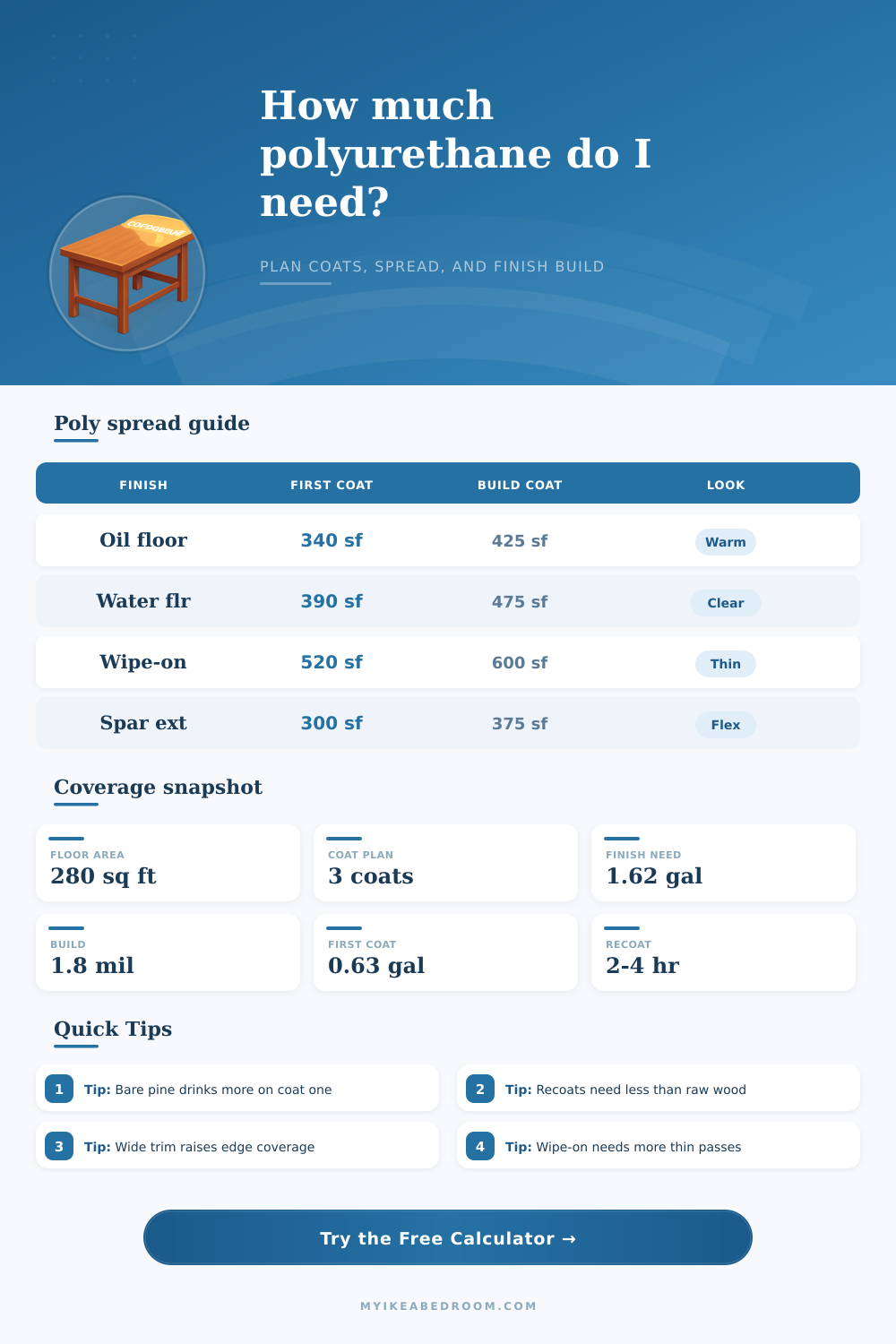
| Water-based floor polyurethane | 390 sq ft/gal | 475 sq ft/gal | 0.60 mil | Clear floors and landings |
| Oil-based floor polyurethane | 340 sq ft/gal | 425 sq ft/gal | 0.72 mil | Warm tone hardwood floors |
| Furniture-grade water poly | 360 sq ft/gal | 450 sq ft/gal | 0.52 mil | Cabinets, shelves, dressers |
| Oil-modified water poly | 350 sq ft/gal | 430 sq ft/gal | 0.58 mil | Desks, trim, and benches |
| Wipe-on polyurethane | 520 sq ft/gal | 600 sq ft/gal | 0.25 mil | Tabletops and hand-rubbed work |
| Spar urethane | 300 sq ft/gal | 375 sq ft/gal | 0.68 mil | Covered outdoor wood |
| Species | Absorbency factor | Behavior | Planning note |
|---|---|---|---|
| Maple | 0.97x | Tight grain | Usually stretches first coat a bit farther. |
| Birch | 0.99x | Even surface | Predictable spread on cabinets and shelves. |
| White oak | 1.05x | Open grain | Needs extra first-coat volume on raw floors. |
| Red oak | 1.08x | Open grain | More thirsty than maple or birch. |
| Walnut | 1.00x | Balanced grain | Close to label spread with flat sanding. |
| Pine | 1.16x | Soft earlywood | Expect stronger first-coat soak. |
| Cedar | 1.18x | Porous and aromatic | Outdoor boards often absorb heavily. |
| Reclaimed rough stock | 1.22x | Mixed density | Add room for milling marks and dry grain. |
| Variable | Choice | Factor | Effect on coverage |
|---|---|---|---|
| Surface | Screened recoat | 0.72x | Already sealed, so coats stay on top. |
| Surface | Tight 220-grit sand | 0.95x | Lower first-coat draw than coarse sanding. |
| Surface | Open-pore floor | 1.12x | More finish disappears into grain texture. |
| Surface | Heavy end grain | 1.15x | Ends and shelf edges soak up material fast. |
| Applicator | Pad applicator | 1.00x | Balanced transfer on flat runs. |
| Applicator | Synthetic brush | 1.05x | More hold-up in bristles and edge loading. |
| Applicator | Foam brush | 1.08x | Higher waste on trim and corners. |
| Applicator | Spray gun | 0.92x | Can improve transfer on large batches. |
| Project | Typical coats | Recoat range | Why it changes |
|---|---|---|---|
| Floor on bare wood | 3 coats | 2 to 4 hr | First coat seals, later coats build wear film. |
| Screen and recoat floor | 2 coats | 2 to 4 hr | Existing film reduces absorption sharply. |
| Furniture with wipe-on poly | 4 to 5 coats | 2 to 3 hr | Thin coats need stacking for depth. |
| Cabinet doors | 3 coats | 2 to 4 hr | Edges and rails need complete wrap coverage. |
| Trim package | 2 to 3 coats | 2 to 4 hr | Narrow parts often load more on first pass. |
| Covered outdoor bench | 4 coats | 4 to 6 hr | Spar films need layered build for flexibility. |
Application tips
Calculating the amount of polyurethane that will be used in a project is a processes that involves several steps. Depending upon the type of wood that will be finished and the way in which the person will apply the polyurethane to that wood, the amount of polyurethane that will be used will change. A person cant simply rely upon the amount of polyurethane that is listed on an can to calculate the amount that will be used for the project; the wood will absorb some of that polyurethane.
If a person does not account for the amount of polyurethane that the wood will absorb, the person may find themself out of polyurethane prior to completing their project. The type of wood that is to be finished is one of the main variable that will impact the amount of polyurethane that is used. For instance, softwoods like pine and cedar will absorb more polyurethane than hardwoods like maple due to the pore in the wood.
How to Work Out How Much Polyurethane You Need
Thus, a person will need to purchase more polyurethane to finish a piece of pine or cedar than they would for a maple hardwood. Additionally, the grain of the wood will also impact the amount of polyurethane that is consumed; woods with large pore will require more polyurethane than woods with small pores. The shape and structure of the object that is to be finished will also impact the amount of polyurethane that is needed.
For instance, a flat piece of wood will have less surface area than an object with many edge, such as a cabinet. Additionally, any objects with profiles will require more polyurethane than those without profiles; the edges of the object will increase the total surface area of the object that must be treated with polyurethane. A person can account for these variables by purchasing extra polyurethane to account for these edges and the waste of polyurethane during the application process.
Another factor to consider is the amount of waste that may occur in the application of polyurethane. For instance, some polyurethane will remain on the brush that is applying the polyurethane to the wood. Additionally, if a person uses a spray gun to apply the polyurethane, some of the polyurethane may drip off of the wood; additionally, some of the polyurethane may be lost to overspray.
Thus, a person should of account for waste by purchasing an additional eight to twelve percent of polyurethane in comparison to the amount that is needed to cover the wood. Failure to account for waste may cause a person to not have enough polyurethane for the final recoat of the project. The type of polyurethane that is to be used will also impact the amount of polyurethane that is used for the project.
Water-based polyurethane will cover the wood more easy when applying build coats; oil-based polyurethane will add an amber color to the wood. Wipe-on polyurethane will require many coat to create a thickly protective film on the polyurethane. Spar urethane is used outdoors, but will cover less area per gallon than other types of polyurethane because it is more elastic.
The condition of the wood will impact the amount of polyurethane that is used. For instance, raw wood will absorb more polyurethane than wood that is sanded. Coarse sandpaper will leave grooves in the wood that polyurethane must fill.
Fine sandpaper will leave a smooth surface for polyurethane to fill. Additionally, the end grain will absorb more polyurethane than the face grain of the wood. Finally, the way in which the person will apply the polyurethane will also affect the amount of polyurethane that is used.
For instance, using a spray gun may waste less polyurethane than a brush, but overspray can be an issue. A brush or foam applicator may contain more polyurethane in the fibers than a spray gun; thus, more polyurethane will be used per pass with a brush or foam applicator. Thus, a person who wishes to purchase the proper amount of polyurethane for their project should be aware of each of these variable.