Sheet 344 | Patio framing planner
Pergola Size Calculator
Set your pergola width, projection, clear height, post spacing, rafter spacing, and slat rhythm to estimate a balanced backyard frame before you lay out footings.
Nine starting layouts for attached patios, freestanding garden rooms, grill corners, and poolside shade.
Full breakdown
Geometry
Framing
Shade and specs
| Plan size | Typical posts | Comfort zone | Typical use |
|---|---|---|---|
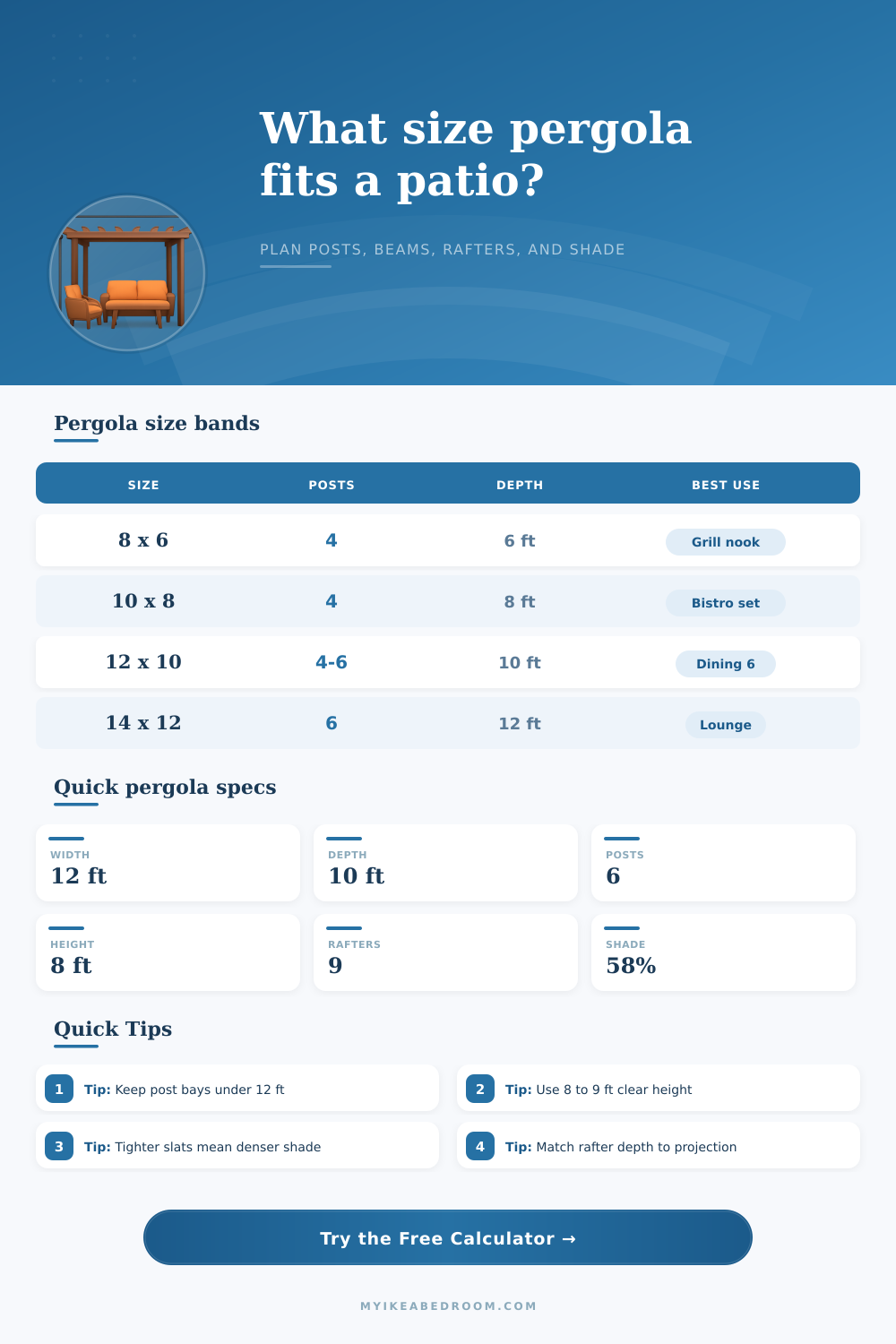
| 8 x 6 ft | 4 posts | 2 seats | Grill corner, side gate, or path entry |
| 10 x 8 ft | 4 posts | Bistro set | Compact attached patio |
| 12 x 10 ft | 4 to 6 posts | Dining for 6 | Most back patio dining zones |
| 14 x 12 ft | 6 posts | Sofa set | Lounge layout with circulation |
| 16 x 12 ft | 6 to 8 posts | Mixed seating | Pool deck or large family patio |
| 18 x 14 ft | 8 posts | Group seating | Courtyard or oversized entertainment zone |
| Beam build | Comfortable post span | Typical width band | Planning note |
|---|---|---|---|
| Double 2x8 | 8 to 9 ft | Up to 10 ft | Works for compact attached pergolas |
| Double 2x10 | 9 to 11 ft | 10 to 14 ft | Common sweet spot for most patios |
| Double 2x12 | 11 to 13 ft | 12 to 16 ft | Useful when you want fewer posts |
| 3-ply 2x12 | 13 to 15 ft | 16 to 20 ft | Better for tall or heavy slat layouts |
| 5-1/8 in glulam | 15 to 18 ft | 18 ft and up | For long clear spans without extra posts |
| Rafter size | 12 in o.c. | 16 in o.c. | 24 in o.c. | Best for |
|---|---|---|---|---|
| 2x6 | 9 ft | 8 ft | 7 ft | Shallow compact pergolas |
| 2x8 | 12 ft | 10 ft | 9 ft | Dining and medium patio depths |
| 2x10 | 14 ft | 12 ft | 10 ft | Deep lounge layouts |
| 2x12 | 16 ft | 14 ft | 12 ft | Large freestanding pergolas |
| Slat and gap | Shade coverage | Sky view | Visual feel |
|---|---|---|---|
| 1.5 in / 2.5 in | 38% | Open | Light, airy, modern |
| 1.5 in / 1.5 in | 50% | Balanced | Classic filtered light |
| 2 in / 1.5 in | 57% | Moderate | Good for dining shade |
| 3.5 in / 2 in | 64% | Tight | Dense pattern for hot patios |
Weight: light to medium
Strength: moderate span capacity
Best for: warm backyard patios
Watch for: slightly shorter spans than fir
Weight: heavy framing stock
Strength: strong for common spans
Best for: painted or stained patio builds
Watch for: more movement while drying
Weight: medium
Strength: high stiffness for rafters
Best for: cleaner long-span members
Watch for: protect exposed end grain well
Weight: light to medium
Strength: similar to cedar
Best for: refined garden structures
Watch for: still size beams conservatively
When you plan a pergola, you must determine the correct dimension for the pergola so that the pergola fit your space and supports the weight of the lumber. Determining the size of a pergola requires you to consider the furniture, the post spacing, the height of the structure, and the type of wood you use. The first step in determining the size of a pergola is measuring the furniture that will sit under the pergola.
If you have a large dining table, your pergola will need to be wider than if you have a small bistro table. You need to consider the space that your furniture will take up and leave ample walking space between the edge of the pergola and your furniture. There are two main type of pergolas: attached pergolas and freestanding pergolas.
How to Plan the Size of Your Pergola
Attached pergolas lean against and are attached to a house or other structure. Attached pergolas use the house for support, so you do not need posts on one side. Freestanding pergolas do not lean against a house, so you need two lines of beams and more post than you would need for an attached pergola.
You need to consider post spacing for your pergola. The spacing between the posts will determine how thick your beams must be. If you place the posts too far apart, the beams will sag under the weight of the wood.
Eight feet is a common height for a pergola; this measurement ensure that people can comfortabley stand under it without hitting the rafters. If you make the pergola nine or ten feet tall, you will need to use larger pergola posts because larger posts are necessary for structures that is taller than the average pergola. The material you use for your pergola will also play a role in the sizing of your pergola.
If you use cedar for your pergola, cedar is a lightweight wood with flexibility to accommodate natural shifts in the wood caused by environmental factor. However, spans using cedar should be conservative because of these properties of cedar. If you use pressure treated pine for your pergola, pressure treated pine will be heavy and can support heavy loads on your pergola.
However, pressure treated pine will twist when it dries, so you will need to seal the wood as soon as you cut it. You must also take into account the amount of snow and the amount of wind in your area. These two factors will impact the sizing of the beams and the rafters of your pergola.
The slats on top of your pergola will play a key role in the amount of shade the pergola will provide. If you use narrow slats with wide gaps for the pergola slats, it will allow more sunlight through the pergola. However, if you choose to use thick slats with narrow gaps between the slats, the pergola will provide more shade for those underneath it.
However, the thick slats will add to the weight of the pergola. You should take into account the amount of snow and the amount of wind in your area when you design the slats of your pergola. In areas that experience alot of snow or strong winds, the rafters and slats will need to be closer together to increase the strength of the pergola.
You should avoid making your pergola appear goodly over the physical requirements of the wood. If your pergola is too large and you do not use thick enough lumber for the rafters, the rafters will be too thin to support the span of the pergola. Additionally, if the pergola is too short, it will make the rafters feel too low for individuals walking through or sitting under the pergola.
Instead, use the measurement of the furniture in the area to determine the size of the pergola. The furniture in the area will determine the size of the area that will be under the pergola. Finally, you will need to plan the footings for the pergola.
The footings will be the base of the pergola posts into the ground. Depending on your area, the footings must be deep enough to prevent the frost from moving the pergola posts. You will also have to check local building code.
Depending on your location, there may be specific ledger bolts that you must use for the pergola to be attached to the house or specific permit may be required for the pergola to be of a certain size. When you have all of the measurements for your pergola planned out, sketch out the pergola on graph paper to ensure that all of the dimensions will work together correct.