🛖 Sauna layout planning
Sauna Size Calculator
Estimate room footprint, adjusted heat load, bench frontage, and seating comfort before you lock in the final wall and bench layout.
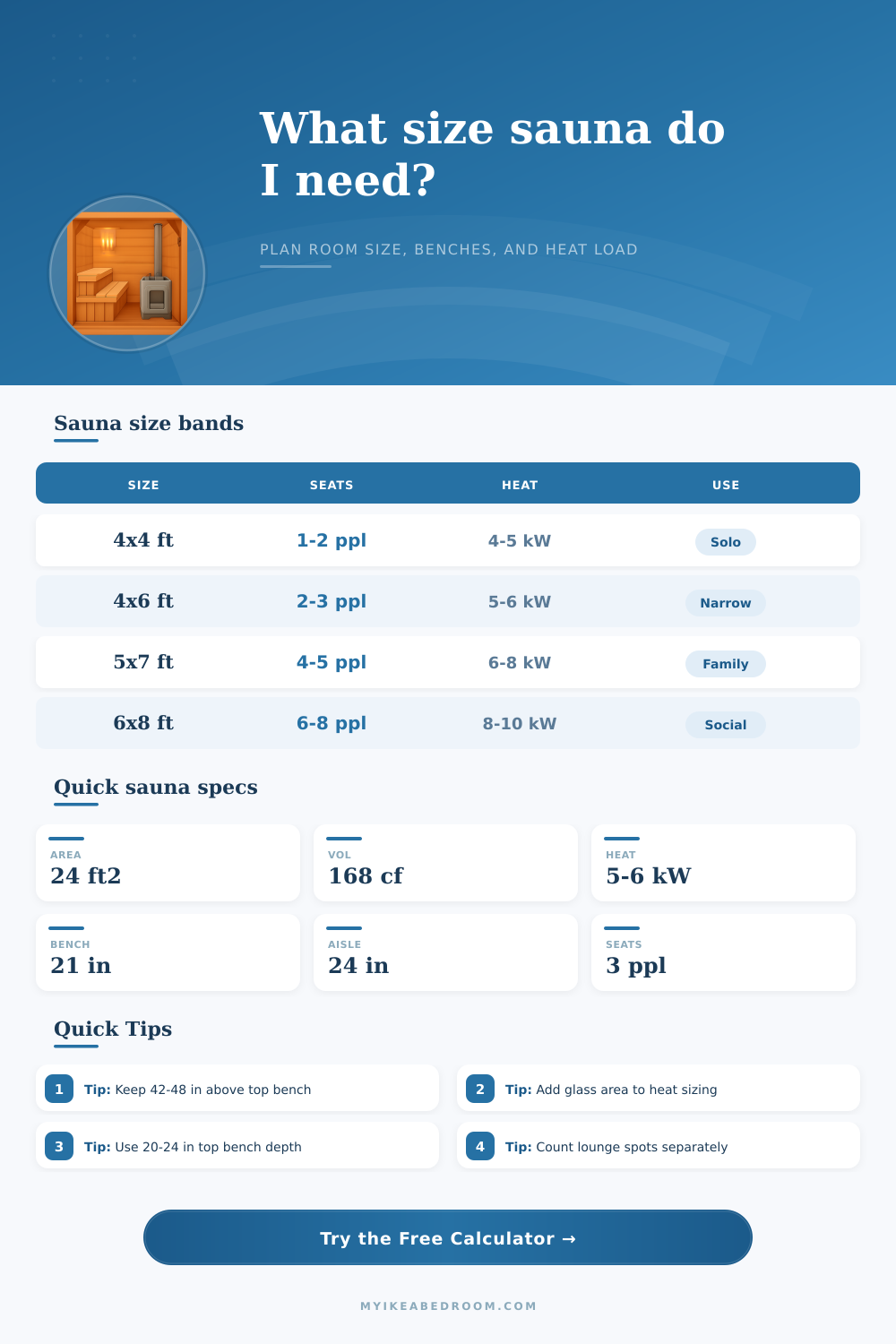
Use these real room-size starting points, then tune bench depth, aisle width, ceiling height, and glass area.
Full layout breakdown
Room Numbers
Bench Fit
This room keeps a practical aisle and a useful upper-bench hot zone.
Many home saunas feel best when the upper bench is about 42 to 48 inches below the ceiling.
Use adjusted volume rather than raw volume whenever the room has a glass door or window wall.
Each layout changes usable bench frontage and aisle pressure, even when floor area stays the same.
Selecting the correct size for a sauna depend on the size of the sauna and how many peoples is going to use it. Saunas that are too small will leave a person without enough room to move within the sauna. Saunas that are too large will allow the heater to take a long time to warming the air within the sauna.
Saunas must be planned with specific considerations in order to determine its size; the interior shell, the bench layouts, the ceiling height, and the heater capacity. The interior shell will dictate the size of the sauna; larger panels indicates that the sauna will be smaller in size due to the insulation that will be present within the sauna. A width of 4 feet is sufficient for one person to use a sauna; 4 feet is too narrow for placing benches on opposite wall of the sauna.
How to Choose the Right Sauna Size
The depth of the benches must also be considered; deeper benches allow people to sit more comfortaly yet require more room within the sauna for benches to be placed. The layout of the benches will dictate how many individual can fit into the sauna. Benches that you place straight along one wall will allow for two or three individual to lie down.
Placing benches in an L shape is common for families as this provides space for a footrest. Bench layouts that place benches opposite one another will increase the seating for individuals along the length of the sauna yet reduce the amount of walking space within the center of the sauna. Saunas that have benches in the shape of a U provide the most seating for individuals along three sides of the sauna but require more space within the sauna for individuals to walk in the center.
The height of the sauna will affect how hot the upper bench become in the sauna. Heat from the sauna will rise to the top of the sauna as such the upper bench must be placed in an area that is hot. If the upper bench is too low it will feel too cold within the sauna; if the upper bench is too high there will not be enough space within the sauna for the individual to stand upright.
Upper benches are typically placed between 42 and 48 inch from the ceiling. Saunas that have glass windows and doors will lose heat from the sauna. The size of the sauna must be calculated larger for saunas with glass to account for the heat loss.
A heater that you select for a sauna with glass will have to be stronger than a sauna without glass as the sauna will lose heat. For example, a sauna that is small in size but has a large glass window may require a 6-kilowatt heater instead of the 4-kilowatt heater required for a small sauna without glass windows. The size of the sauna must also be calculated in relation to the number of individual who will use the sauna.
Each individual needs 22 inches of space on the upper bench of the sauna to feel comfortable. To accommodate four individual for example, the bench must have enough space for four individuals on the bench. The sauna must also provide at least 18 inches of space for an individual to walk into and out of the sauna.
The power of the heater that is used within the sauna is based off the size of the sauna. Saunas that are smaller than 120 cubic feet require 4 to 5 kilowatts of power. Saunas that are between 175 and 250 cubic feet require 6 to 8 kilowatts of power.
The power that is selected for a sauna will impact the rate at which the sauna heats up within the cold nights. Some mistakes that people often make when building saunas include making the sauna too narrow for benches yet shallow in depth. Saunas that are too shallow may have cold areas on the upper bench for individuals to sit.
Some also focus on providing seating for individuals when they need to provide space for an upper bench that becomes very hot yet leave space for an opposite, cooler bench for individuals to rest their lower half. Finally, barrel saunas that are built outdoors have curved walls yet provide less space for individuals to stand compared to a square sauna. A few common reference guides can assist in selecting the correct dimensions for a sauna.
Size bands describe the types of saunas based upon the number of individual who will use the sauna. Bench charts show the depth that benches should be in order for them to be comfortable for individuals who use the sauna. Finally, clearance tables state that an 82 inch to 84 inch ceiling height is the standard sauna.