Coverage planning for sealant joints
Caulk Coverage Calculator
Estimate how many cartridges you need for tubs, showers, backsplashes, windows, thresholds, trim, and movement joints by converting bead size into actual filled volume.
To calculate the amounts of sealant you need, you must understand the volume of the bead. The bead is the sealant that come out of the tube. The volume of the bead is the amount of sealant that will cover one tube.
The width of the gap and the depth of that same gap determine the volume of the bead. The more wider the gap, the more sealant is required. Additionally, if the gap is deep, it will take more sealant to properly cover that area.
How to Work Out How Much Sealant You Need
The shape of the gap also dictate the amount of sealant that will be used. For instance, if the gap is straight, it will form a rectangular bead shape. Rectangular beads requires a specific amount of sealant to properly coat the area.
If there is an inside corner, such as in a bathtub, there will be a triangular bead. The reason that there is a triangular bead is because of the fillet. Triangular beads use less sealant then rectangular shapes.
If the toolier tool the sealant, such as to form a concave shape, it will use less sealant than if it were not toolied. Another important factor to consider is the depth of the gap. If the gap is very deep, a backer rod will be used to fill the depth of the gap.
A backer rod is a foam rod that fill the gap and limits the depth of the sealant. The depth of the sealant should be limited to half of the width of the gap. If the depth of the sealant is limited, the sealant will flex.
If there is no backer rod and the depth are limited, it is possible that the sealant will crack. Waste in the amount of sealant that is squeezed from the tube must also be considered. There will always be more sealant used than calculated for the volume of the gap.
If the surfaces to be sealed are even, there will be less waste. However, if the surfaces is uneven, such as brick or tile, there will be more waste in the sealant use. Professionals often add twelve or fifteen percent for waste.
Additionally, there should always be a reserve of sealant. This reserve will ensure that there is enough sealant to complete the project. The size of the cartridge of sealant will also determine the amount of area that will be covered by that tube.
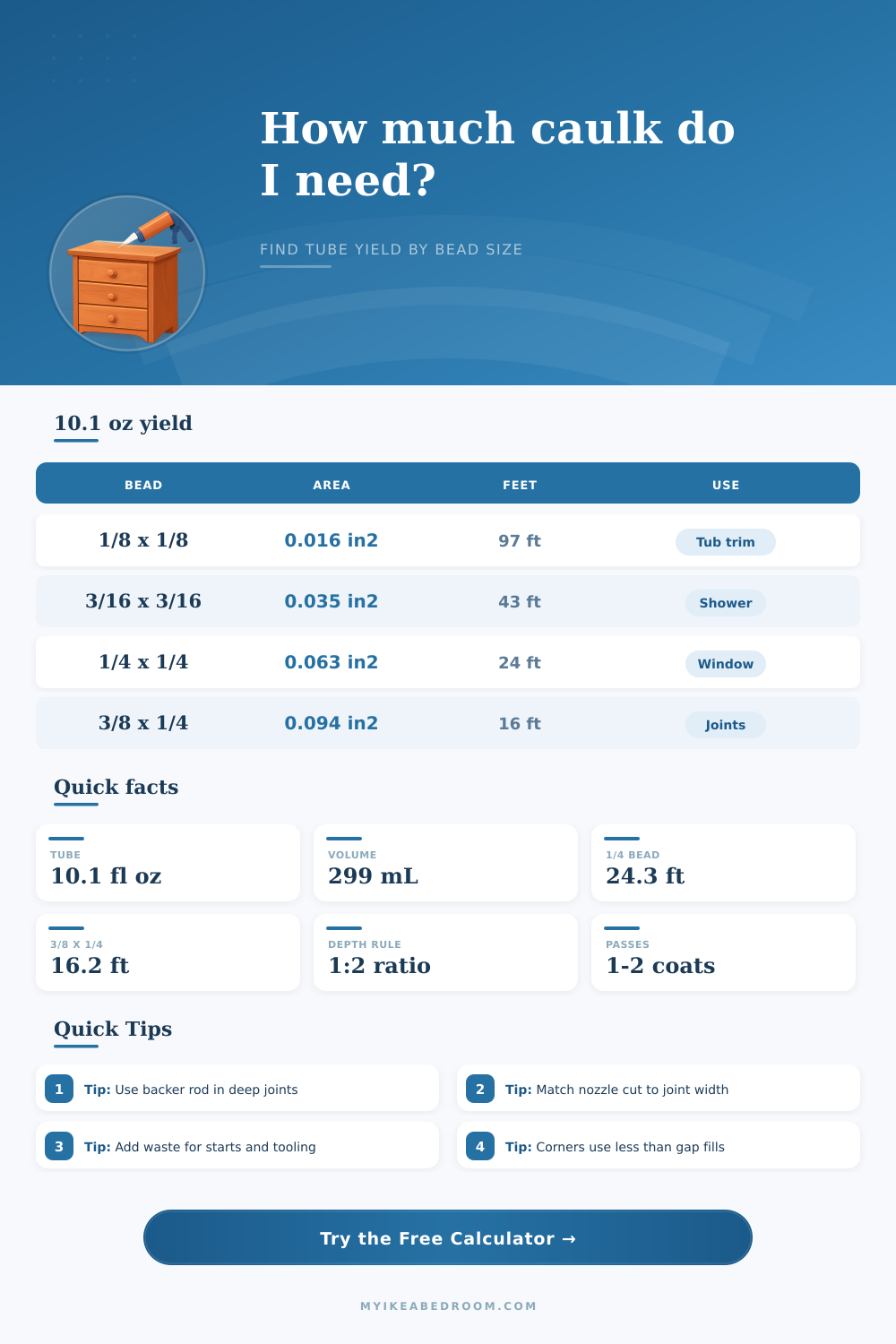
A standard size for sealant tubes is ten point one fluid ounce. This amount of sealant can cover twenty four feet of a quarter inch square bead. However, the same amount of sealant can cover ninety seven feet of an eighth inch bead.
To determine the amount of sealant needed, it is necessary to measure the width of the gap to be sealed. Using this measurement, you will purchase the number of ten point one fluid ounce tubes. Different types of sealant are used in different types of projects.
For instance, silicone sealant is used in wet areas, such as bathrooms. The reason for the use of silicone is that it is water resistant. However, it cannot be painted.
Additionally, acrylic latex sealant is used in interior trim projects. The reason for the use of this type of sealant is because it is easy to clean and tool. However, it doesnt handle movement well.
Hybrid sealants is used in windows and doors because they adhere to many different materials. Polyurethane sealant is used in projects involving masonry and concrete because it can handle a high amount of movement. Each of these sealants can be used for specific projects to ensure that it perform correctly.