📐 Stair framing geometry
Stair Stringer Angle Calculator
Use total rise, total run, tread count, and board depth to check stringer pitch, plumb and level cuts, blank length, and the throat left after each notch.
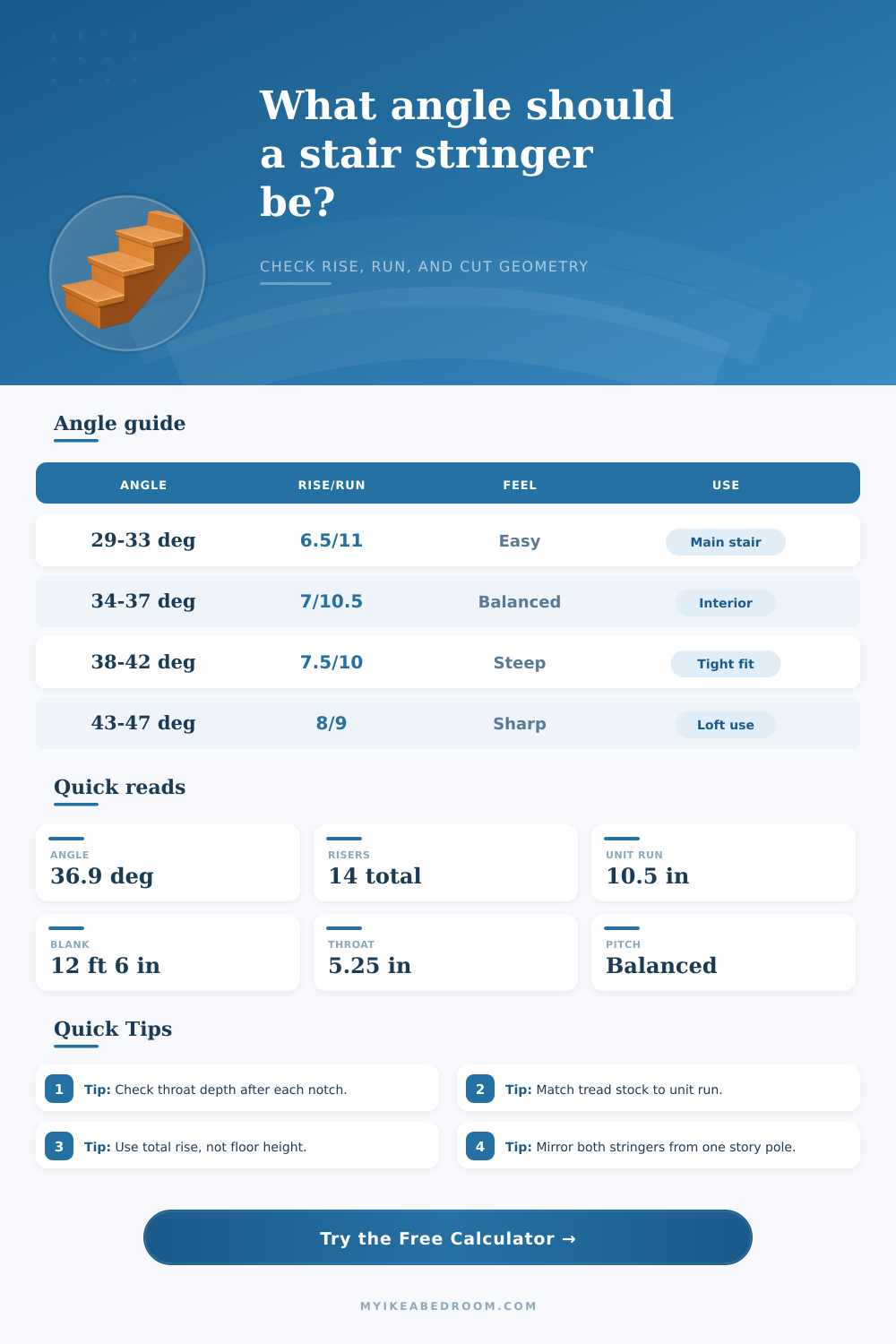
To build a staircase, a person must first determine the angle of the stringer. A person can determine the angle of the stringer by divide the total rise by the total run and calculating the result with trigonometry. Since the angle of the stringer determine how steep the stairs will be, the angle must be chosen carefuly so that the staircase is both safe as well as comfortable for the individual who must use the staircase.
The angle of the stringer for an interior staircase is often 37 degrees, as this angle provide for a balanced riser and tread. In instances, however, where the staircase must be build into a tight space in the structure, a person may choose a steeper angle like 42 degrees. In these instances, however, care must be taken to ensure that the notches cut into the stringer for the treads and risers are not too deep; as any depth into the stringer that reduces the stringer to a throat depth that is too small may lead to the stringer fracturing under weight of the individual using the stairs.
How to Measure and Cut Stair Stringers
To ensure that each step of the staircase are identical to the others, the unit rise and unit run of the stairs must be calculated. The unit rise of the stairs is determined by dividing the total rise of the stairs by the total number of risers; the total number of risers is one more than the total number of treads. The unit run of the stairs is determined by dividing the total run by the total number of treads.
For example, each riser may be 7 inches in height and each tread 10.5 inches in length; these measurements provide for an easy and comfortable stride for those who use the stairs. Any deviation from these measurements may lead to fatigue of the legs or heels that may catch on the stair treads. Another consideration of the staircase is the thickness of the stringer.
For instance, a 2×12 board is actualy 11.25 inches in width. Once you cut notches for the treads and risers, however, the width will be reduce. The throat depth of the stairs must be at least 3.5 inches in depth to ensure the strength of the stringer.
For wider staircases, however, more than one stringer are required. For instance, stairs that are 72 inches in width, for example, will require three stringers so as to distribute the weight of the treads without the treads sag. For cutting the stringers, a framing square can be utilized.
You can set the framing square to the rise and run measurements of the stairs; this will lock in the angle of the stringer. The measurements can first be marked on one stringer; that stringer can then serve as a template to mark the remaining stringers. This template will ensure that each stringer is of the same size; identical stringers will create level and plumb step.
Finally, the finished floor height and headroom must be accounted for in the building of the stairs. The total rise of the stairs must be measured from the finished floor to the finished floor; the thickness of the subfloor, drywall, and carpet will alter the total height of the stairs. If the thickness of the finished floor is not accounted for in the building of the stairs, the risers will not be even.
Furthermore, 6 feet and 8 inches of headroom must be provided above the nosing of the treads; the individual should not hit there head while walking down the stairs. Thus, by following these steps and using these measurements in the building of the staircase, the resulting staircase will be structurally sound and more easy for individuals to climb.