Column sizing for pergola framing
Pergola Post Size Calculator
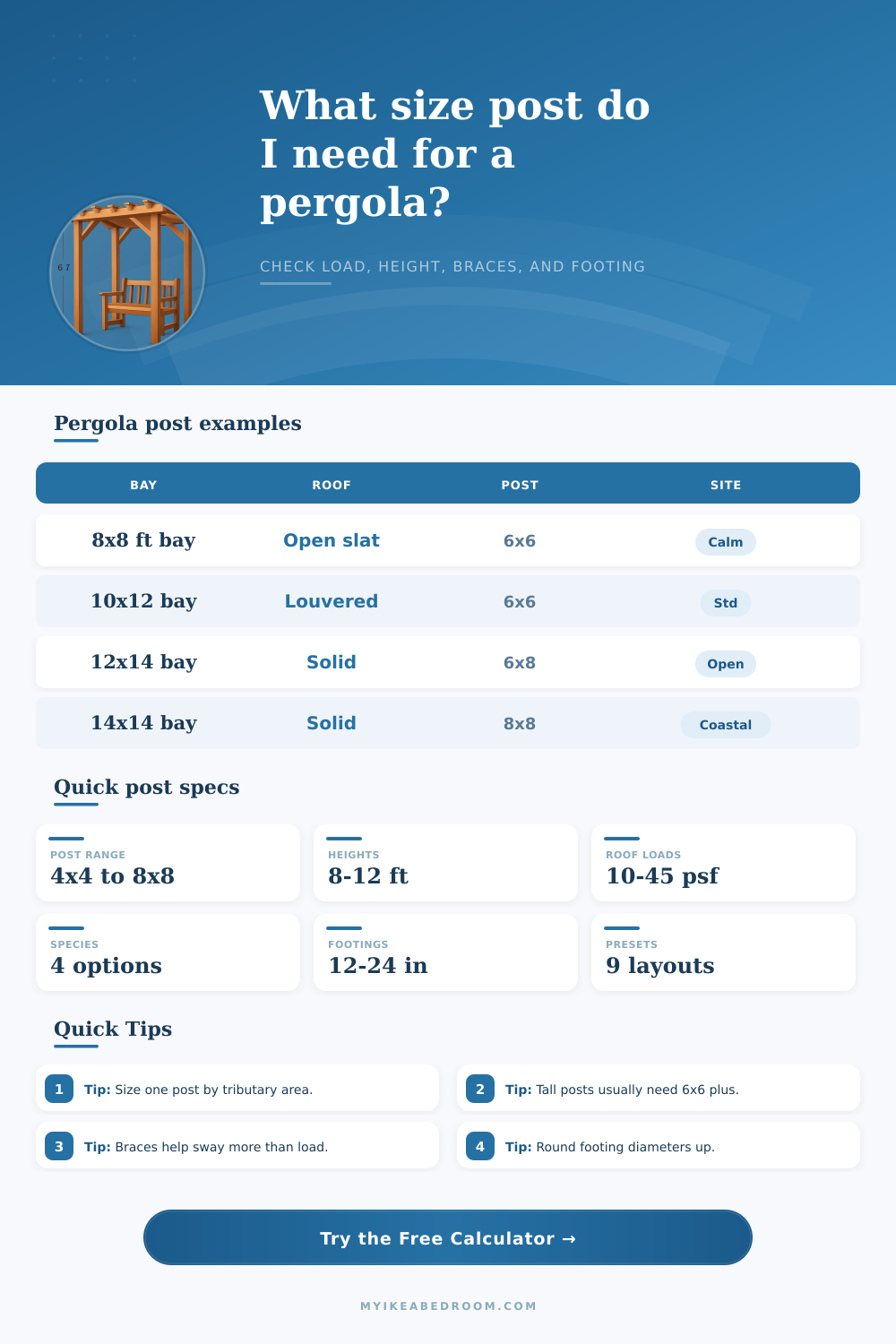
Compare stock post sizes with tributary roof area, clear height, braces, roof dead load, live or snow load, species stiffness, and a footing check sized to the post reaction.
A corner post on a 12 x 12 freestanding pergola usually supports about half the bay in each direction, not the full 144 sq ft roof plan.
Dead load covers roofing, rafters, purlins, and hardware. Live or snow load is the temporary roof load for your local design band.
Reference values below are planning data points used to understand the calculator. Final structural design should still follow local engineering requirements and permit review.
A 12 x 16 pergola can still have small per-post reactions if the load is split across several posts. Tributary width and tributary length are the inputs that matter here.
Compression capacity is rarely the only limit. Tall unbraced posts can feel flexible long before they reach axial capacity, which is why the stability ratio is shown next to the load ratio.
When you build a pergola, you have to ensure that you select the correct size for the pergola posts because the post size will determine the stability of the pergola. The pergola that you build must remain stable so that it does not sway or wobble when the wind hits your pergola structure. There are several factor to consider when you are selecting the size of the pergola posts for your pergola.
The factors include the weight of the pergola roof, the height of the pergola posts, the type of wood that you use in the pergola, and the soil in which the pergola will be built. Additional factors include the tributary area of the pergola roof, the species of the wood, and the footings of the pergola. The first factor to consider when selecting pergola posts is the tributary area.
How to Choose the Right Pergola Post Size
The tributary area is the area of the pergola roof that will place its weight onto the pergola posts. Many individuals may assume that each pergola post will bear the weight of the entire pergola roof. However, this isnt true.
For instance, if the pergola is constructed in a way that each corner of the pergola has its own pergola post, then the area of the roof that each post will bear the weight of is its tributary area. To calculate the total weight of the pergola roof, you will have to calculate the weight of the roof material. If the pergola feature a solid roof, then the roof will be heavier than a pergola that features open slats on the pergola roof.
The heavier the pergola roof, the more weight that will be placed onto the pergola posts. Additionally, the heavier the pergola roof the more wind that will act upon the pergola roof, which will force the pergola posts to exert more force to stabilize the pergola. The second factor to consider when building pergola posts is the height of the pergola posts.
If the pergola features tall posts, then those posts will sway more than pergola posts that are of a shorter height. One way to prevent the pergola posts from swaying too much is to use knee braces. The knee braces will limit the height of the pergollos that are created.
Although the pergola posts may be strong enough to bear the weight that acts upon the posts, the posts may wobble if they are of a tall height. Therefore, another consideration when building pergola posts is the effective height of the pergola posts to ensure that the posts are of a strength that can withstand these force. The third factor to consider when building pergola posts is the species of the wood that you use to build the pergola.
Different species of wood are of different strength and resistance to rot. For instance, cedar is a type of wood that has naturaly rot resistance. However, the wood is softer than other species of wood.
Another type of wood that you can use to build pergolas is pressure treated spruce. This type of wood is stronger than cedar. Additionally, another type of wood that can be used for pergolas is southern pine.
This type of wood is very strong and can support heavy roof for the pergola. Therefore, a pergola builder must consider the weight of the pergola roof and the environment of the yard when selecting the type of wood for the pergola. The fourth factor to consider when building pergola posts is the soil in which the pergola is to be built.
The type of soil will affect the footings that hold the pergola posts into the ground. For example, if the soil in the yard is soft clay, it may not be able to support the weight of the pergola and its posts as well as the ground that features dense gravel can support the posts. The footings for the pergola posts must be dug beneath the frost line of the yard.
This is necessary for the footings to be dug beneath the frost line to prevent the frost in the ground from pushing the footings of the pergola posts out of the ground. Additionally, if the footings are too short to act as the proper support structure for the pergola, the wind may lift the pergola out of the ground. Finally, one of the mistakes that you should of avoid when building pergola posts is to only calculate the compression that will act upon the posts.
The force of the roof acting downwards upon the posts is the compression force. However, you must also calculate the lateral force of the wind pushing against the sides of the pergola posts. If the posts are too slender, they will buckle in a way that the posts are too weak to defend against the lateral force of the wind.
The posts must be constructed to be of a thickness that can handle the compression and lateral force of the pergola roof. By avoiding these mistake and following these steps, pergola builders will be able to create pergolas that have the correct size of posts so that the pergola will remain stable and remain still in the yard.