Loose-fill attic planning
Cellulose Attic Insulation Calculator
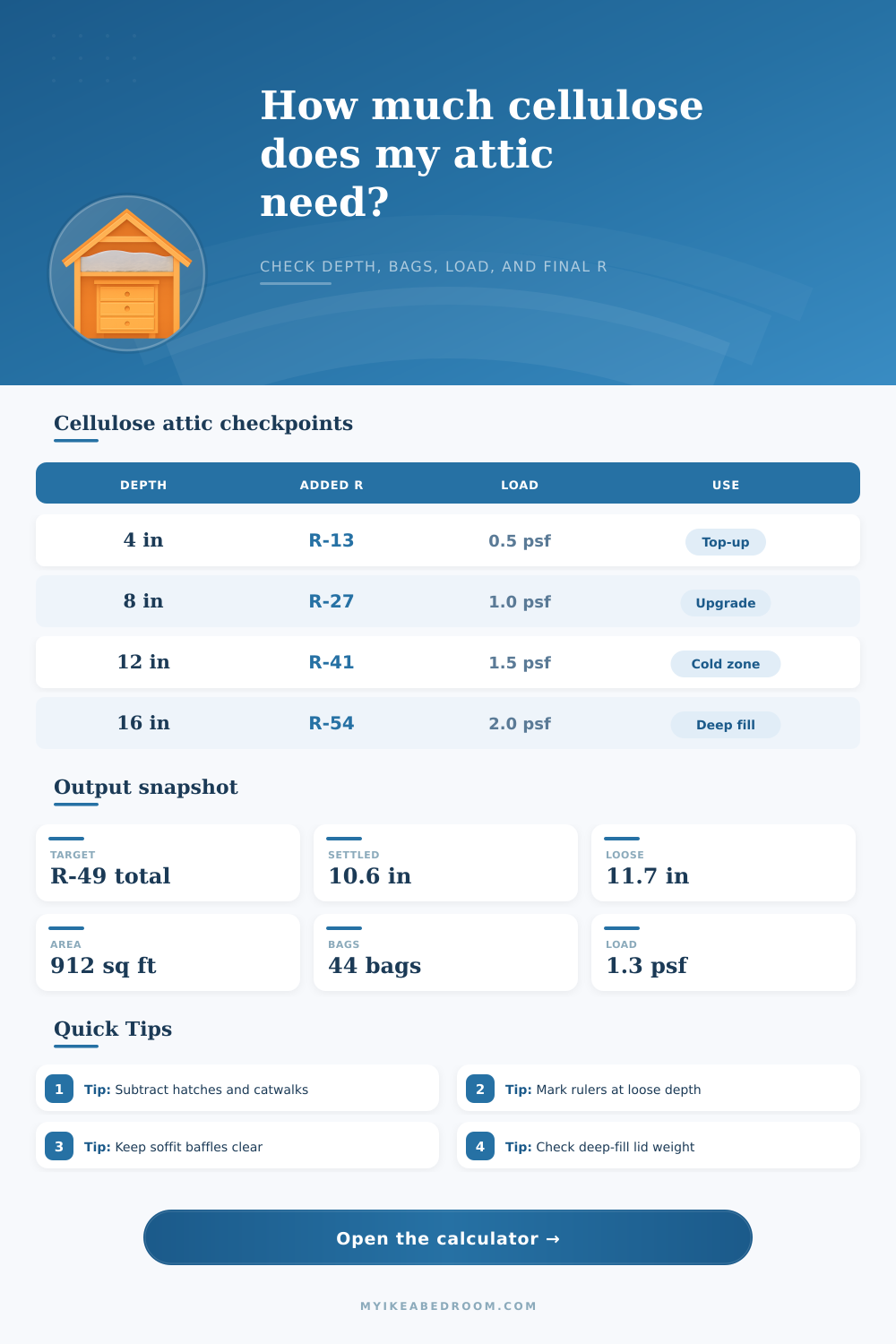
Estimate net fill area, added R-value, settled blanket depth, loose ruler height, bag count, and attic load for blown cellulose without mixing in cost assumptions.
Preset attic scenarios
Cellulose planning inputs
Attic cellulose results
Area geometry
Thermal target
Install planning
Material comparison grid
Standard loose-fill cellulose
R per inch: 3.2
Settled density: 1.5 lb/ft3
Bag weight: 25 lb
Best fit: Typical attic top-ups where ruler height and bag count can be straightforward.
Premium low-dust cellulose
R per inch: 3.4
Settled density: 1.45 lb/ft3
Bag weight: 30 lb
Best fit: Attics where a slightly thinner blanket helps around shallow framing and mechanical runs.
Low-settle stabilized cellulose
R per inch: 3.6
Settled density: 1.7 lb/ft3
Bag weight: 30 lb
Best fit: Colder attics chasing higher R-values with a tighter loose-to-settled spread.
Loose-fill fiberglass context
R per inch: 2.5
Settled density: 0.5 lb/ft3
Bag weight: Varies
Best fit: Comparison only, showing why cellulose usually reaches the same R-value with less depth.
Reference tables
| Climate band | Typical attic target | Approx. settled cellulose depth | Planning note |
|---|---|---|---|
| Zone 1-2 | R-30 to R-38 | 8.3 to 10.6 in | Warm and hot attics often start here. |
| Zone 3 | R-30 to R-49 | 8.3 to 13.6 in | Mixed climates can swing between cooling and heating priorities. |
| Zone 4 | R-38 to R-60 | 10.6 to 16.7 in | Common retrofit range for four-season homes. |
| Zone 5-8 | R-49 to R-60 | 13.6 to 16.7 in | Cold-weather lids usually need a deeper blanket. |
| Blend | R per inch | Settled density | Bag weight | Field use |
|---|---|---|---|---|
| Standard | 3.2 | 1.5 lb/ft3 | 25 lb | Balanced open-attic top-ups. |
| Premium | 3.4 | 1.45 lb/ft3 | 30 lb | Lower dust and slightly thinner coverage. |
| Borate retrofit | 3.3 | 1.5 lb/ft3 | 25 lb | Good match for topping older attic layers. |
| Stabilized | 3.6 | 1.7 lb/ft3 | 30 lb | Deep blankets with lower settling drift. |
| Settled depth | Added R at 3.2 per inch | Load at 1.5 lb/ft3 | Install readout |
|---|---|---|---|
| 4 in | R-12.8 | 0.50 psf | Light refresh layer. |
| 8 in | R-25.6 | 1.00 psf | Common whole-attic top-up depth. |
| 12 in | R-38.4 | 1.50 psf | Cold-climate retrofit blanket. |
| 16 in | R-51.2 | 2.00 psf | Deep fill that merits lid and vent checks. |
| Existing layer | R per inch | Depth clue | Why it matters |
|---|---|---|---|
| Bare ceiling | 0.0 | No blanket | All target R must come from new cellulose. |
| Fiberglass batts | 3.1 | Defined joist bays | Often performs below label when compressed or gapped. |
| Loose fiberglass | 2.5 | Fluffy blanket | Needs more depth for the same R-value. |
| Older cellulose | 3.0 | Settled paper fiber | Top-ups should account for the settled starting layer. |
| Mineral wool | 3.3 | Dense fibrous mat | Higher starting R can reduce new bag count. |
When you are planning to insulate the attic, you first need to calculate the net area of the attic. The net area is the total area of the attic minus the area that dont require insulation. These area can include hatches, catwalks, and HVAC systems.
Any areas that do not require insulation should be subtract from the total area of the attic. Otherwise, you will purchase too much cellulose insulation for the attic; you dont want to buy bags of cellulose that you wont be able to use. Cellulose insulation is made from recycled paper.
How to Measure and Install Cellulose Insulation in Your Attic
The cellulose acts as an effective form of insulation for the attic space. However, cellulose can settle over time. When you blow cellulose into an attic, the cellulose is initial fluffy.
However, the cellulose will settle over time to form a more denser material. Because of this settling of the cellulose, you must blow the cellulose to a greater depth then the desired depth of the cellulose once it has settled. For instance, if the desired depth of cellulose is 10 inches once the cellulose has settled in place, the cellulose may need to be blown to a depth of 11 or 12 inches when blown into the attic.
Next, the weight of the cellulose must be consider. Any cellulose blown into the attic will add to the weight of the ceiling. If the cellulose is too heavy for the ceiling structure, the ceiling may break or sag.
You can calculate the total weight of the cellulose by multiplying the area of the attic by the weight of the cellulose per square foot. If the attic has plaster ceilings (as might be true of an older house), extra care should be taken to ensure the ceiling can support the cellulose insulation. The R-value of the cellulose insulation determine the ability of the cellulose to insulate against heat flow.
The R-value requirements for attics can differ according to a climate. In colder climates, higher R-values are required. For instance, R-49 or R-60 insulation values are required in colder climates.
In warmer climates, an R-30 insulation value may be sufficient. These values do not have to be calculated if there is old fiberglass or cellulose insulation already present in the attic; the existing insulation will impact the total R-value calculations. When measuring the attic, use a laser measure or tape measure to determine the total dimensions of the attic floor.
Make sure to carefully measure the attic; using incorrect measurements will lead to purchasing the incorrect number of bags of cellulose insulation. Many people makes the mistake of measuring the gross area of the attic rather than the net area. If you measure the gross area of the attic, the area for the vents and hatches will be included in the measurements.
By using the gross area rather than the net area, people will end up purchasing too many cellulose for the attic. Additionally, ensure that the cellulose will not cover the soffit vents or vent baffles; if the cellulose does cover these vents, there will be issue with the attic regarding heat and moisture. Finally, ensure that there is a waste allowance for the cellulose insulation.
The waste allowance is the additional bags of cellulose that are purchased beyond the amount needed for the attic to be insulate. These extra bag are purchased to account for any spillage of the cellulose during installation. If you dont purchase extra bags of cellulose, you may run out of cellulose before the attic insulation is complete.
You need to have enough cellulose for the job to be completed without having to cease work to order more cellulose. By considering the net area of the attic, the settling of the cellulose, the weight of the ceilings, the R-value of the cellulose, the size of the attic, and the waste of the cellulose, you can successfully insulate the attic in your home.