MyIKEABedroom Entry Lighting Planner
Foyer Chandelier Size Calculator
Balance the foyer footprint, ceiling height, and circulation path so your chandelier feels intentional from the front door, staircase, and upper landing.
This calculator blends the classic room-dimension rule with a foyer-specific width cap, door-scale anchor, and placement-based hanging zone. It works for both single-story entry halls and open two-story foyers.
Use the presets for quick starting points, then fine-tune the profile and visual presence until the diameter, fixture body, and drop all align with your space.
Preset Foyers
Each preset loads realistic foyer dimensions, placement assumptions, and a fixture profile that suits the architecture.
Foyer Inputs
Recommended Chandelier Range
Scale Breakdown
Hanging Breakdown
Reference Tables
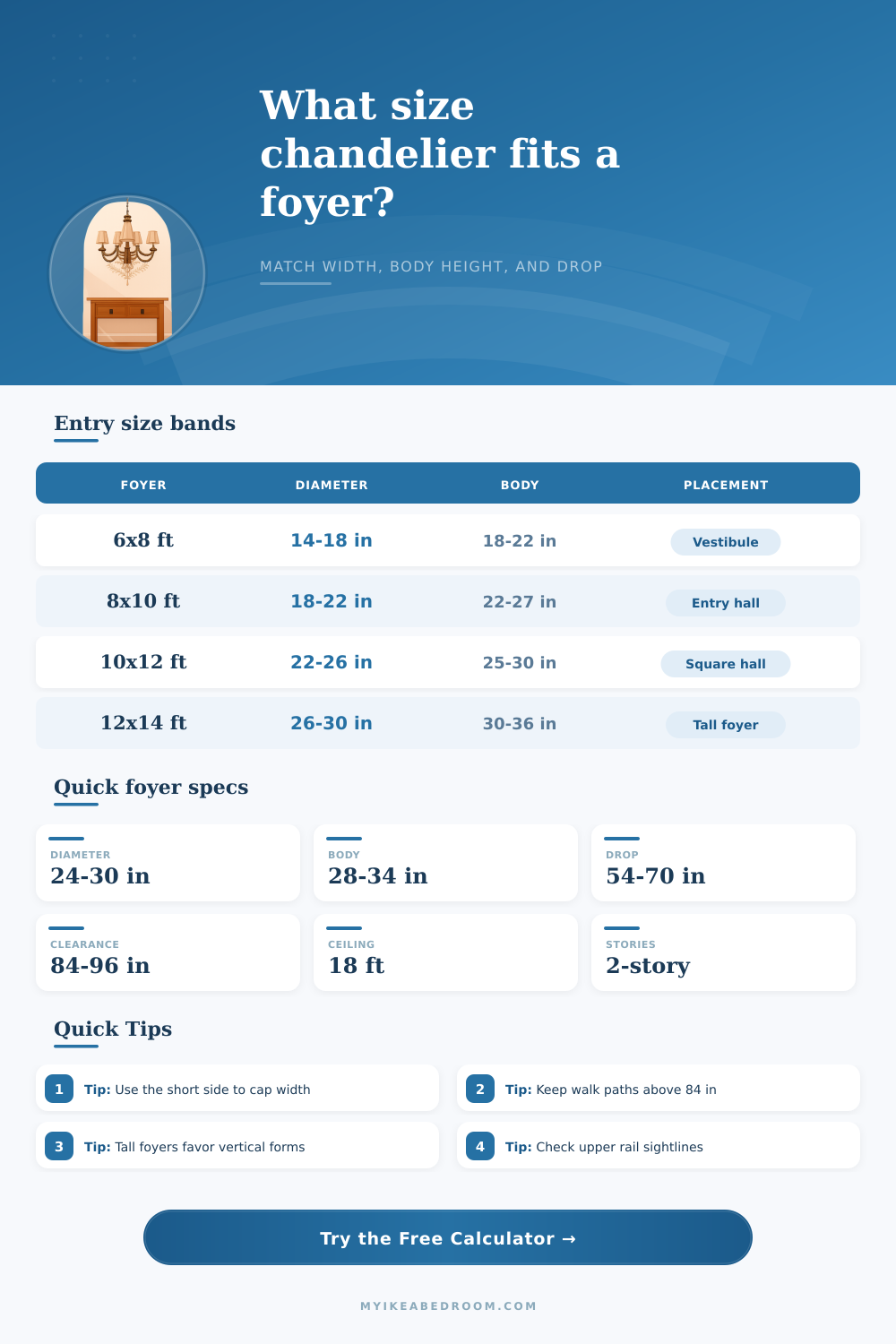
Foyer Plan Size to Diameter
| Foyer size | Diameter | Profile | Use case |
|---|---|---|---|
| 6 x 8 ft | 14-18 in | Drum | Small vestibule |
| 8 x 10 ft | 18-22 in | Lantern | Standard entry |
| 10 x 12 ft | 22-26 in | Candle | Square foyer |
| 12 x 14 ft | 26-30 in | Tiered | Larger hall |
| 14 x 16 ft | 30-36 in | Cascade | Grand opening |
Ceiling Height to Fixture Body
| Ceiling | Body height | Mounting | Notes |
|---|---|---|---|
| 8 ft | 18-22 in | Short stem | Keep it shallow |
| 9 ft | 22-27 in | Stem or chain | Most entries |
| 10 ft | 25-30 in | Stem or lantern | Open sightline |
| 12 ft | 30-36 in | Tall lantern | Open stair hall |
| 18 ft | 42-54 in | Tiered or cascade | Two-story foyer |
Bottom Clearance by Placement
| Placement | Bottom band | Best for | Reason |
|---|---|---|---|
| Walk path | 84-90 in | Single-story | Head clearance |
| Entry table | 66-72 in | Console below | Decor focal point |
| Two-story void | 90-110 in | Open volume | Mid-height view |
| Stair overlook | 45-55% | Upper landing | Visible upstairs |
Profile Depth and Light Spread
| Profile | Body depth | Light feel | Best foyer |
|---|---|---|---|
| Drum | 12-18 in | Soft downward | Modern entry |
| Lantern | 20-36 in | Balanced spread | Classic hall |
| Candle arms | 18-30 in | Airy and open | Sightline focus |
| Tiered crystal | 28-48 in | High sparkle | Formal foyer |
| Cascade | 36-72 in | Vertical drama | Tall volume |
Material and Spec Comparison Grid
Blackened Iron
Visual weight: Bold outline
Light character: Defined arms and shadows
Best body: 22-40 in
Best for: Farmhouse and industrial foyers
Aged Brass
Visual weight: Warm but light
Light character: Soft reflection
Best body: 20-36 in
Best for: Transitional and classic entries
Crystal Glass
Visual weight: Light by day, dense at night
Light character: High shimmer
Best body: 28-60 in
Best for: Formal tall foyers
Wood Bead
Visual weight: Soft texture
Light character: Diffused glow
Best body: 18-34 in
Best for: Coastal and relaxed entries
Designer Tips
Use profile to solve width limits
If the foyer width cap trims your diameter range, choose an open candle or lantern profile before shrinking the chandelier too far. Open shapes read lighter while still holding presence from the curb and staircase.
Check the upper landing view
In a two-story foyer, stand at the second-floor rail and at the front door. The fixture should feel centered in both views, with enough drop to occupy the volume but not so much that the top disappears into the ceiling line.
When you are selecting a chandelier for your foyer, you must consider its scale relative to the foyers dimensions. A chandelier that is too small will look insignificant in your foyer. A chandelier that is too large for the foyer will dominate the space and may even interfere with people moving through the foyer.
The chandelier you choose should be sized to appropriately anchor the foyer without overwhelming the space. Many people use a rule of thumb that suggest that the size of the chandelier in feet should be the sum of the foyers width and length in feet, and the result should be in inches the diameter of the chandelier. This is a rule of thumb used most for dining rooms and may not accuratly reflect the sizing needed for foyers.
How to Choose the Right Chandelier for Your Foyer
To calculate the diameter of the chandelier for your foyer, measure the shortest wall to wall dimension and subtract space needed for trim or movement. Consider the width of the front doors of your foyer in your calculations. Chandeliers for six-foot wide doors are smaller than those needed for double doors of the same width.
The height of the ceiling of your foyer will also impact the type of chandelier you should select. Foyers with nine-foot ceilings often use chandeliers with shallow chandelier bodies of around twenty-four inches in height. The bottom of the chandelier should hang eighty-four inches from the floor.
In a foyer with two story ceilings of eighteen feet or more in height, you may select chandelries with longer bodies. Chandeliers with tiered or cascade chandelier bodies of three feet or more in height are appropriate for foyers with high ceilings. These types of chandeliers should be centered on one of the foyers walls to ensure the chandelier visually balance within the foyer.
Another consideration in hanging your chandelier is the placement of the chandelier in the foyer. If your foyer features a walking path through the foyer, ensure that the chandelier allows for at least eighty-four inches of head room for those of tall stature. Place chandeliers lower, around seventy inches above the floor, if the chandelier will be above a console table or similar piece of furnitures not used for walking through the foyer.
Place chandeliers with open profiles, such as candle arm chandeliers, if you plan to align the chandelier with a staircase to avoid visually blocking the staircase. The size of the chandelier relative to the foyer can have a huge impact on the visual appearance of the foyer. In an understated foyer, a chandelier that is ten percent smaller than the calculated scale of the foyer may be better for the space.
Choose a statement chandelier if you have a high volume foyer that you would like the fixture to dominate visually. Allow for at least eighteen inches of space between the chandelier and the foyer wall to avoid a visually too-crumpled foyer. A common mistake in chandelier selection is to choose one that is too large for the foyer.
This will force individuals to move around the chandelier to avoid it. Another common mistake is to choose a chandelier that is too small for the foyer to visually suit the architectural features of the foyer. Ensure that when hanging the chandelier, you dont place it so close to the ceiling that when viewed from the upstairs landing, the chandelier appears too small in the foyer.
The material of the chandelier can also change the visual appearance of your foyer. Chandeliers with blackened iron elements are perfect for farmhouse styles. Aged brass chandeliers reflect the rooms light and are great for more transitional styles.
Crystal chandeliers add sparkles to formal foyers. Wood bead chandeliers provide a soft texture to coastal homes. Make sure the material of your chandelier matches the profile of your chandelier.
One way to test the size of a chandelier prior to purchase is to use mockups. Tape a ring of cardboard to the ceiling to represent the chandeliers diameter. Stand back from the foyers doorway and climb the stairs to visually assess whether the chandelier mock-up is to scale to your foyer.
Use reference bands of chandelier size to help you select the proper size for your foyer. For example, a six-by-eight-foot vestibule may require a chandelier with a drum in the range of fourteen to eighteen inches in diameter. A grand foyer that measures fourteen by sixteen feet may require a thirty-six-inch cascade chandelier.
These techniques would of helped you to ensure that the chandelier you purchase is the correct size for your foyer.