Blade Height Planning
Ceiling Fan Downrod Length Calculator
Estimate a practical downrod by balancing preferred blade height, ceiling-to-blade clearance, sloped-ceiling geometry, and the space above tall furniture.
Presets use common residential fan geometry. Always confirm your fan's own canopy-to-blade measurement before ordering a rod.
Calculation breakdown
Room inputs
Drop geometry
Fit checks
Most residential fans use threaded steel downrods sized to the motor yoke. Match the thread type and diameter to the fan maker before buying extensions.
A downrod is the metal pole that connects the ceiling fan to the ceiling. The length of the downrod will determine the height of the ceiling fans. The higher the ceiling fan will be, the more air it will move in the room.
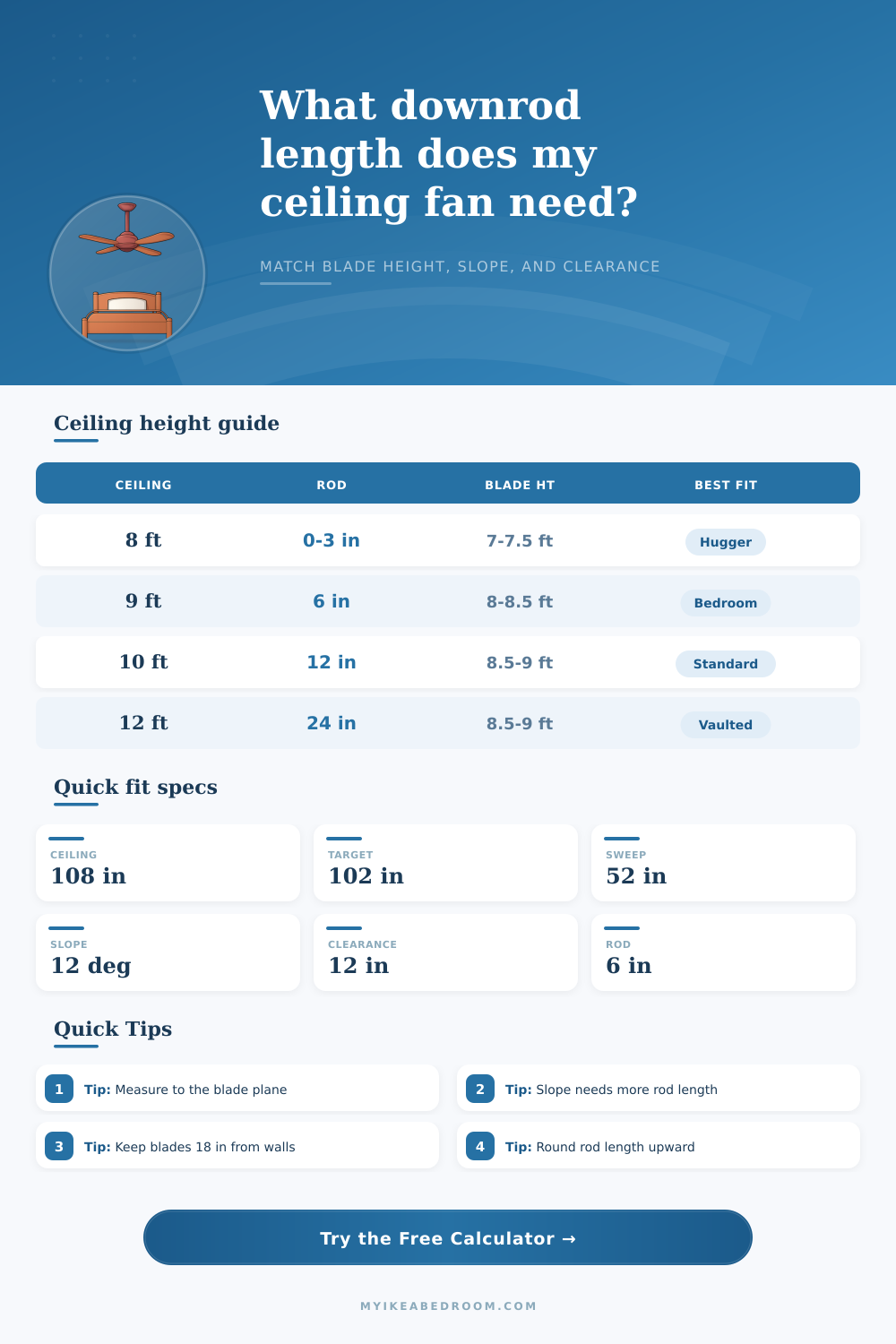
If the downrod is too short, the ceiling fan may be too close to furniture or too close to an individual head. If the downrod is too long, the ceiling fan may be too far from the floor and the air will not be able to reach the individual in the room. Most rooms should have the ceiling fan blade between 8 feet 5 inches and 9 feet above the floor.
How to Choose the Right Downrod for Your Ceiling Fan
This height is use in most cases to allow the ceiling fans to move the air in the rooms effective. If the room ceilings are 8 feet high, ceiling fans come with flush mount hardware. For rooms with ceilings higher than 8 feet, however, you must use an extension downrod.
An extension downrod is also needed for rooms with slope ceilings. Using the incorrect downrod may cause the ceiling fan to wobble or may prevent it from moving the proper amount of airs. The pitch of the ceiling is the angle of the ceiling.
For flat ceilings, the total height of the ceiling minus the desired height of the blades can calculate the length of the downrod. For sloped ceilings, however, the low side of the slope may bring the ceiling closer than the ceiling fan. You must use an extension downrod for sloped ceilings to ensure the ceiling fan does not hits the ceiling.
The design of the ceiling fan also play a role in the length of the downrod that is required. Most ceiling fans have a distance between the canopy and the blades that is between 9 and 14 inches. If the ceiling fan has a light kit attached to it, the blades will add another 6 to 10 inches to the total length.
Since ceiling fans are not all the same, it is necessary to measure the dimension of the ceiling fan that is to be installed. Additionally, if the ceiling fan has a wide blade sweep, it might require a longer downrod if the ceiling are sloped. The amount of furniture in the room may also impact the height of the ceiling fans.
For example, if there is a wardrobe or entertainment center in the room, there must be at least 18 inches between the ceiling fan and the furniture. This provides clearance for the ceiling fans blade to rotate without hitting the furniture. If the furniture in the room is too tall for the desired ceiling fan height, a longer downrod may be necessary.
The type of mount for the ceiling fan can determine the ceiling’s pitch. For instance, flat canopies are design for ceilings with a ceiling pitch of no more than 12 degrees. For ceilings with a pitch of 27 degrees or less, ceiling fans can have angled adapters; however, the downrod must be at least six inch long.
For ceilings that are very steep, however, you will need to install a specialized downrod kit. These kits are at least 12 inches in length and allow the ceiling fan to pivot on the ceiling mount. Using the incorrect mount for the ceiling may cause the ceiling fan to vibrate or the blades may binds to the ceiling.
Some ceiling fans come with presettings for different downrod lengths. For instance, for a bedroom with a 9-foot ceiling and a 52-inch ceiling fan, a 6-inch downrod will position the ceiling fan blades to 8 feet 4 inches above the floor. For a vaulted attic with a 12-foot ceiling, setting the downrod to 24 inches will allow the ceiling fan to remain proportional to the vaulted ceiling.
These are not rules for all individual and all rooms; however, they can be utilized as examples of how presettings for downrods may work within a ceiling. The length of the downrod that should be purchased can be calculated by comparing the desired drop to the minimum safe drop. The desired drop is the total height of the ceiling minus the desired height of the blades.
The minimum safe drop is the ceiling clearance for the ceiling fan plus the length need for the slope of the ceiling. Each of these should be calculated, then the higher number should be chosen. After the higher number is chosen, however, you must subtract the canopy drop and the motor drop from this number.
Finally, the resulting number must be rounded up to the nearest standard length for downrods, such as 3 inch or 6 inch. Beyond calculating the proper length of the downrod, it is also necessary to ensure that the downrod is of the correct material. A half-inch threaded steel downrod is the lightest option and is suitable for small ceiling fans.
For medium-sized ceiling fans, however, a three-quarter-inch downrod is recommend. For ceiling fans that are to be installed on covered porches, a coated downrod is the best choice to protect the ceiling fan from dampness in the covered area. Lastly, the diameter of the downrod and its thread size must match the specification of the ceiling fans yoke.
The wrong size of downrod will prevent the downrod from being connected to the ceiling fan. Some individuals may make mistake when installing a downrod. For example, they may refer to the measurements in the brochure for the ceiling fan but will forget that the measurements are for the total length of the ceiling fans.
The measurement of the ceiling fan to the walls should also be consider. There should be at least 18 inches between the blades of the ceiling fan to the walls in the ceiling. Prior to installing the downrod, hanging a string from the ceiling to the floor to mark the desired height of the blades from the floor can verify the measurements of the ceiling.
This will ensure that the measurements is correct prior to the installation. The goal of installing the downrod correctly is to allow the ceiling fan to effectively move air in the room. In a room that has bunk beds, for instance, the ceiling fan should be installed such that the ceiling fan blades do not come in contact with the bed.
In a large room, the ceiling fan may need to be installed higher in the ceiling to allow the ceiling fan to effectively circulate the air for the entire volume of the room. In a reading nook that has a sloped ceiling, the downrod must be adjusted for the pitch of the ceiling. The proper length of downrod will allow the ceiling fan to move air effective throughout the room.