Ceiling grid planning
Drywall Grid Calculator
Estimate board sheets, suspended mains, cross tees, hanger wires, perimeter angle, and border cuts for gypsum ceiling grids before layout starts on site.
Board layout breakdown
Grid hardware breakdown
When you are installing a suspended drywall ceiling, you must plan the grid layout to ensure the ceiling remains flatly. A suspended drywall ceiling include a metal grid, hanger wires, and drywall boards. The metal grid includes main tees, cross tees, and perimeter angle locks.
Main tees provides the primary support of the metal grid. Cross tees connect to main tees and create a series of square or rectangles within the metal grid. You must space main tees correctly to allow drywall board to be fastened securey to the metal grid.
How to Plan and Install a Suspended Drywall Ceiling
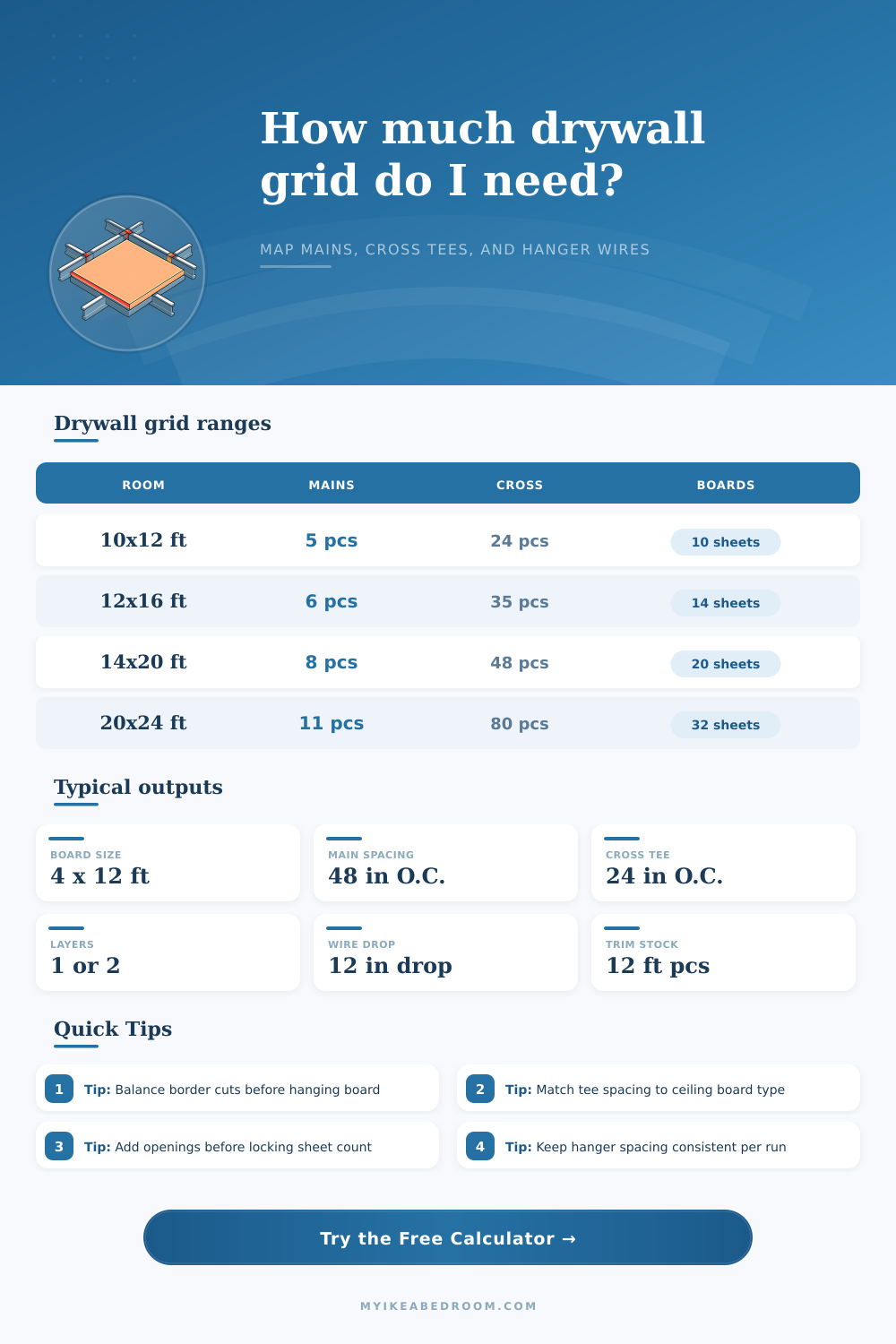
Main tees is typically placed 48 inches apart on center because the standard width of a drywall board is 48 inches. Cross tees are placed at 16 or 24-inch interval along the main tees. Cross tees provide drywall boards more area to be fastened to the metal grid.
Using cross tees at 16-inch intervals will allow the metal grid to be more stronger but will require the use of more cross tees. Hanger wires connects the metal grid to the structure above the suspended drywall ceiling. The spacing of the hanger wires needs to be frequently spaced to distribute the weight of the metal grid and the drywall boards.
If the metal grid and drywall boards is too heavy for the hanger wires, the ceiling may sag or sway. The dimensions of the room will dictate the layout of the metal grid. The metal grid should be centered in the room to ensure the perimeter edges of the ceiling are even.
If the metal grid is not centered in the room, there may be issue with the drywall boards that must cover the borders of the ceiling. Borders of drywall that are too narrow may break during installation since narrow drywall is more difficultly to fasten to the metal grid. Calculating the width of the borders prior to installation will help determine if the metal grid should be shifted to allow the borders to be of a more even width.
The type of drywall that you will use will impact the weight of the drywall ceiling. 1/2-inch drywall is lighter than 5/8-inch Type X drywall. The 5/8-inch Type X drywall will place more stress on the metal grid and hanger wires due to it’s greater weight.
The use of 5/8-inch Type X drywall will require more hanger wires or the wires should be spaced closer together. Additionally, if you will use moisture-resistant drywall, the ceiling will be heavier, so the metal grid and hanger wires will need to be calculated for the additional weight. Openings will be made in the drywall ceiling for various item such as exhaust vents or ceiling lights.
The area taken up by these openings will reduce the total area of drywall that will be required. The layout of the metal grid must also be adjusted according to these openings. The edges of the drywall openings must align with the metal grid for support.
Waste will be created when you cut drywall boards to fit the borders of the suspended drywall ceiling. Eight percent waste should of been added to the total amount of drywall boards that will be ordered. If there are many corners or obstructions in the area to be covered by the drywall, there may be additional waste beyond the eight percent allowance.
The linear footage of the perimeter angle locks should be calculated based off the dimensions of the room that will be covered by the drywall ceiling. Additionally, extra length for the perimeter angle locks should be purchased to account for the corners of the room. A plan should be created for the installation that includes the total area of the drywall ceiling, the number of main tees that will be used, the number of cross tees that will be used, the number of drywall boards, and the number of hanger wire.
The plan will help to avoid mistake during installation. Ensuring the metal grid is level and the drywall suspension wires are secure will result in a flat drywall ceiling with drywall boards that are properly support.