🛠 Stair layout planning
Alternating Tread Stair Calculator
Size compact alternating steps, pitch, floor run, and assembly weight for loft access, mezzanines, and steep space-saving stairs.
Average module weights are shown per cubic yard so the density spread is easy to compare at a glance.
Use these tables to sanity-check the stair geometry, stock size, and tread pitch before you cut.
Alternating tread stairs are a specific type of stairs design that is used to save floor space in tight areas of a building. An alternating tread stair is designed such that each step in the stair have either a wide tread or a narrow tread. Because the treads in each stair alternate in width from step to step, the alternating tread stair has a smaller footprint than a standard stairway.
Alternating tread stairs is often used to provide access to lofts, workshops, or other attic areas within a building. The basic design of an alternating tread stair incorporates a pattern of wide and narrow treads of even size within each “module” of the stairs. Each module consist of one step with a wide tread and one with a narrow tread; the wide tread allow for one’s foot to land on the stair, while the narrow tread allow for the next step to be walked upon.
Alternating Tread Stairs: How They Work and Stay Safe
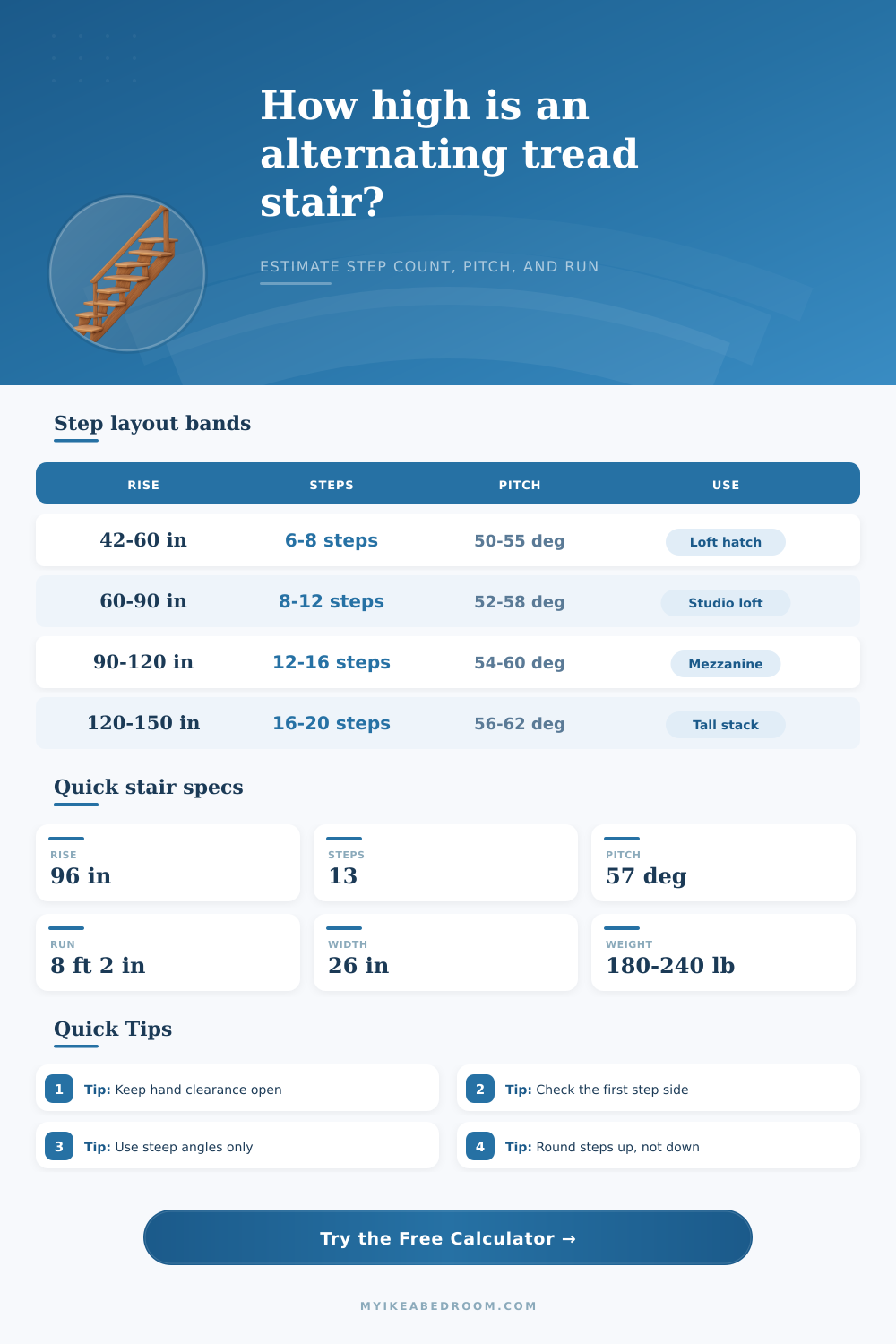
Because the builder constructs alternating tread stairs in these modules, the pitch of the alternating tread stair is steeper than stairs that is constructed in a standard pattern. Alternating tread stairs have a slope angle that range from 55 to 62 degrees. Because of the steepness of these angles, alternating tread stairs are typically only used for secondary access into the floors of a building; alternating tread stairs isnt recommended for main floors of a building.
Before constructing an alternating tread stair, one must calculate the rise of the alternating tread stair. The rise is the total vertical distance between the lower floor and the upper floor of the building. The number of risers on the stair will divide the rise to determine the height of each riser; individuals should aim to make each riser the same height to ensure that the alternating tread stair is safe to walk upon.
The total number of modules for the alternating tread stair will be one fewer than the total number of risers; the final module will connect to the landing on the top floor of the building. Through calculating the rise and the number of modules needed for the alternating tread stair, an individual can ensure that the footprint of the alternating tread stair will remain small. An individual must also decide whether the alternating tread stair will be a left-first or a right-first stair.
A right-first stair will have wide treads that are positioned to allow an individual to place their feet on each step if the stair is on the left side of the individual. A left-first stair will have wide treads that are positioned to allow an individual to place their feet on each step if the stair is on the right side of the individual. Each of these designs will have a different headroom on the top of the alternating tread stair; the stair will be constructed to allow an individual to walk through it and not hit their head.
The width of the alternating tread stair will be between 26 and 36 inches. The materials that will be used to construct the alternating tread stair will impact the weight of that structure. Wood species that is often used to construct alternating tread stairs include Douglas fir, southern pine, and cedar.
Douglas fir and southern pine are common due to their density and strength as wood species; cedar is often used as it is lighter than other woods. The person will calculate the total weight of each stair by multiplying the volume of the wood that will be used by the density of each of the wood species. Add an additional 10% to 15% to this calculation to account for any wood waste that will be created in the construction of the alternating tread stair.
Safety regulations must be read and followed when constructing an alternating tread stair. The nosing of the first step must be constructed to provide proper clearance for an individual to walk over the edge of that tread without tripping. The nosings of each tread should be rounded to prevent any injury should an individual walk over one of those rounded edges.
A handrail must be installed along the open side of the alternating tread stair. Finally, the headroom for the structure must be measured to ensure that an individual will not hit their head on the stair while walking up or down the alternating tread stair. An alternating tread stair is a helpful structure that can be used to maximize the available space in small buildings or areas within a building.
Because alternating tread stairs use alternating wide and narrow treads, there is less floor space that are required for the stairs to be constructed. By carefully planning the rise, modules, start side, and material that will be used to build the alternating tread stair, an individual can create a structure that is both functional as well as practical for allowing individuals to access their loft or workshop. By following these steps and planning careful, an individual can successfully construct an alternating tread stair that will provide a helpful way to access the area within the building.