🏗 Concrete Coverage Calculator
Estimate slab volume, bag counts, coverage, and weight for patios, footings, pads, and walkways with imperial or metric inputs.
📋Project presets
🔧Calculator inputs
📊Material weight grid
📋Reference tables
💡Practical tips
📈Calculation results
To calculate the amount of concrete needed for a project, a person must calculate the volume of the project. To calculate the volume, a person must multiply the surface area by the depth of the required concrete. The surface area is the area that the concrete will cover, and the depth is the thickness of the poured concrete.
If a site include holes for trees or posts, a person must calculate the volume of those holes and subtract that number from the total volume. The thickness of the poured concrete is essential for concreting projects as it determine the amount of weight the poured concrete can bear. For example, a person might use four inches of thickness for a walkway but use six inches or more for a driveway that must bear the weight of heavy trucks.
How to Figure Out How Much Concrete You Need
If the thickness is too thinly for the project, the poured concrete might crack due to soil settling or frost. Thus, a person must choose the thickness appropriately for the use of the poured concrete. The shape of the concreting project affects how a person calculates the surface area.
For instance, a person has to multiply the length by the width of the area for a rectangular project. For circular projects, the diameter must be used in the calculation of the area. For instance, for a circular fire pit, a person has to use the diameter in the calculation of the area that will be covered with poured concrete.
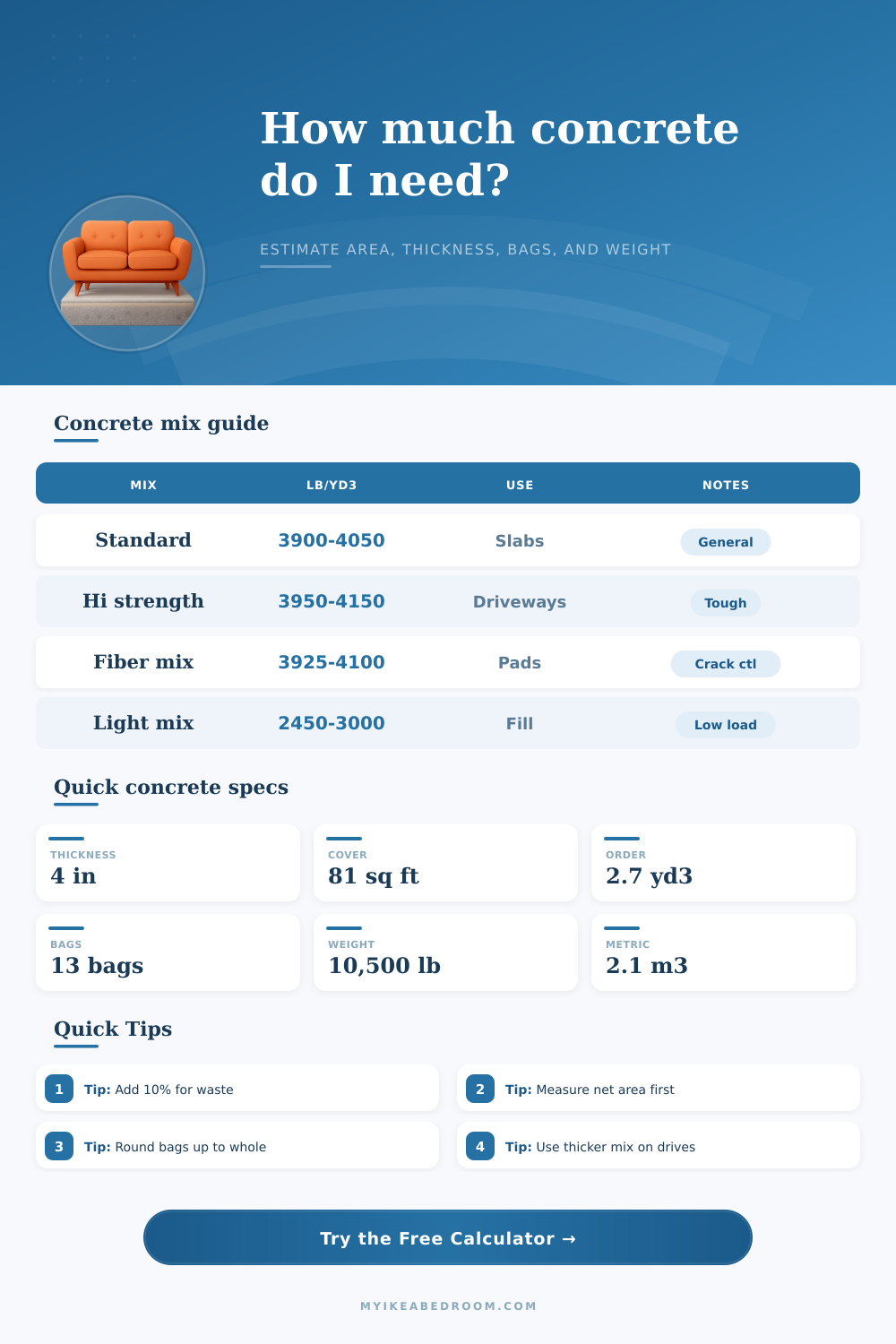
Once the person calculates the area, the person can calculate the volume of the project by multiply the area by the depth of the poured concrete. The volume of the project is measured in cubic yards or cubic feet. A person should always add a buffer to the calculated amount of concrete that will be poured for a project.
A ten percent buffer for the total amount of concrete to be purchased is the industry standard as this will account for spillage of the concrete or uneven ground where the poured concrete will be placed. If a person does not include a buffer in the calculations of how many bags of concrete is needed for a project, a person might find themselves out of concrete before the project is complete. Additionally, a person should always round up the number of bags of concrete that is needed for a project because a person cant purchase a fraction of a bag of concrete.
The type of concrete that is used for a project can also impact how much is needed to complete that project. Standard concrete is typically used for slabs while high-strength concrete is used for driveways because high-strength concrete is more resistant to the freeze-thaw cycle that can occur in those areas. Some types of concrete include fiber to control cracking in the poured concreate while other types of concrete are made to be lightweight for transport.
Each of these types of concrete have different densities which can impact the weight of the poured concrete. In addition to considering the type of concrete that is to be poured into an area, a person must also ensure that the area where the concrete will be poured has appropriate soil preparations performed in advance of concreting the area. Soil must be compacted prior to pouring the concrete to prevent the concrete from cracking.
The weather conditions at the time of concreting also has an impact upon the concreting process. In hot weather, workers can add retarders to the pour to prevent the concreting from hardening too rapid while cold weather may require blankets to be placed upon the poured concreting to ensure that the poured concreting remains warm enough to properly cement to the compacted soil. Finally, workers use vibration tools during the concreting process to remove air pockets from the poured concreting which will increase the strength of the poured concrete.
In order to calculate how many bags of concrete will be needed for a project, a person can calculate the volume of the project by determining the area of the project that will be covered by the poured concreting and the thickness of the poured concreting. Any openings in the project area should be subtracted from the total area measurement while a buffer of ten percent of the total volume can be added to account for any loss of concrete during the concreting process. Additionally, a person should determine the thickness of the poured concreting according to the type of load that will be placed upon the poured concreting while the type of concrete that is used should be chosen according to the environment in which the poured concreting will be placed.
By taking these steps, a person can ensure that they have the correct amount of concrete for there project.