Chain Link Fence Post Spacing Calculator
Plan line posts, terminals, gate breaks, and footing sizes for straight runs, corners, and perimeter chain-link layouts.
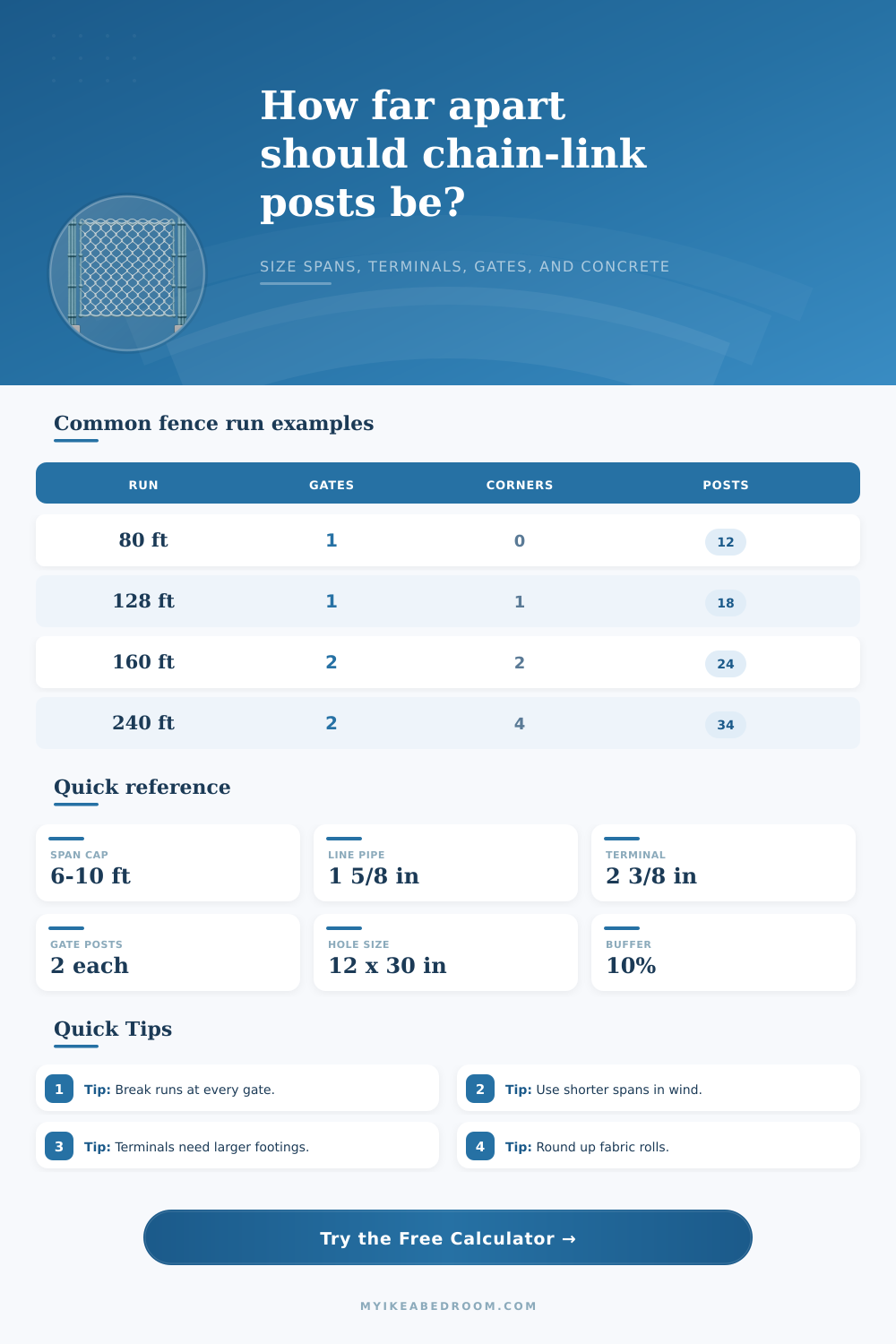
Mark gate openings first, because each gate adds two posts before the line posts can be spaced cleanly.
Use the strongest post size at corners or windy edges, then var the calculator tighten the remaining spans.
When you are installing a chain link fence, you must determine the distance at which to place each line post. The distance between each line posts is referred to as the span of the fence. The span will determine the stability of the fence and the way that the fence will appear.
If the spans between the line posts are too wide for the height of the fence, the fence will sag. If the spans between the line posts are too narrow, then you will end up spending too much moneys on the fence on the line posts and the concrete needed for each line post. The height of the chain link fence will play a role in the distance between the line posts.
How to Space Chain Link Fence Posts
For instance, four foot tall fence spans can be ten feet apart, but an eight foot tall fence will require five or six foot spans between line posts. If you are to incorporate privacy slats into the fence, the increased load from the slats will require that you place the line posts more closer together. The total length of the fence run will need to be calculated prior to installing the line posts.
You will need to subtract the width of any gate or the space needed for terminal posts from the total length of the fence run. Gates require terminal posts, which is much wider then line posts. Corners require terminal posts as well, for the same reasons that the gate posts are larger; they must anchor the fence to the corner.
The location of the fence will also play a role in the distance between each line post. If you install the fence in a sheltered area, such as a patio, the spans between the line posts can be longer. If, however, you install the fence in an open area that is exposed to high winds, the spans between the line posts will need to be shorter.
If the fence is to be installed in a coastal area, it may be exposed to salt air, which can corrode the metal more fast. In this case, the posts may need to be heavier or place closer together. The diameter of the line posts will play a role in the distance between the line posts.
For residential fence installations, the standard line post diameter is 1 5/8 inch in diameter. These line posts are suitable for shorter spans when they are installed in calmer areas. For commercial areas, the line posts may be two inches in diameter, which allow for the longer spans and the increased load from the wind.
Concrete will be required to install the line posts into the ground. The amount of concrete will depend upon the size of the hole that will be dug for each line post. Line posts only require holes that are ten inches in diameter and thirty inches deep.
Terminal and gate posts will require holes that are twelve inches in diameter and thirty-six inches deep. The volume of each of these holes can be calculated to determine how many bag of concrete are required to purchase. However, because there are so many fence posts to be installed, it is better to purchase extra bags of concrete than to risk not having enough to install each line post.
Prior to installing the line posts, you should mark the locations of the gates and terminal posts. After you have marked the terminal posts with a tape measure, the remainder of the fence line can be divided into equal distance for the line posts. These spans between line posts should be even; otherwise, the tension created in the chain link fabric will not be even, and the fence will not appear even.
Finally, once you have installed the line posts, you should use a tape measure to ensure that the distance between each line post is even. Additionally, you can use a level to ensure that each line post is placed plumb; a plumb line post is one that is perfectly vertical. By placing the line posts at even intervals and ensuring that each line post is plumb, the chain link fabric will remain tight, and the fence will remain stable for a long time.