Deck Railing Post Spacing Calculator
Set post centers, corner returns, stair breaks, and panel bays for straight runs, wraparounds, balconies, and stair edges.
Measure the face of the post, then confirm the rail panel still clears the chosen spacing after the final cut.
For stairs and corners, check the tightest bay first so the full run stays consistent from end to end.
When building a deck railing, you must calculate the spacing of the posts. The railing must be stable and meet the building codes. If you dont calculate the spacing correctly, the panels of the railing may be either too large or too small to fit into the spaces between the posts.
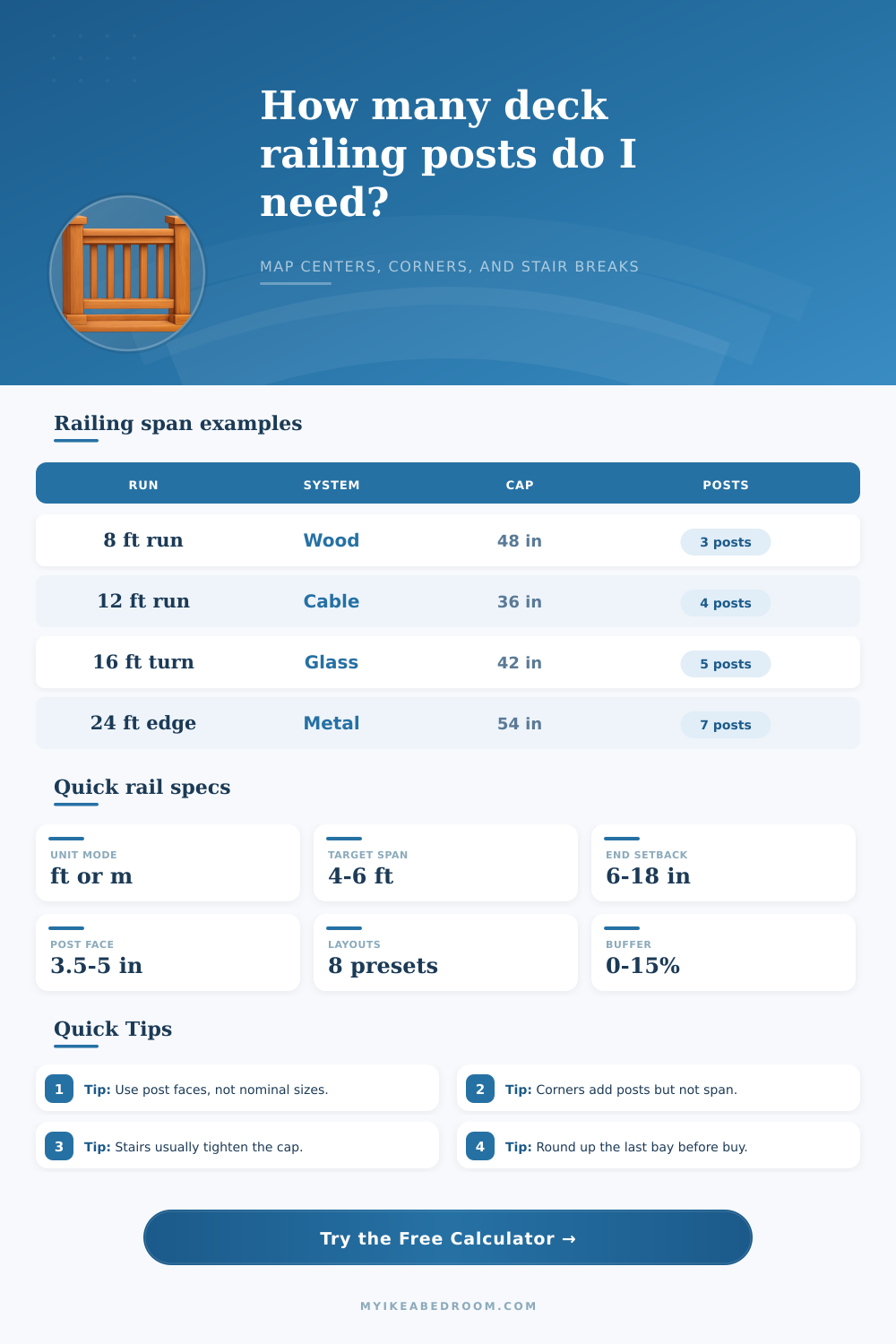
To calculate the number of posts for a railing, you first must determine the usable span of the railing. The usable span of the railing is the total length of the railing minus the setback at each end of the railing. There are setbacks at each end of the railing where the railing connect to the deck’s rim joist and fascia board.
How to Calculate Deck Post Spacing
Thus, you must subtract the setback measurement from the length of the railing twice to account for both ends of the railing. Once you have calculated the usable span of the railing, you can decide on the target spacing of the posts. The target spacing of the posts is the distance between the centers of the posts.
The target spacing will depend upon the type of railing system you are using for your deck. For instance, wood guard railings can be up to six feet in length between each post, but cable railing system must be approximately four and a half feet in length between each post because the cables will sag under the weight of people standing on the railing. Corners in the railing will alter the calculation of the number of posts needed for that section of the railing.
You require an extra post at each corner to ensure the railing is stable in each direction along the corner. While corners may reduce the length of the railing that can be used for the spacing between the posts, corners do not reduce the usable span of the railing. However, the presence of stairs within the railing system will alter the layout of the railing; the angle of the stairs affect how the railing interacts with gravity.
Thus, you will require posts at each stair as well, indicating that the total number of posts will increase. An increased number of posts will ensure the railing remains stable and does not wobble. The width of the posts will also impact the calculation of the number of posts required for the railing system.
Many individuals calculate the number of posts based off the nominal width of the posts. For instance, 4×4 posts are not four inches in width each. The actual width of 4×4 posts is three and a half inches in width.
You must measure the actual width of the posts to ensure that the panels of the railing will fit into the spaces created by the width of the posts. The space between the posts (known as the clear opening) will indicate the size of the railing infill panels that will go into that section of the railing. It is a good practice to order extra posts for the railing system.
You should order ten percent extra posts in case of any mistakes in the ordering of the posts or in the size of the lumber used to build the posts. Additionally, you should round up the number of posts to the nearest whole number for the last bay in the railing. Rounding up the number of posts will ensure that the last bay of the railing is smaller than the target spacing of the posts; a smaller spacing between the posts is better than having a space between the posts that is too large for the railing infill panels.
Depending on the layout of the deck, different strategies will have to be used to calculate the spacing of the posts. For instance, for decks with straight runs in their layout, you can space the posts as calculated. For decks with wraparound structures, however, you must make adjustments to the calculations for the spaces between the posts.
Additionally, if the deck contains stair runs, you must make adjustments to the calculations to account for the angles of those stairs. Additionally, local building codes will dictate the maximum span of the railing. For instance, in some coastal zones where high winds are common, the building codes may require that the spans of the railing be shorter to prevent the railing from swaying due to those strong winds.
You should verify your layout for the posts prior to installing the posts. One way to do this is to place a string line between the two ends of the railing to indicate where each post should be placed. Additionally, you can perform a “dry fit” of one railing panel into the spacing between the posts to ensure the panel will fit into the space.
If it will not fit, you must make adjustments to the placement of the posts. The most important reason to correctly calculate the spacing of the posts in a deck railing is for safety. The railing must be stable and able to support the weight of individuals who may be using the deck.
Additionally, it should not bow under that weight. Thus, even if you calculate the posts according to local building codes, you should of perform one last check of the railing to ensure it will be sturdy and safe to use. Youll want to make sure the furnitures is secure and its isnt wobbling.
You should of checked the post length more carefully to avoid any moddern errors. One way to recieve a better result is to check the spacing more than once. Making sure the railing is stable is more important then anything else.
All the posts is important to the structure. Making sure the railing is stable is more important then anything else. If you dont take care, the railing could be dangerus.
Use a lot of attention to detail when you are installng it. You cant skip steps. The rails length matter for the safety of the deck.