🎨 Epoxy Coverage Calculator
Estimate epoxy gallons, primer needs, coat totals, kit counts, and weight ranges for garage floors, basements, and custom slabs.
📋Fast presets
🔧Calculator inputs
📋Coverage cards
📊Reference tables
💡Practical tips
📈Calculation results
Calculating epoxy coverage are a necesary step for any person who intend to coat a concrete floor with epoxy. The coverage rate of epoxy will help to determine how much epoxy to purchase to complete the entire projects. Should the person perform the calculations incorrectly, it is possible that the person will either run out of epoxy before the project is completed, or that they will purchase too much epoxy for the project, wasting there money.
The coverage rate of epoxy is not a set number, but depend upon the condition of the concrete beneath the epoxy, as well as the type of epoxy that is to be used. The condition of the concrete can range from porous to non-porous. Porous concrete can lead to the concrete absorbing the epoxy, and therefore requires more epoxy to adequately coat the area.
How to Calculate Epoxy Needed for a Concrete Floor
For instance, if the concrete is broom finished (has a texture to it), that type of concrete is porous and will require more epoxy to coat the area then non-porous concrete. In contrast, non-porus concrete will allow one gallon of epoxy to cover more square foot than porous concrete will allow for the same area. Thus, the person must examine the condition of the concrete prior to calculating the coverage rate for epoxy.
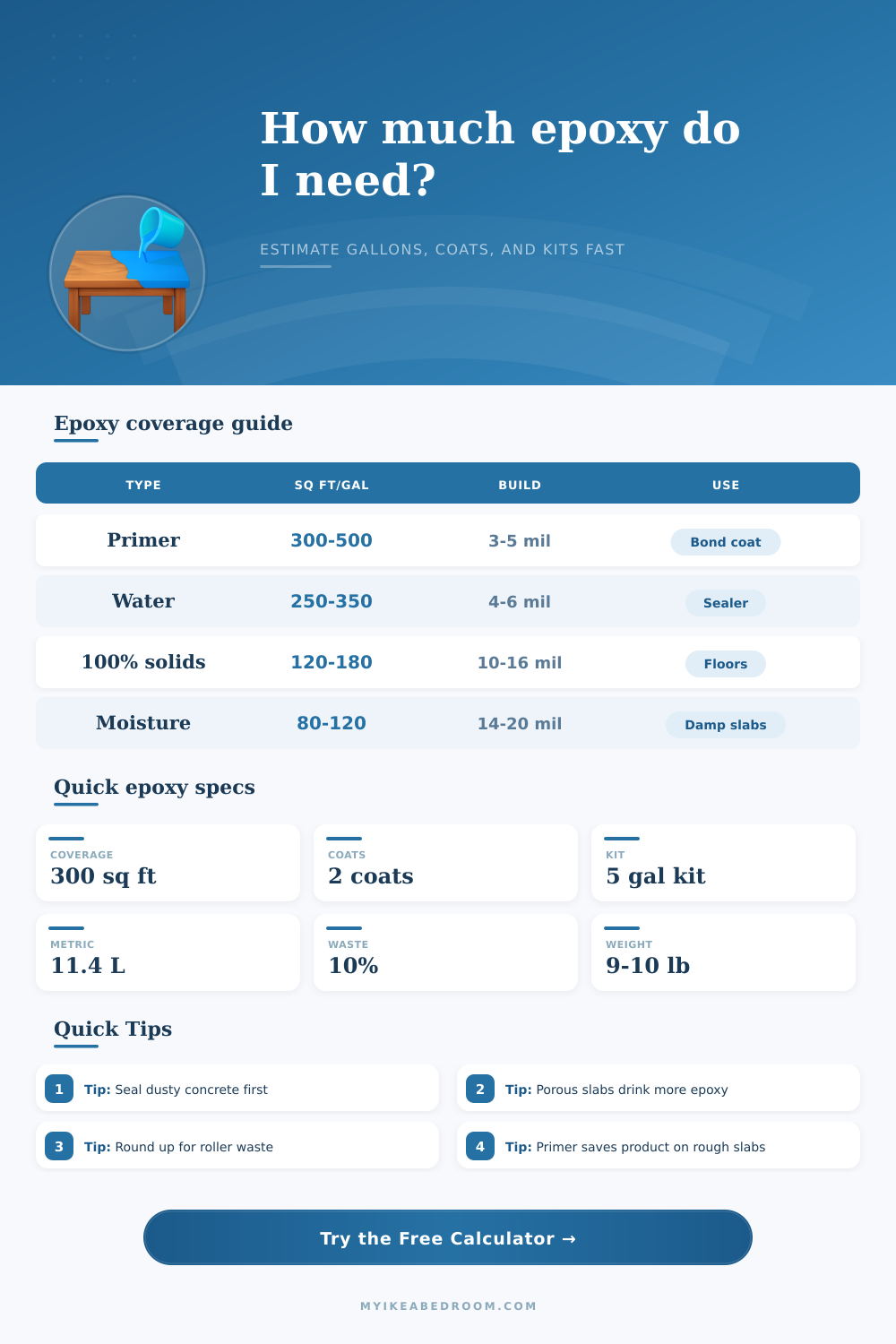
The type of epoxy system can also impact the coverage of epoxy. For instance, water-based epoxy sealers are thin liquids, while 100% solids epoxy are thicker. Consequently, the thinner water-based epoxy will cover more square feet per gallon than the 100% solids epoxy.
Additionally, moisture barriers are also thick liquids, and are used on concrete that contain moisture in the ground. The type of epoxy system to use will depend upon the use of the floor, as well as the amount of epoxy that the system will require. An epoxy primer is often used prior to apply the finish coats of epoxy to the concrete floor.
The primer helps to seal the pores of the concrete, as well as ensure that the finish coats of epoxy adhere to the concrete. Should the person not use epoxy primer on concrete that has pores, the base coats of epoxy will be absorbed into the concrete. Thus, the epoxy primer will cover a different amount of square feet per gallon than the finish coats of epoxy.
For these reasons, the amount of epoxy primer and finish coats must each be calculate separately. In addition to the factors mentioned above, it is also important to include a waste buffer in the number of gallons of epoxy that is calculated for a project. A waste buffer accounts for the amount of epoxy that may be lost during the pour and application process of the epoxy.
It is common to include between ten and twenty percent waste buffer to the total amount of epoxy necessary for a project. Otherwise, there may not be enough epoxy to complete the project entire. Finally, the total amount of epoxy will be sold in kit.
Thus, another consideration for the epoxy purchase will be the number of kit that are necessary to provide the amount of epoxy that was calculated. The environment in which the concrete is being treated can also impact the amount of epoxy that is used. For instance, high humidity can cause a sticky film to form on the epoxy, and changes in temperature can make the epoxy thinner or thicker.
If the epoxy is too thick due to the low temperatures, it may be difficult to spread the epoxy on the ground. These factors should also be considered when purchasing epoxy for a project. Lastly, the total film thickness of the epoxy will determine its durability on the floor.
The more higher the film thickness of the epoxy, the more durable the floor will be when compared to a floor that contains a low amount of film thickness of epoxy. Thus, a high film thickness will require more epoxy to coat the floor. The durability of the epoxy will not allow for any attempt to save money by using too thin of a coat of epoxy on the floor.
In other words, each of these factors must be considered prior to purchase the epoxy for the project.