🏗 Paver Patio Slope Calculator
Estimate patio fall, slope percent, edge heights, and taper volume for a drainage-friendly paver layout.
📋Descriptive slope presets
🔧Calculator inputs
📋Slope reference grid
📊Reference tables
💡Practical tips
📈Calculation results
A paver patio must has a slope for the water to drain away from the patio. A slope allow the water to flow across the patio. If the patio dont have the correct slope, the water will pool on the patio.
The pooling water can create moss on a paver patio or other issues related to stand water on the patio. If a paver patio is too steeply, the pavers could shift under the weight of a person walking on the patio. In either of these situation, it is essential to use the proper slope to ensure that the paver patio is dry and does not pose any risk to the individuals that use the patio.
Paver Patio Slope to Drain Water
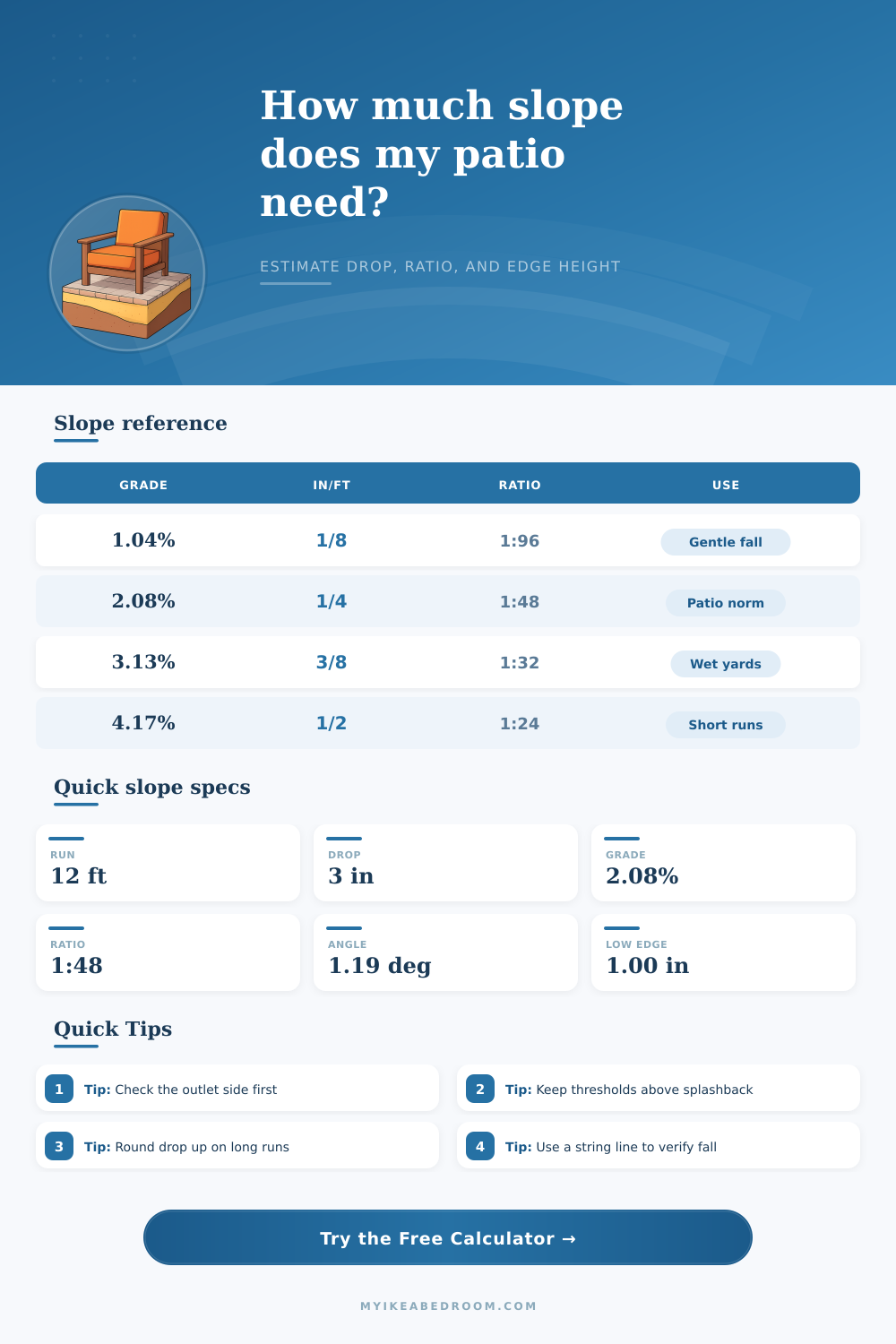
A common standard for drop in inches for every foot of distance of a paver patio is ¼ of an inch. This drop allows the rain to flow to the lawn, other drainage outlet, or the street. Many individuals aim for this slope because it allows water to flow efficient while maintaining a flat appearance for those who sit on the patio.
The run is the distance from the high edge to the low edge of the paver patio. If the patio is in the shape of a rectangle, there are two options for sloping the pavers. The pavers can slope along the length or the width of the patio.
If the pavers slope along the length, the water will flow toward the back of the patio. If they slope along the width, the drainage will be more narrower. For patios of odd shapes, such as circles or corners of triangles, there will have to be a diagonal slope for the water to properly run across the paver patio.
The percent grade of the patio will indicate how many inch the patio will drop for every hundred feet of the patio run. A 2% grade will drop 2 unit of inches for every 100 units of run. A 2% grade will create a drop of 3 inches in a 12-foot run.
While a 2% grade is often sufficient for paver patios, in areas that receive alot of rain, a steeper slope may be needed for proper drainage. The high edge is the highest point along the paver patio. You must find the total drop of the slope and subtract it from the height of the high edge to determine the height of the low edge of the patio.
The low edge must be high enough to ensure that mud and soil does not encroach onto the patio. The difference between the two edges of the patio is known as the taper in the base material. This wedge shaped portion of the base material must be excavated and filled with base material.
Many people make mistake when installing a paver patio. One of the most common is assuming that a level paver patio is the same as a flat paver patio. A level paver patio isnt the same as a flat one because the patio must slope to allow the water to properly run off the pavers.
People also often disregard the outlet for the water from the patio. The slope of the paver patio must drain into a proper outlet because water flowing into another persons foundation is not an option for the patio design. String line can help create the proper slope for the paver patio.
String lines can be stretched between high stakes and low stakes and periodically checked with a level to ensure that the slope is as required. Before the installation of the pavers, you can test the slope with a hose to ensure that the water does not pool on the base material. If there is pooling of water, the slope needs to be corrected before the installation of the pavers.
It is far easier to correct the slope before the pavers are place on the slope than after the installation of the pavers.