Fence Post Spacing Calculator
Plan post centers, gate breaks, turning posts, and footing concrete for straight runs, corner lots, and perimeter fence layouts.
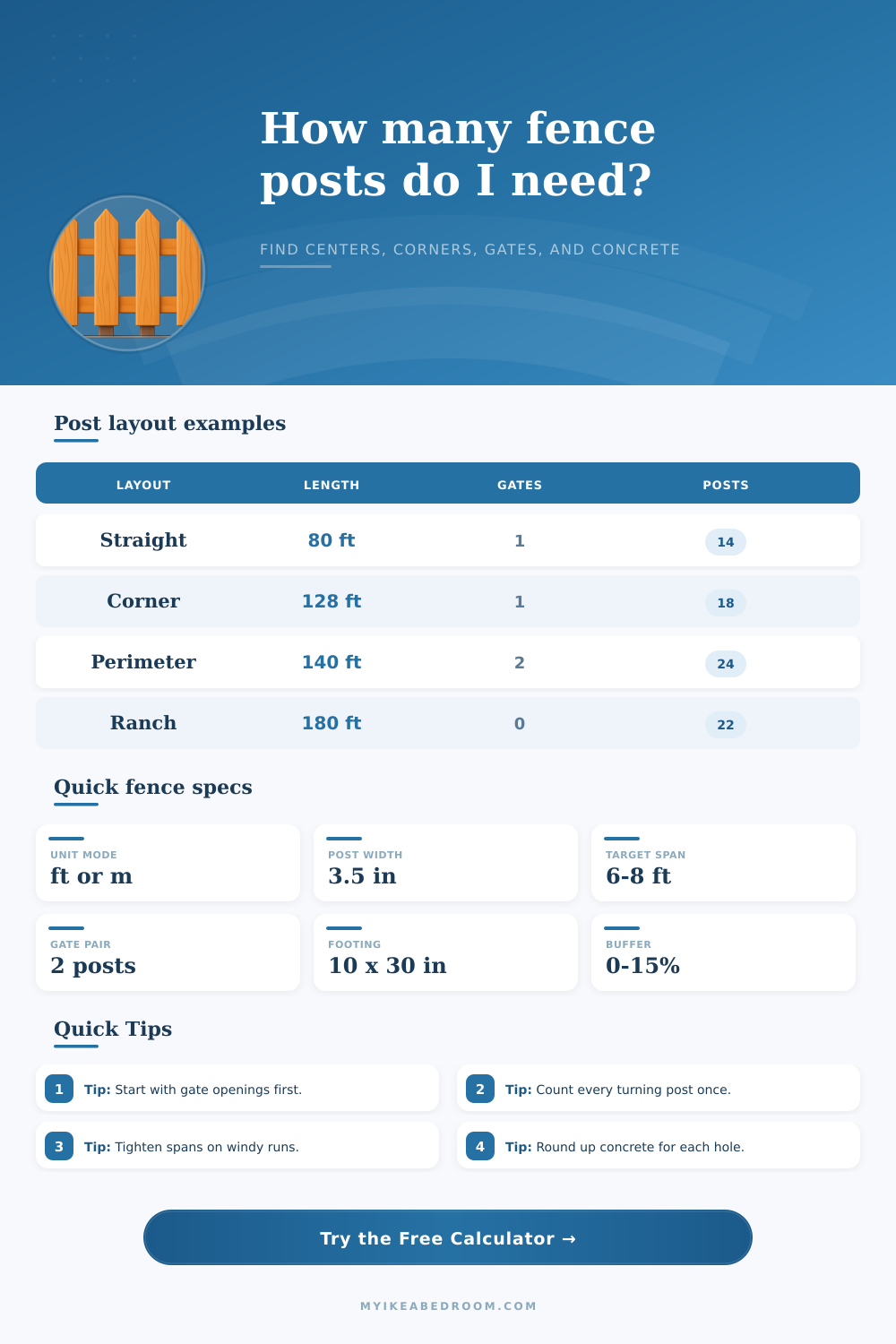
Mark gate openings first, because each gate adds two posts before the line posts can be spaced cleanly.
Use the strongest post size at corners or windy edges, then var the calculator tighten the remaining spans.
Calculating an number of fence posts is a necesary part of fence construction. Calculating the number of fence posts correct will ensure the fence remains stable once it’s constructed. Installing too few fence posts may result in the fence panels sag or warped due to insufficient support for the fence panels.
Installing too many fence posts will cost the fence installer more money because they will buy more lumber and concrete then the fence will require. The distance between fence posts is important because the distance between fence posts will have to support the fence panels weight, the fence boards weight, and the force of the wind pushing against the fence panels. The distance between fence posts for most backyard privacy fence application should be between six and eight feet.
How to Calculate the Number of Fence Posts
If the distance between the fence posts is more than eight feet, the fence may lean or even break due to the force of the wind. When measuring the distance between fence posts, subtract the length occupied by setbacks and gates. Setbacks are required to ensure fence posts is not planted too close to trees or fence corners.
Gates will require a pair of fence posts to support the weight of the gate when it is open. The distance between the center of each fence post should be measured. This distance is known as the center to center distance of the fence posts.
You dont need to measure the distance between the fence posts faces because the width of the fence posts will change that distance. For instance, if the center-to-center distance is six feet and each fence post is four inches in width, the distance between fence posts will be less than six feet. The environmental factors in place will impact the distance between fence posts.
For instance, if the wind endures high wind and the fence will be constructed in an open field, the distance between fence posts should be five or six feet. Fence posts should be placed closer together in high winds so that they do not move the fence. Conversely, if the fence is to be constructed in a sheltered area, fence posts can be placed further apart at eight feet because there will be less wind in the sheltered area.
Terrain will also impact the placement of fence posts. Fence posts on flat terrain are easy to install then fence posts on sloped terrain. Sloped terrain will require fence posts to be closer together to ensure fence rails remains level with the ground.
The type of fence material will dictate the distance between fence posts. If the fence posts use four by four pressure treated wood, the distance between fence posts should be no more than six feet. Six-by-six fence posts can be used for fence spans of ten or twelve feet.
When measuring the fence, measure and mark the locations of the fence gates and corners first. Gates and fence corners require more fence posts than a straight fence span. After marking the locations of the corners and the gates, measure the distance between fence posts to determine the number of bays.
A bay is the distance between two fence posts. Add a few fence posts to ensure no bay span more than the recommended length for the fence post material. Add between 10 and 15 percent to the fence material list because some fence posts may break during installation.
Installing fence post footings with concrete is a necesary part of fence installation. Fence post holes must be cylindrical in shape and the volume of the holes will determine the amount of concrete necessary to set the fence posts. Ten-inch fence posts dug to a depth of thirty inches will provide a solidy grip in the dirt.
However, corner and gate fence posts will have wider and deeper holes. Fence posts must be embedded in the ground below the local frost line. In northern states, fence posts must be embedded in the ground to a depth of more than thirty inches because the frost line in these areas is deeper than the frost line in the southern part of the USA.
Finally, fence post footings with concrete should of be ordered in whole bag of concrete because concrete products cant be purchased in fractions of a bag.