🔧 Drywall Repair Calculator
Estimate patch footprint, compound, tape, primer, and sanding needs for bedroom wall fixes, seam cracks, cutouts, stains, and skim passes.
📌Room presets
📊Results
🧱Compound reference grid
📈Reference tables
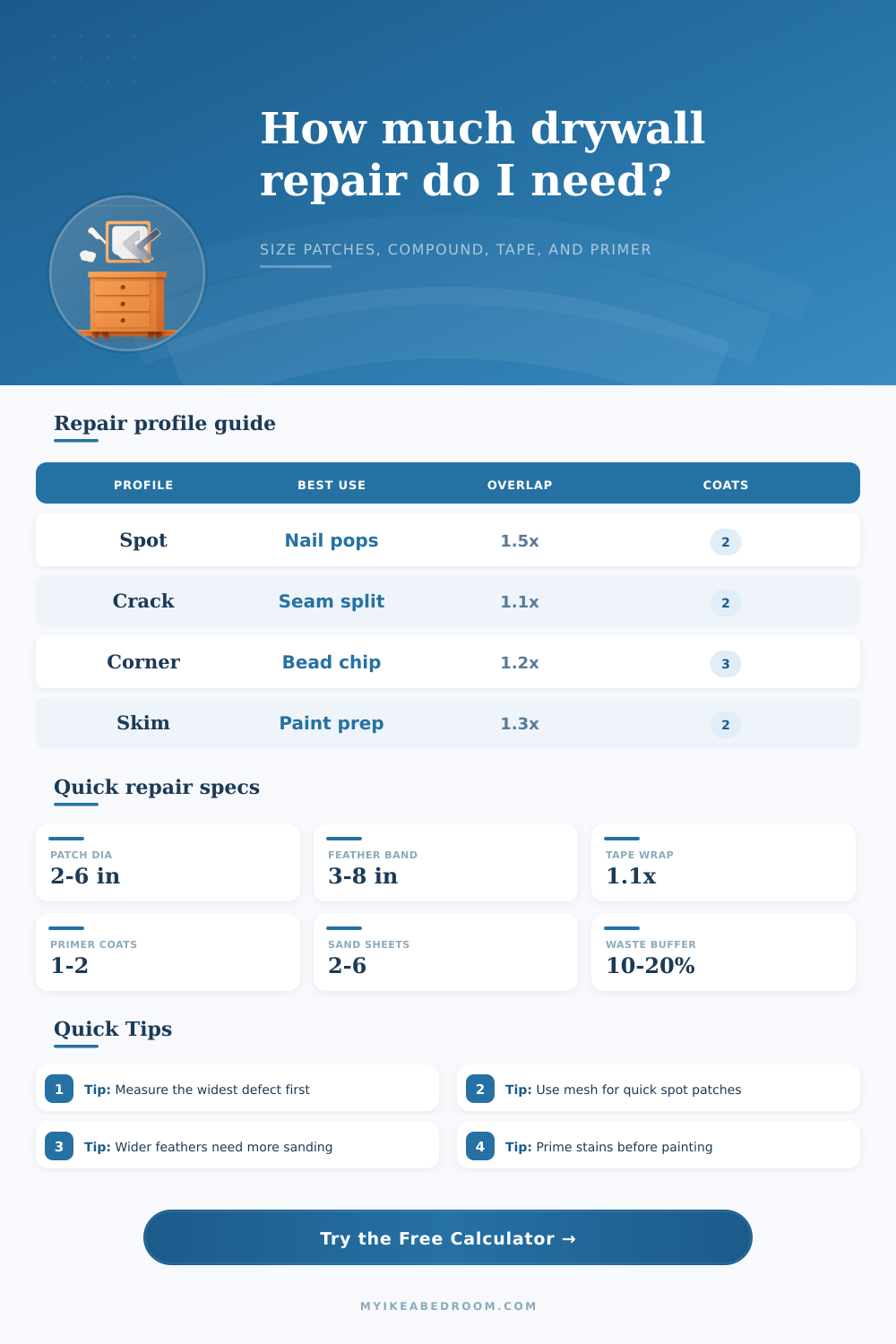
| Profile | Footprint rule | Support | Coats |
|---|---|---|---|
| Spot patch | Circle + margin | Mesh patch | 2 |
| Crack repair | Strip along seam | Paper tape | 2 |
| Corner bead | Long edge band | Corner tape | 3 |
| Skim pass | Wide feather area | None | 2 |
| Compound | Density | Work time | Best fit |
|---|---|---|---|
| Ready-mix | 11.8 lb/gal | 240 min | Easy finish |
| Set 45 | 12.9 lb/gal | 45 min | Fast patch |
| Lightweight | 10.2 lb/gal | 180 min | Broad fill |
| Topping | 11.1 lb/gal | 120 min | Final coat |
| Defect | Typical size | Field A | Field B |
|---|---|---|---|
| Nail pop | Small dent | 0.5 in | 0.25 in |
| Doorknob hit | Round hole | 4-6 in | 4-6 in |
| Seam crack | Long split | 48-120 in | 1/8 in |
| Corner chip | Edge damage | 24-48 in | 1-2 in |
💬Practical tips
Drywall damage can be found when a person finds a hole, a dent, or a crack in the drywall. Various objects or occurrences can cause drywall damage, such as a dresser that lean against the drywall or an nail that pops out of the drywall. To repair drywall damage, a person must use the correct amount of patch material and joint compound.
If the amount of joint compound are not correct, the drywall will not appear seamless once it dries. If the amount of patch materials is not correct, the drywall will fail. The first step is to measure the size of the damage.
How to Repair Drywall Holes, Dents, and Cracks
A person must measure the hole or crack’s widest part. The width of the damage will determine the footprint of the drywall repair. A person should also measure the depth of the hole.
A person should add a margin for overlap to the depth of the hole to ensure that the drywall repair’s edges blends into the wall. Many peoples make the mistake of guessing the size of the hole in the drywall. If a person guesses the size of the hole in the drywall, the size of the repair will be too small.
If the drywall repair is too small, it will crack when the person sands the drywall. A person must decide on a support method for the drywall damage. A person can use fiberglass mesh to stick directly on the hole in the drywall.
Fiberglass mesh will allow the joint compound to grab onto the hole in the drywall. A person can use paper tape if the damage done to the drywall is along a long seam. A person should embed the paper tape within the wet joint compound so that the paper compound create a strong seam within the drywall.
If the drywall damage is medium sized, a person can use self-stick patches so that the drywall repair saves time. However, self-stick patches will limit how wide of a margin a person can leave between the drywall and the drywall damage. Finally, if a person encounters large breaks in the drywall, he or she will have to use a backing board to fill the gap behind the drywall.
A person must use the correct type of joint compound for the drywall repair. Ready-mix all-purpose joint compound will work well for drywall repair for beginners because it will stay workable for many hour and is forgiving of multiple coats. Setting compounds will harden within approximately 45 minutes.
Setting compounds is dense so that they will fill the hole in the drywall without shrinking when it hardens. Lightweight joint compound will spread thinly on the drywall so that it will be easy to sand for a smooth finish when a person performs broad skims on the drywall. A person must account for the density of the joint compound that will be used for drywall repair because the density of the joint compound determines how many pounds or gallons of the compound the person will need to purchase for drywall repair.
Feathering is when a person tapers the joint compound until it becomes paper-thin. This process is necessary to blend the drywall repair into the drywall so that it is invisible to the human eye. If a person is repairing drywall that is smooth, he or she will need to feather the joint compound less than if the drywall is textured.
If the drywall has a heavy orange-peel texture, a person must feather the joint compound over a wider area to accommodate the texture of the drywall. A person should also feather the joint compound wider on the ceilings because gravity will pull the joint compound down in an unevenly way on the drywall. A person must calculate how many material are needed for the drywall repair.
A person should calculate the square footage of the footprint of the drywall damage. Based on the size of the drywall damage, a person can calculate how many gallons or pounds of joint compound will be needed. Based on the size of the drywall damage, a person can calculate how many feet of tape will be needed for the drywall and how many gallons of primer will be needed for the drywall repair.
A person should add a buffer to account for wastes in the repair because some of the joint compound will spill and a person may mix too much joint compound for the drywall repair. Many mistakes will ruin a drywall repair. A person should not rush the application of the first thin coat of joint compound because the first thin coats of joint compound will have pockmarks on them.
A person should build the volume of the joint compound early with setting mud and then finish the drywall repair with feathering. A person should not sand the drywall too aggressively with sandpaper because this will dig ridges into the drywall. A person should prime the stain on the drywall before painting the drywall with paint so that the stain will not bleed through the paint.
Finally, a person should ensure that the texture of the joint compound matches the texture of the drywall so that the repair will not have flat spots on it.