💡 Recessed Lighting Spacing Calculator
Estimate fixture spacing, wall setback, rows, and total lumens for a balanced recessed-light layout.
📋Room presets
🔧Calculator inputs
📋Fixture spec comparison grid
📊Reference tables
💡Practical tips
📈Calculation results
Recessed lighting provide illumination for a room by hiding the light source within the ceiling. Recessed lighting create a clean appearance in the room because the lighting fixtures dont hang down from the ceiling. Incorrect placement of recessed lighting can create dark spots in specific areas of the room.
The spacing of the recessed lighting will determine the evenness or unevenness of the illumination in the room. The required spacing of the recessed lighting will depend on the beam angle of the recessed lighting fixture and the height of the ceiling. The beam angle of the recessed lighting determines the width of the circle of light that will radiate from each fixture.
How to Place and Space Recessed Lights
A narrow beam will illuminate a small circle of light, while a wide beam will create a wide circle of light. If the beams of light from each recessed lighting fixture do not overlap in the room, there will be dark spots between each beam of light. Therefore, the beams of light from each fixture should overlap in the middle of each area.
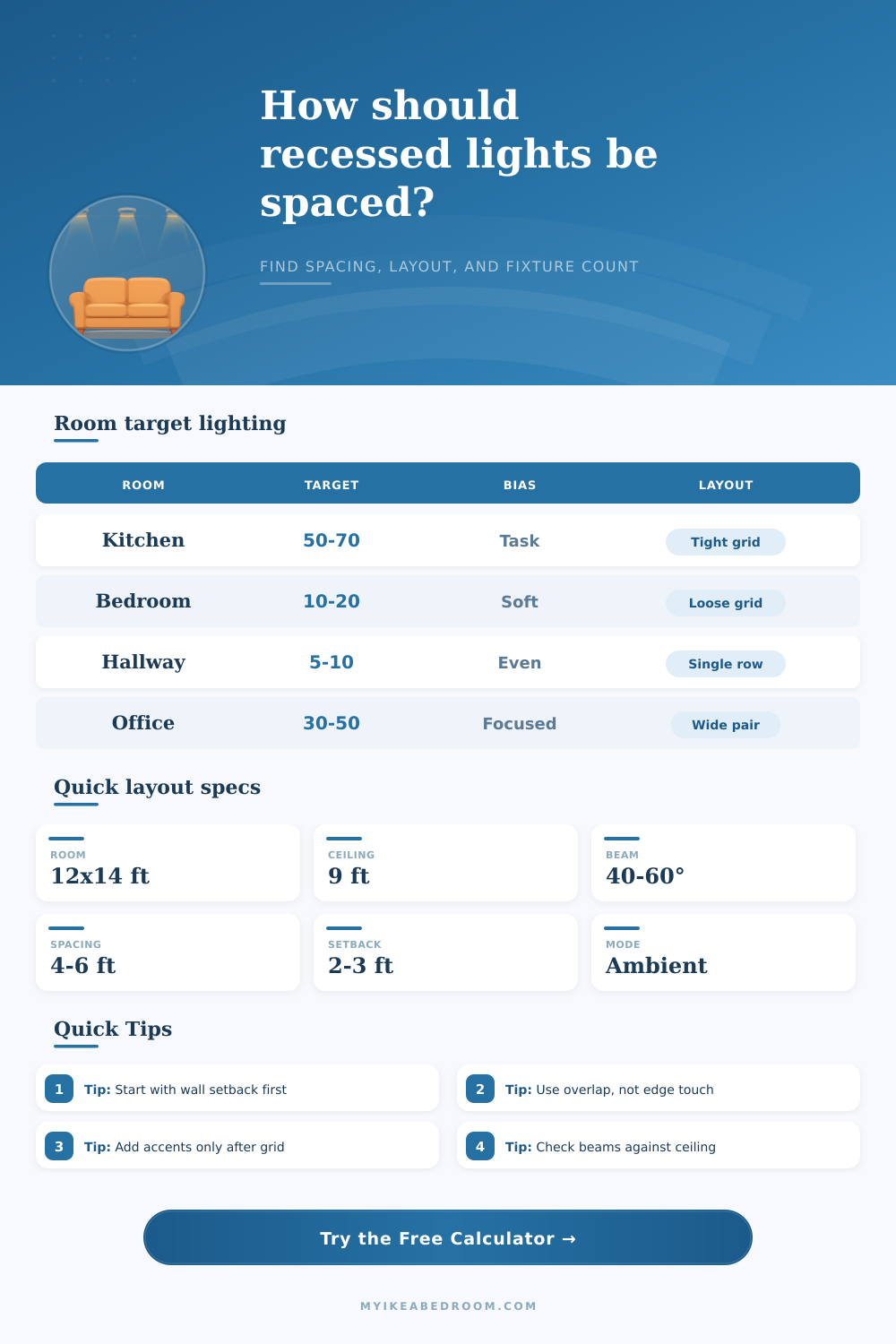
For most rooms, the recommended beam angle is between 40 and 50 degrees. A beam angle of 40 to 50 degrees will allow the circles of light from each recessed lighting fixture to touch one another without crowding together. The height of the ceiling in a room also affects the lighting created by the recessed lights.
If the ceiling is high in a room, the beams of light have more of a chance to spread across the room before they reach the floor. The required spacing of the recessed lighting will have to be calculated based off the height of the ceiling in the room. The placement of the recessed lighting in the ceiling also matters.
If the recessed lighting is too close to the walls, it might create harsh glares or bright spots on the furnitures in the room. In this case, you should pull the recessed lighting fixtures back from the walls of the room. They can be installed half to three-quarters of the way back from each wall.
This will ensure that the lights do not create harsh lighting on the perimeter of the room but instead provide even lighting to the entire area. The purpose of the room will determine the amount of light that is needed and the spacing of the recessed lighting fixtures in that area. For instance, kitchens will require a high level of light because people will use the lights to prepare food.
The spacing of the recessed lighting in the kitchen will be tighter than in another type of room. Bedrooms will require less light than kitchens because there isnt a need for high lighting levels for any particular task. Therefore, the spacing can be further apart.
Hallways will only require lighting in a single row of recessed lighting down the length of the hallway. However, offices will require more precise lighting for the work that takes place at the desks in those areas. The use of a lighting calculator will help determine the proper requirements for each type of room.
A lighting calculator will take into account the number of foot-candles that are required for each area and the layout of the space to provide these recommendations. Another thing that you will have to consider when designing the recessed lighting layout in your space is the type of trim that will be used for each fixture. Baffle trims are often used in more casual areas in the home because the baffles will help to reduce glare from the lights and will help to widen the area of light coverage.
Reflector lighting is another alternative but will create different light patterns in the room different than baffle lighting. The total number of lumens that are needed for each room will also impact the recessed lighting plan. The total number of lumens will determine the electrical load that each set of recessed lighting fixtures in the room creates.
If the room has an irregular shape to it, the perimeter of the area has to be sketched out for the lighting plan. This will ensure that the corners of the room do not remain dark when the lights are turned on. Finally, recessed lighting can always start with the installation of the base grid of lighting to provide even lighting for the main area of the room.
In addition to this, if the room should feature any special lighting highlights, accent lighting can always be added to them at a later time.