🛠 Tread layout planning
Stair Tread Calculator
Estimate tread widths, cut depth, board count, seam count, and waste for straight stair treads, caps, and retrofit covers.
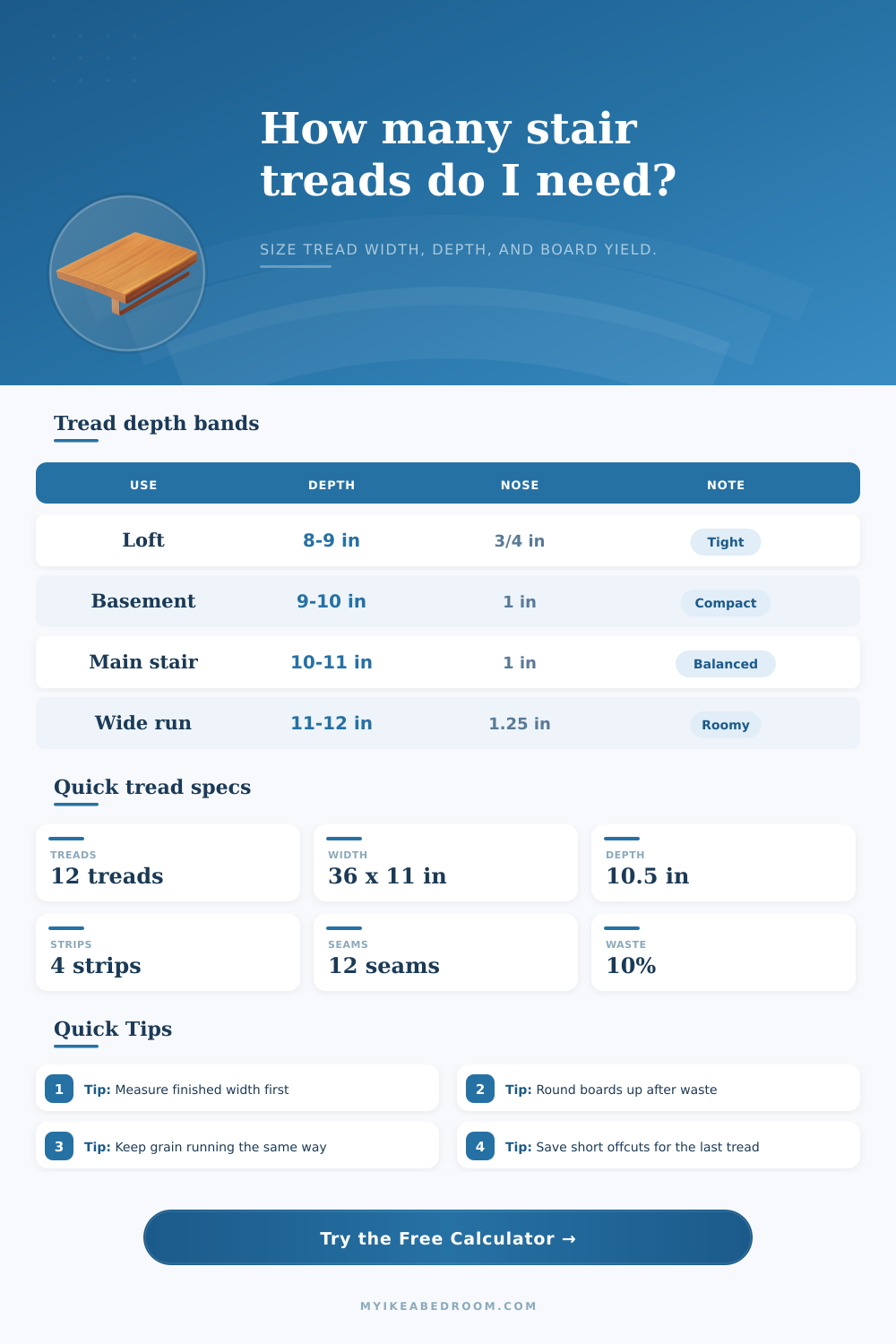
| Use | Depth | Nose | Note |
|---|---|---|---|
| Loft | 8-9 in | 3/4 in | Tight |
| Basement | 9-10 in | 1 in | Compact |
| Main stair | 10-11 in | 1 in | Balanced |
| Wide run | 11-12 in | 1.25 in | Roomy |
| Stock | Cut depth | Strips | Use |
|---|---|---|---|
| 1x12x8 ft | 10.5 in | 8 strips | Solid wood |
| 1x12x10 ft | 10.5 in | 10 strips | Long run |
| 3/4 ply 4x8 | 11 in | 8 strips | Sheet cap |
| 4x10 sheet | 11 in | 10 strips | Wide cap |
| Preset | Count | Material | Boards |
|---|---|---|---|
| Basement | 12 | Pine | 6-8 |
| Loft | 10 | Birch ply | 3-5 |
| Family | 13 | Oak | 7-9 |
| Workshop | 6 | PLY | 2-3 |
When you are replacing carpeted stairs with wood stair treads, you must think carefuly about your measurements and purchases. Because stair treads are not like standard lumber, you must plan your purchase carefuly. If you purchase too much wood, you have wasted money; if you purchase not enough, the stairs wont have enough wood to cover the area with uniform tread.
Wood stair treads has to have a specific depth. The depth of the stairs should measure between nine and twelve inch, as this is a standard depth of a stair tread. If the depth is too shallow, the persons heel will hang off the stair tread; if it is too deep, the depth of the rise of the stair will be incorrect.
How to Measure and Buy Wood for Stair Treads
The depth of the nosing, or the portion of the stair tread that extends over the stair below it, should measure one inch. This extension provides both safety and visual appeal for the stair tread. Additionally, if the stairs are open, you must account for the return on the side of the stairs in the width of the wood needed to purchase.
The amount of wood required can be calculate if you know how you will cut the boards. Most lumber stock boards is of a specific size, such as eleven inches in width and eight feet in length. These boards will need to be ripped into strip.
For instance, if the stair run is thirty-six inches in width, multiple strip will be required for each stair tread. Each stair must be calculated for the number of strips needed. Additionally, you must account for the width of the saw blade, or the kerf.
Finally, the grain of the wood must run from the front to the back of each tread for stability of the treads. The type of material for the stair treads is another factor to consider. Some of the best material include red oak for its durability and pine for its relative ease of cutting.
Additionally, you can use plywood sheets for creating sheet caps on stair treads, and the sheets of plywood may allow for more strips of wood to be produce than solid wood. However, solid wood is preferred for areas that is humid, such as a basement. In these areas, solid wood will breathe better than plywood.
Five percent of the boards can be wasted for clean cuts of the lumber; however, if the stair treads will have complex profile, twenty percent of the lumber can be wasted. The number of boards will need to be rounded up, as the final stair tread will need a backup piece of lumber. Some of the mistake people make when buying wood for stair treads include only measuring the width of the stair between the stringers.
The width of the stair must be measured to the finished face of the stair. People also make mistakes in choosing the material. For instance, many people do not account for how heavy the material will be.
Red oak is a very heavy wood. Instead, people should choose pine for the stairs. Other mistake that people should avoid include measuring the finished width of the stair tread first.
Additionally, people should ensure that the grain of the wood is kept consistent across all stair treads to avoid the joints being visible on the stair treads. Finally, people should save any short offcuts of lumber for the top and bottom stair treads so that the less visible treads wont have to use the long edges of the lumber. Other environmental factor to consider include how humid the area will be where the stairs will be built.
For instance, wood species such as pine will swell in humid environments more than other, such as maple. Additionally, as the stairs settle over time, you will need to leave a small amount of space in the seam in which the wood treads will join. Once you have determined the number of step the stairs will have, the width and depth of each tread and stair, and the type of lumber that will be used, you will know what to purchase for the stairs.
Additionally, calculating the yield rate for the lumber will allow you to ensure that you are using the wood efficient for creating the stair treads. The higher the yield rate, the more efficiently the lumber will be in the creation of the stair treads.