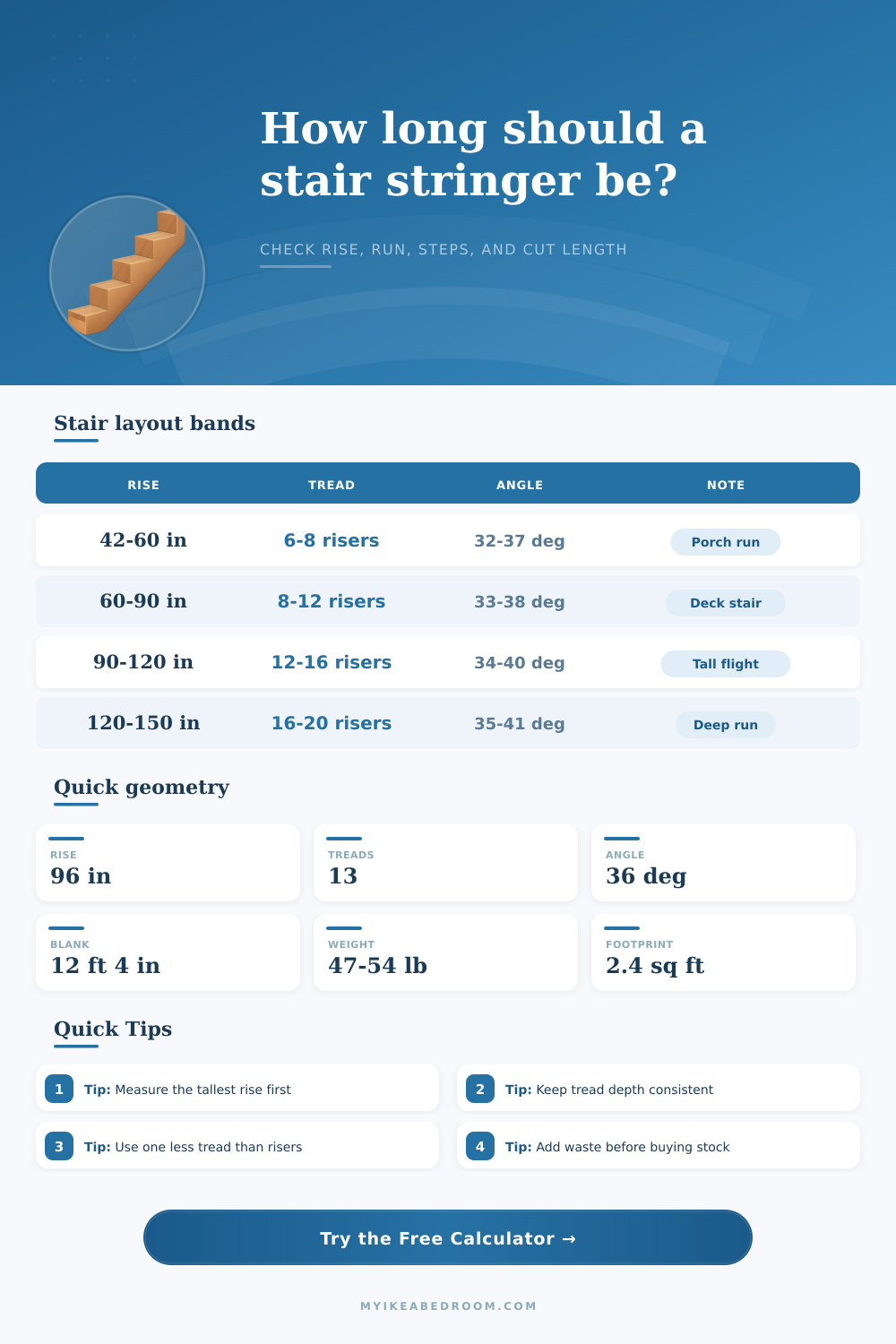
🛠 Stair layout planning
Stair Stringer Calculator
Size straight stair stringers from total rise, tread depth, and stock length, then compare presets for real project spans.
Average blank weights are shown per cubic yard so the density spread is easy to compare at a glance.
Use these tables to sanity-check the stair geometry, stock size, and stringer angle before you cut.
When building stairs for a deck, it is essential to calculates the dimensions of the stringers that will support the stairs. Stringers are the diagonal supports that will hold the tread and risers. To assist in creating safe and sturdy stair for a deck, you must cut the stringers to ensure that each step is the same height.
If individual risers are of unequal heights, stairs will be difficult to climb and will present a tripping hazard to the individuals that use the stairs. The first step in calculating the dimensions for the stringers is to measure the total rise of the stairs. The total rise is the vertical distance from the finished floor at the bottom of the stairs to the finished floor at the top of the stairs.
How to Measure and Cut Stringers for Deck Stairs
This dimension must be measured from the finished floor at the bottom of the stairs to the finished floor at the top of the stairs. Measuring from the rough framing will not yield an accurate measurement of the total rise because this measurement does not account for the thickness of the flooring that youll use on the deck. Once you measure the total rise, calculate the number of risers by dividing the total rise by the target riser height.
A target riser height for stairs should be between four and eight inches high. A target riser height of seven inches are often used for stairs because it is comfortable for the body when climbing stairs of this height. Adjust the numbers for the risers as necessary so that all risers are exactly the same height.
The next step is to determine the depth of the treads and the total run of the stairs. The depth of the treads should be between ten and eleven inches deep. To determine the depth of the treads, subtract the thickness of the nosing of the stairs.
The total run is the total horizontal distance that the stairs will be. You calculate the total run of the stairs by multiplying the depth of the stairs by the number of treads. Use the number of risers minus one to calculate the total run because the top riser will even with the finished floor of the upper deck.
If you dont calculate the number of treads as one less than the number of risers, the stringer will not fit correctly within the structure of the stairs. The third step in calculating the dimensions of the stringers is to calculate the length of the stringer. You can calculate the length of the stringer by using the Pythagorean theorem.
To use this theorem, square the total rise of the stairs. Square the total run of the stairs. Add these two numbers together.
Calculate the square root of this number to determine the length of the stringer. Add extra length to the stringer to allow for wood waste when cutting the stringer boards to size. The type of lumber that you can use to create the stringers for the deck can be either southern pine or cedar.
Southern pine is a popular lumber for stringers because it is very dense and stiff. Cedar is often used because cedar naturaly resists rot if it is used in outdoor structures. Use lumber that is one and a half inches thick.
The number of stringers that you use will depend on the total width of the stairs. Three or four stringer are used for stairs that are three feet in width. Using more stringers ensures that the stairs have the strength to support the individual weight.
It also reduces the bounce within the stairs. There are several different styles of stringers that can be used for stairs. Open-cut stringers have notches on each side that will allow the treads to be secured to the stringers.
The disadvantage of open-cut stringers is that the edges of the stairs that are cut will be exposed to the weather. Housed stringers have the treads placed within the stringer. These stairs have a more even and visually appealing look but require more precise measurements.
Closed stringers use skirt boards to cover the sides of the stairs. This hides the structure of the stairs. Mono stringers have only a single center beam of lumber for the stringer.
To build mono stringers, use engineered wood such as LVL to avoid the mono stringer flexing under the weight of the individuals that use the stairs. In any building project, it is required to follow the building codes of the state in which the project will be built. The building codes for stairs state that the riser height should be no higher than seven and three quarter inches and the depth of each tread should be no less than ten inches.
If the total rise of the stairs is more than thirty inches, a handrail should be installed on each side of the stairs. If the stairs will be built outdoors, use pressure-treated lumber for the stringers to protect the wood from rot due to the exposure of the wood to the elements. Finally, ensure that there is sufficient headroom for the individuals that will use the stairs.
If the stairs are too steep, or the ceiling is too low, the individuals may hit there heads against the ceiling while using the stairs.