🖼 Art Print Size Calculator
Find the right print width, frame size, mat border, and file resolution for a bedroom wall, bed, sofa, console, or blank space.
📋 Quick presets 8 room setups
📈 Print inputs
🖼 Common ratio cards
📊 Reference tables
| Print size | Ratio | Common use | Best feel |
|---|---|---|---|
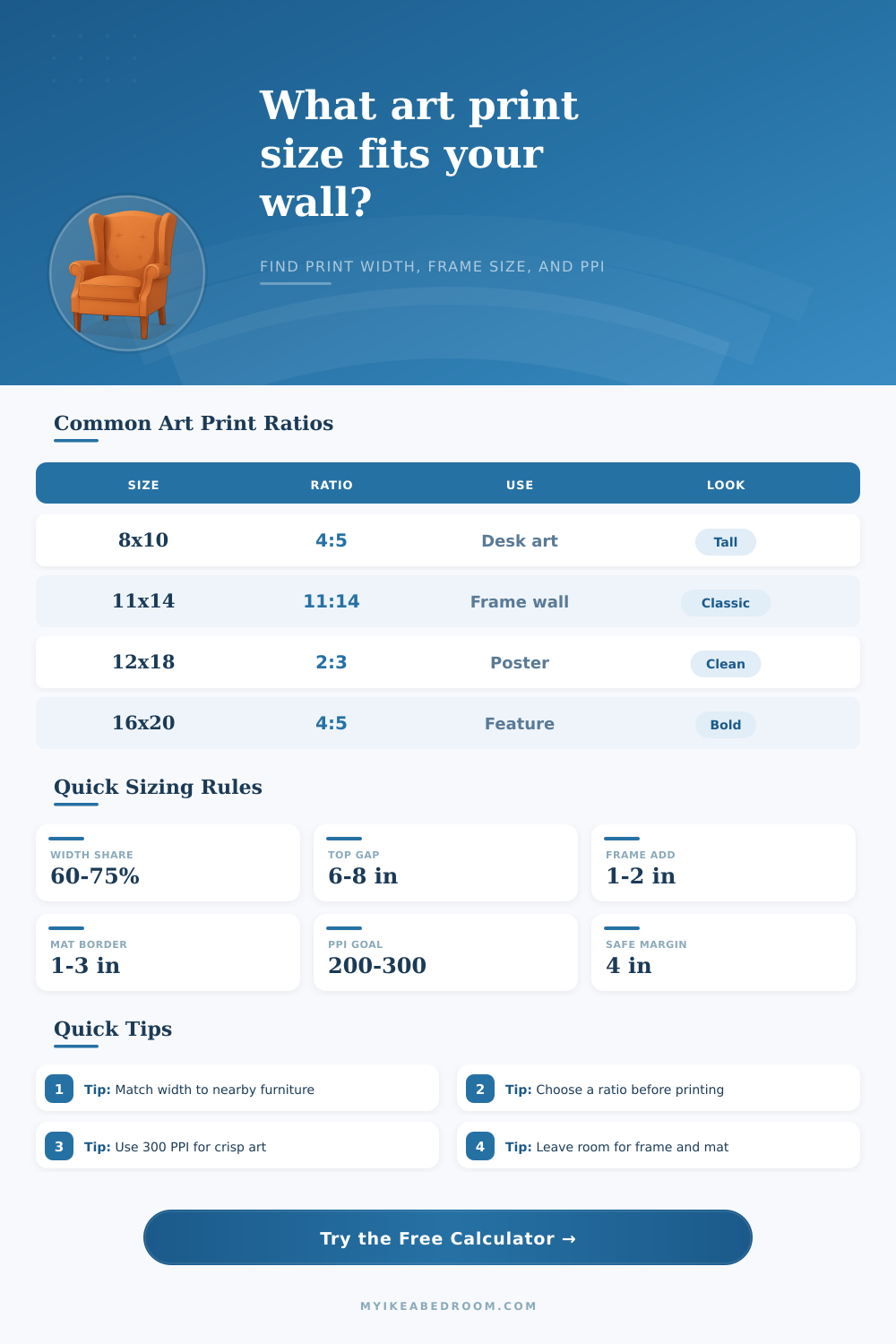
| 8 x 10 in | 4:5 | Desk art | Compact portrait |
| 11 x 14 in | 11:14 | Frame wall | Classic print |
| 12 x 18 in | 2:3 | Poster art | Clean and simple |
| 16 x 20 in | 4:5 | Feature wall | Balanced statement |
| 18 x 24 in | 3:4 | Gallery wall | Good mid-size |
| 24 x 36 in | 2:3 | Large anchor | Strong focal point |
| Placement | Width share | Top gap | Look |
|---|---|---|---|
| Above bed | 60-75% | 6-10 in | Calm center |
| Above sofa | 55-70% | 6-8 in | Relaxed anchor |
| Above console | 65-80% | 5-8 in | Tighter frame |
| Blank wall | 45-70% | Varies | Solo statement |
| Gallery wall | 70-85% | 4-6 in | Layered rhythm |
| Above desk | 50-65% | 5-7 in | Light workspace |
| Print size | Mat each side | Frame add | Finished size |
|---|---|---|---|
| 8 x 10 in | 1 in | 2-3 in | 10 x 12 to 12 x 14 |
| 11 x 14 in | 1-1.5 in | 2-3 in | 13 x 16 to 14 x 17 |
| 12 x 18 in | 1.5 in | 2-4 in | 15 x 21 to 16 x 22 |
| 16 x 20 in | 1.5-2 in | 2-4 in | 19 x 23 to 20 x 24 |
| 18 x 24 in | 2 in | 2-4 in | 22 x 28 to 24 x 30 |
| 24 x 36 in | 2-3 in | 3-5 in | 28 x 40 to 30 x 44 |
| PPI | File size feel | Best use | Note |
|---|---|---|---|
| 150 | Small file | Big wall art | Good from far |
| 200 | Medium file | General prints | Nice middle ground |
| 240 | Clean file | Framed art | Good for closer views |
| 300 | Sharp file | Premium prints | Best all-round target |
| 360 | Large file | Fine-detail work | Great for crop room |
| 400+ | Huge file | Archival source | Use when detail matters |
Standard sizes for art prints, as 8×10, 11×14 and 16×20 inches, enjoy big popularity thanks to their flexibility and low cost. They fit usual frames so you can easily frame and show them Stores as Target, Walmart, craft stores and online stores almost always have frames in 5×7, 8×10, 11×14 and 16×20. Makers of frames prepare those sizes because they sell well, which makes a perfect cycle.
Choosing a standard size helps the customer avoid the cost for expensive custom frames. Prints in 3×5, 4×6, 5×7 or 8×10 sell more than odd sizes, especially for that reason. Among them, 8×10 stays the fovairte for many styles.
Common Sizes for Art Prints and Frames
The 5×7 size is commonly chosen, because it is bigger than typical photo size. You easily frame it, and you use it for desk portraits or tiny images. It works well in small places and little walls.
Small prints since 4×6 are like postcards and work for personal areas as bookshelves or grouped with other on big walls. Many artists now do mini and micro prints in postcard or even more little size.
Square prints use less paper and more easily fit with mats, so they sell widely well and cost less to clients. Most commonly you find 8×8, 10×10, 12×12 and 16×16. Artists that sell squares commonly pre-mat them for rectangular frames as 4×6, 8×10, 11×14, 16×20 or 18×24, because those are most easily found.
The main goal is to reach balance in space; not too empty nor too crowded. The visual weight of a piece matters a lot. For a little vertical space between a window and a bookshelf, hang a pile of mini prints up.
8×10 images work well in tiny rooms, for instance kids rooms, bathrooms or home offices. Big frames in 12×16 or 16×20 commonly serve for photographs as a focal point, like a portrait above a fire.
IKEA frames are available in 4×6, 5×7, 8×10, 12×16, 16×20, 19.75×27.5 and 24×36. Each has a slightly smaller mat window. Many come with mats, so you choose between two print sizes. Typical IKEA metric sizes are 30×40 cm, 50×70 cm and 61×91 cm, perfect for art, posters or gallery walls.
Frames of 8×10 until 11×17 are middle size, good for illustrations or layered gallery. Professional prints in IKEA sizes as 19¾ x 17½ can be difficult to find, but custom prints solve that.
Three standard full paper sizes for good art are 16×20, 18×22 and 20×24, from that 16×20 is most commonly used. A4 is by far the most sold in metric lands, and in bigger sizes from here you sell less.