🖼 Floating Frame Calculator
Calculate your frame's inner opening, outside dimensions, moulding length, and depth compatibility for any canvas or artwork.
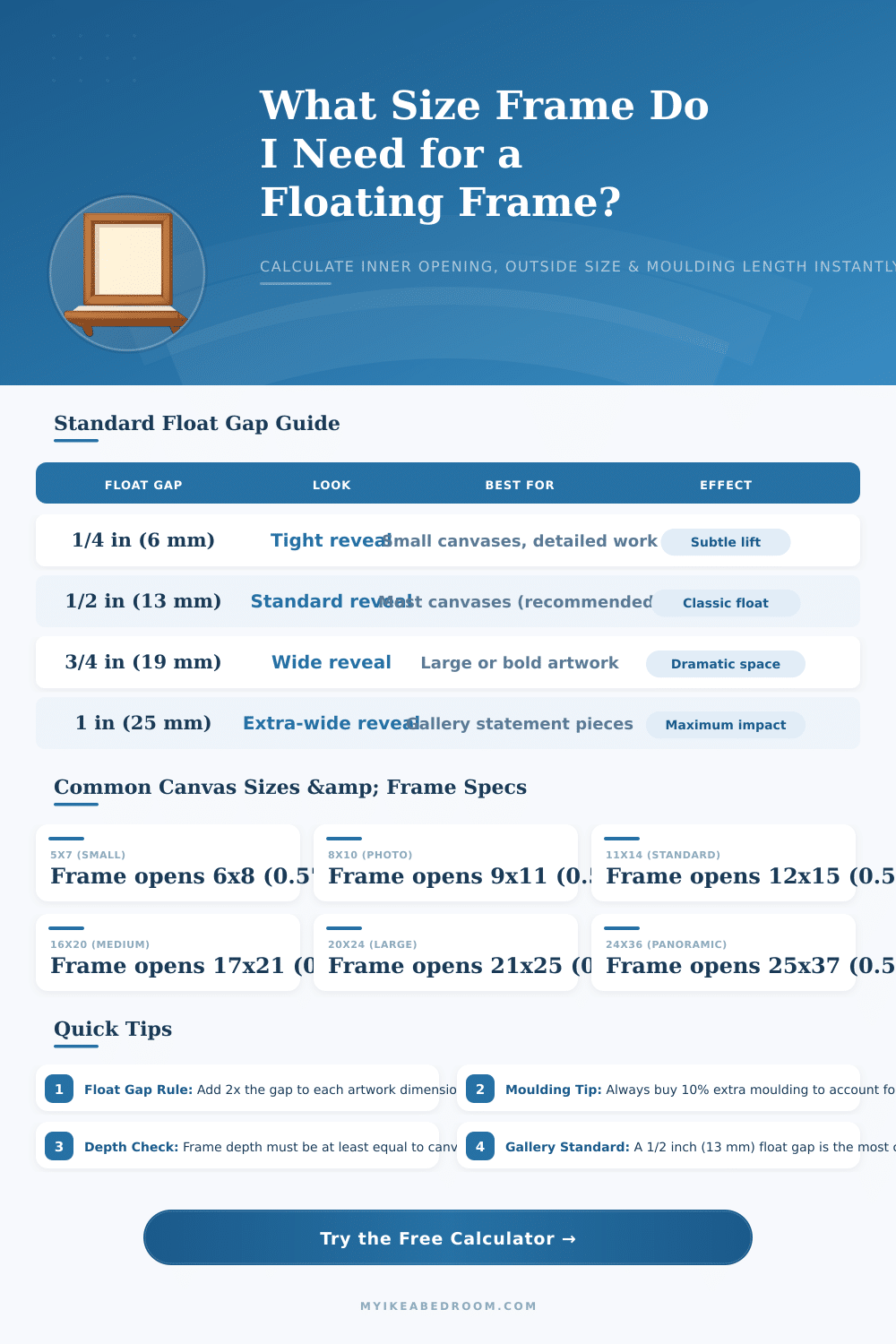
| Canvas Size | Float Gap | Inner Opening | Outside (1.5 in moulding) | Outside (2 in moulding) |
|---|---|---|---|---|
| 5 x 7 in | 1/2 in | 6 x 8 in | 9 x 11 in | 10 x 12 in |
| 8 x 10 in | 1/2 in | 9 x 11 in | 12 x 14 in | 13 x 15 in |
| 11 x 14 in | 1/2 in | 12 x 15 in | 15 x 18 in | 16 x 19 in |
| 12 x 12 in | 1/2 in | 13 x 13 in | 16 x 16 in | 17 x 17 in |
| 16 x 20 in | 1/2 in | 17 x 21 in | 20 x 24 in | 21 x 25 in |
| 20 x 24 in | 1/2 in | 21 x 25 in | 24 x 28 in | 25 x 29 in |
| 24 x 12 in | 1/2 in | 25 x 13 in | 28 x 16 in | 29 x 17 in |
| 24 x 36 in | 1/2 in | 25 x 37 in | 28 x 40 in | 29 x 41 in |
| Float Gap | Metric | Look & Feel | Best Canvas Size | Style |
|---|---|---|---|---|
| 1/4 in | 6 mm | Tight, subtle lift | Up to 11x14 in | Detailed, intricate art |
| 1/2 in | 13 mm | Classic float (standard) | All sizes | Versatile, gallery-ready |
| 3/4 in | 19 mm | Dramatic reveal | 16x20 in and up | Bold, modern, abstract |
| 1 in | 25 mm | Maximum impact | 20x24 in and up | Large statement pieces |
| Canvas Size | Inner Opening | Outside (1.5 in moulding) | Moulding Needed (incl. 10% waste) |
|---|---|---|---|
| 5 x 7 in | 6 x 8 in | 9 x 11 in | 48 in (4 ft) |
| 8 x 10 in | 9 x 11 in | 12 x 14 in | 60 in (5 ft) |
| 11 x 14 in | 12 x 15 in | 15 x 18 in | 74 in (6.2 ft) |
| 12 x 12 in | 13 x 13 in | 16 x 16 in | 72 in (6 ft) |
| 16 x 20 in | 17 x 21 in | 20 x 24 in | 98 in (8.2 ft) |
| 20 x 24 in | 21 x 25 in | 24 x 28 in | 115 in (9.6 ft) |
| 24 x 12 in | 25 x 13 in | 28 x 16 in | 97 in (8.1 ft) |
| 24 x 36 in | 25 x 37 in | 28 x 40 in | 150 in (12.5 ft) |
A floater frame, sometimes called floater, is a frame that leaves the artwork hover inside it, as if it does not touch the sides. That arrangement gives a fresh visual impression and adds to the whole feeling of depth and dimension The name comes from this impact: the piece seems floating in the space, separating from the frame that surround it.
This style is most popular for canvas artwork. A floater frame for canvas gives protection together with an attractive look. It works this well, because it is built specially for stretched canvas, so no edge of the artwork stays hidden.
What Is a Floater Frame
Everything shows, including the sides. The gap between canvas and frame creates that raised, floating impsression, that keeps the attention on the artwork, without competition from the frame.
Floater frames present a modern way in the display of art. They work well for canvas prints and photographs, bringing depth and style to anything that you hang. The artwork itself becomes the star, nothing else matters.
Artists and collectors both like canvas floater frames, because the canvas art then seems alive and raised.
There is a bit of confusion between float mounting and floater frames, and honestly, the word “float” is partly to blame. One is a mounting, that keeps the artwork above the mount board inside the mat. The other is entirely another frame style for canvas, where the piece seems floating inside it.
Two different things, but folks mix them always.
When you choose a frame for a poster, print or photograph, a good notion is adding a beveled mat to attract the eye to the artwork. The internal edge of the mat usually covers the art by around a quarter inch at every side, keeping everything flat in the place. Even so, if you want every bit of the artwork to show, maybe because of a special paper edge or signature that you want to show, then floating is the more elegant solution.
Floater frames now come in several materials. You find metal, wood and acrylic versions for walls or tables. Some are made of solid wood as maple, oak, cherry or walnut, with finishes in black, white or metallic tones.
There are also frameless acrylic variants, where two acrylic panels press the art for a borderless sight that lets the gloss of photographs shine. Others have modern details as brass bolts or matte black hardware, commonly handmade from frame acrylic.
To build one, follow some basic steps. Create a backing frame by joining four wooden bits, later stick it to the back of the board for more depth. The floater frame attaches to that wooden base.
Canvas sets by means of pin nails through the back of the floater frame in the stretcher beams. Foam core separates the layers, and basswood works as a strainer to keep everything steady, instead of tabs or tapes. Broader floater frames cost more, because the extra wood and finishing addexpense.