🏠 Gutter Hanger Spacing Calculator
Find exact hanger count & placement for any gutter run length — standard or snow-load zones
| Gutter Run | @ 12 in spacing | @ 18 in spacing | @ 24 in spacing | Metric Equiv. |
|---|---|---|---|---|
| 10 ft | 11 hangers | 8 hangers | 6 hangers | 3.05 m |
| 15 ft | 16 hangers | 11 hangers | 8 hangers | 4.57 m |
| 20 ft | 21 hangers | 14 hangers | 11 hangers | 6.10 m |
| 25 ft | 26 hangers | 17 hangers | 13 hangers | 7.62 m |
| 30 ft | 31 hangers | 21 hangers | 16 hangers | 9.14 m |
| 40 ft | 41 hangers | 27 hangers | 21 hangers | 12.19 m |
| 50 ft | 51 hangers | 34 hangers | 26 hangers | 15.24 m |
| 60 ft | 61 hangers | 41 hangers | 31 hangers | 18.29 m |
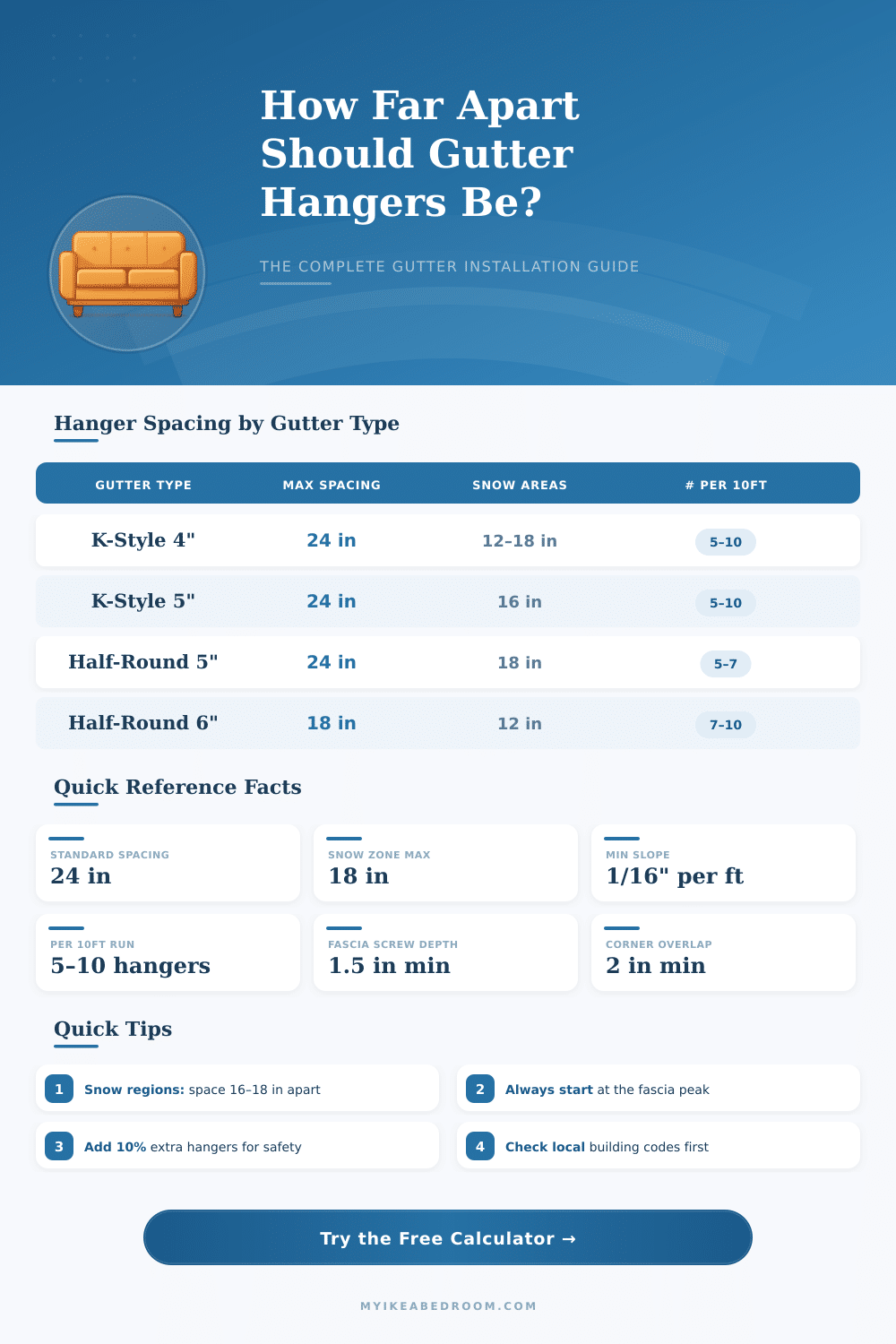
| Gutter Type | Std. Max Spacing | Snow Zone Spacing | Hanger Type | Notes |
|---|---|---|---|---|
| K-Style 4 in | 24 in | 16 in | Hidden / spike | Residential standard |
| K-Style 5 in | 24 in | 16–18 in | Hidden bracket | Most common size |
| K-Style 6 in | 24 in | 12–16 in | Heavy-duty bracket | High-volume rain |
| Half-Round 5 in | 24 in | 18 in | Wrap-around strap | Historic / traditional |
| Half-Round 6 in | 18 in | 12 in | Heavy strap | Large roof areas |
| Box 4 in | 24 in | 18 in | Bracket / clip | Commercial / European |
| Box 5 in | 24 in | 16 in | Heavy bracket | High-flow commercial |
| Fascia Gutter | 18 in | 12 in | Integral clip | Fascia-integrated |
| Project | Total Run | @ 24 in +10% | @ 18 in +10% | @ 12 in +10% |
|---|---|---|---|---|
| Small Shed | 20 ft | 12 | 15 | 23 |
| Garage (single) | 24 ft | 14 | 18 | 27 |
| Ranch Home | 80 ft | 45 | 60 | 89 |
| Two-story Colonial | 120 ft | 67 | 89 | 133 |
| Large Home | 160 ft | 89 | 118 | 177 |
| Small Commercial | 200 ft | 111 | 148 | 221 |
Gutter hangers are the hidden heroes of the home exterior. Right choice and installation help keep the gutters steady, stop water damage and stop the sagging of the tubes. But too big a gap between them can create serious troubles so pay attention to the distance they have
As is the kind of gutter, the maximum advised distance between gutter hangers should not pass three feet. More than that will put the whole structure of the system at risk. If they stand too far from one another, they will not support enough, and sections of the gutters will start to sink.
How Far Apart to Place Gutter Hangers
Sagging hapen, when the gutter hangers loosen or are spaced too wide. Bad spaced gutter hangers can destroy the life of the whole system.
The spacing of gutter hangers depends on the climate of the region. In warm areas you can lay them around 36 inches or three feet from one another. In cold places as Minnesota the gutter system must bear heavy snow and ice.
Hence gutter hangers should go at least every two feet in north regions, where the added snow adds weight to the gutters.
Short distances between gutter hangers let gutters bear more water. That gives a nice advantage beside the extra support.
When gutters pull away from the wall, the excessive weight damages fascia, soffits, foundation and more. Separated gutters lose the right slope, so they poorly remove the running water. The hook of the hanger should rest above the edge of the gutter and fix to the fascia.
Correctly on that wooden bit the gutters must lean.
Fast advice for placement at the roofline. Many owners lay them right on the limit, thinking that is the best, but then rain slips upward the bottom side of the roof and stays under it. Hence the position of gutters is key in the installation.
It is good to leave space between gutter hangers and soffits, so that the roof edges do not cover them or divert the water away from where it belongs. Check the general slope of the gutter before setting the gutter hangers to get an idea about the best plan.
Some setups space gutter hangers at 48 or even 60 inches. That is entirely too much and soon will cause problems. For good work guides suggest 18 to 24 inches in rafter tails, with a quarter inch fall for every 10 feet to the downspouts.
Use stainless steel screws and sealant to set gutters so they don’t fallfrom the work.