📚 Bookshelf Weight Calculator
Find out how much weight your bookshelf can safely hold based on material, shelf length & thickness
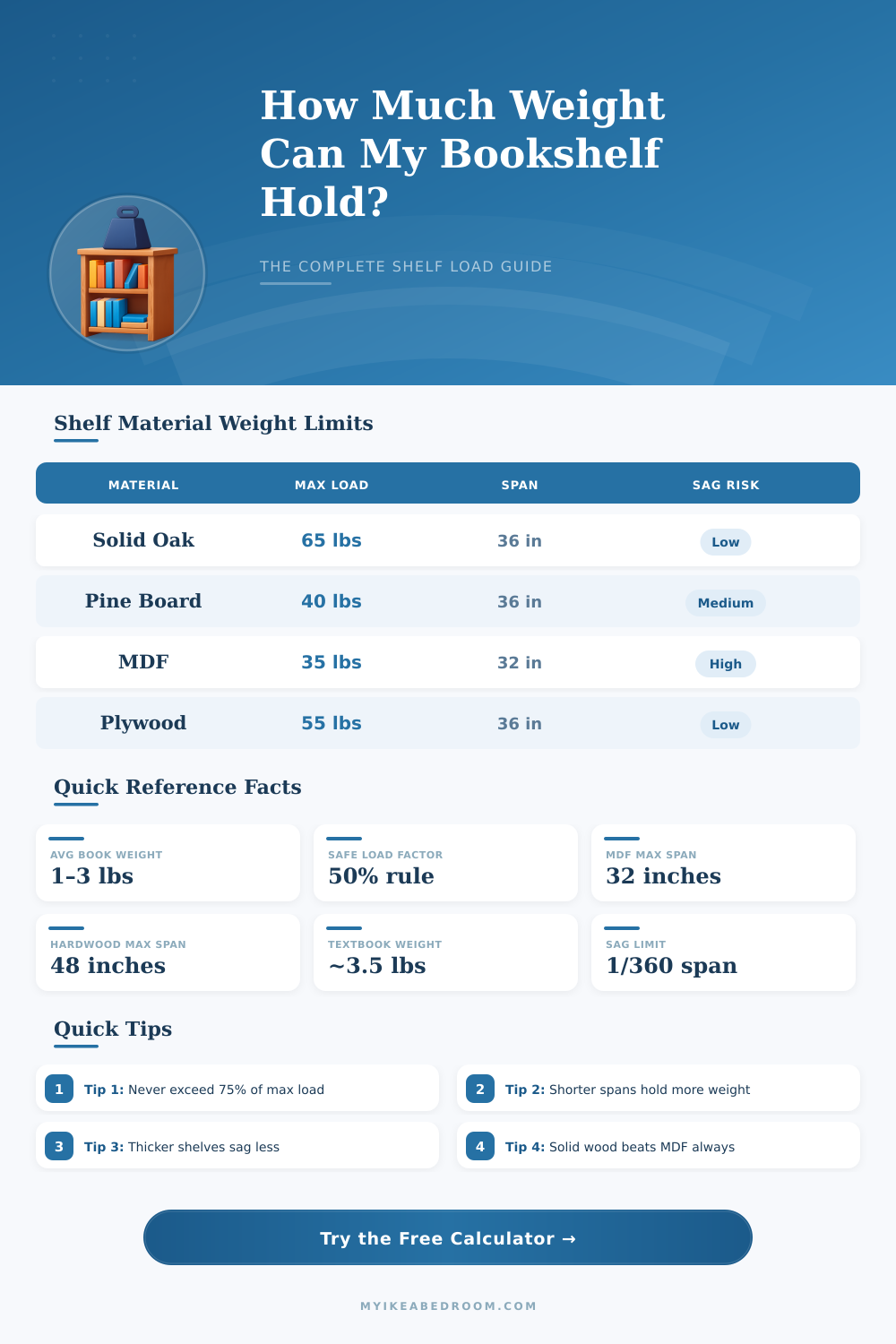
| Material | Modulus of Elasticity (E) | Max Safe Span (3/4 in thick) | Sag Risk at 36 in | Relative Strength |
|---|---|---|---|---|
| Solid Oak | 1.78 million psi | 48 in | Low | ⭐⭐⭐⭐⭐ |
| Solid Maple | 1.83 million psi | 48 in | Low | ⭐⭐⭐⭐⭐ |
| Pine (SYP) | 1.20 million psi | 36 in | Medium | ⭐⭐⭐ |
| Plywood (birch) | 1.50 million psi | 42 in | Low–Med | ⭐⭐⭐⭐ |
| MDF | 0.50 million psi | 32 in | High | ⭐⭐ |
| Particleboard | 0.35 million psi | 28 in | Very High | ⭐ |
| Tempered Glass (1/4 in) | 10.0 million psi | 24 in | Low (brittle) | ⭐⭐⭐ |
| Steel (14-gauge) | 29.0 million psi | 60+ in | None | ⭐⭐⭐⭐⭐ |
| Shelf Span | Solid Oak (lbs) | Plywood (lbs) | Pine (lbs) | MDF (lbs) | Particleboard (lbs) |
|---|---|---|---|---|---|
| 24 in (61 cm) | 95 | 82 | 60 | 52 | 38 |
| 30 in (76 cm) | 78 | 66 | 50 | 43 | 30 |
| 36 in (91 cm) | 65 | 55 | 40 | 35 | 25 |
| 42 in (107 cm) | 52 | 44 | 30 | 25 | 18 |
| 48 in (122 cm) | 42 | 35 | 22 | 18 | 12 |
| 60 in (152 cm) | 28 | 23 | 14 | 10 | 7 |
| Item Type | Avg Weight Each | Per Linear Foot | Notes |
|---|---|---|---|
| Paperback novel | 0.5–0.8 lbs | 8–10 lbs | ~14 books/ft |
| Hardcover novel | 1–2 lbs | 10–18 lbs | ~10 books/ft |
| Textbook / reference | 2.5–5 lbs | 20–35 lbs | ~7 books/ft |
| Encyclopedia set (vol) | 3–6 lbs | 30–45 lbs | ~8 vols/ft |
| Vinyl record (LP) | 0.6–0.8 lbs | 20–25 lbs | ~30 records/ft |
| DVD case | 0.3–0.4 lbs | 12–15 lbs | ~40 DVDs/ft |
| Decorative ceramic | 2–8 lbs | varies | Spot weight |
| Small plant (6 in pot) | 3–6 lbs | varies | Including soil + pot |
| Support Configuration | Load Multiplier | Best For | Notes |
|---|---|---|---|
| Both ends only | 1.0x (baseline) | Spans under 36 in | Standard bookcase shelf |
| Both ends + 1 center | 1.8–2.0x | 36–60 in spans | Dramatically reduces sag |
| Wall brackets every 16 in | 2.5–3.0x | Long wall shelves | Must anchor into studs |
| Floating (hidden brackets) | 0.6–0.8x | Light display only | Anchor strength limits load |
Knowing how much weight your bookshelf can bear matters, especially if you have children or pets because things could drop on them Typical hardcover books weigh between 2 and 7 pounds, while most paperback books are more lightweight. That does not seem like a lot alone, but when you start stacking them, the numbers quickly grow. I heard about folks that had 600 to 1,000 pounds of books without they themselves noticing that.
Bookshelves come with weight limits, that entirely depends on the material and the way of construction. If you follow the instructions of the maker and do not stuff the shelves too much, you will stop them from curving or even collapsing. Most standard shelves hold around 50 pounds per shelf, that is quite a lot for hardcovers, magazines and vinyl records.
How Much Weight Can Your Bookshelf Hold
Even so, I saw newer systems that hold a mmaximum of 44 pounds.
Take something like “Justice League Dark”, that thick book weighs almost 9 pounds and is 2.8 inches wide at the spine. You probably could lay around 10 of those there on one shelf before you reach the limit. I once tried a 90cm shelf filled with A4 bound journals, and it weighed almost 80 pounds when I finished.
That is a lot of weight focused in one spot.
Floating shelves are a different stole. They hold up to 50 pounds if the bracket is bound to a stud, blocks or solid masonry. Here the quality of the bracket and the material of the shelf matter.
If you use only plastic anchors and some screws, do not go past 50 pounds, you are asking for problems. Use a detector to find actual wood or metal behind the drywall to be much more safe and it is worth the effort.
The tension and the move of the anchors in real conditions can differ, even if the ratings say otherwise. Toggle anchors help to distribute the pressure on the drywall instead of focusing it in one spot. But if you overload such a shelf, the drywall can bulge out; and that is not the look that you want.
Because of the physics of a cantilever design, the weight matters more the further it is from the attachment points. A 15-inch shelf holds better than a 30-inch, partly because you lay fewer books on it. If you keep it lightweight, for example 40 pounds max on those short shelves (you will be safe).
For a solid and cheap bookshelf that can bear 100 pounds each shelf, good plywood is the right choice. Keep the design simple with vertical supports, use wood glue and screw everything together for real stability. A basic 2×4 can bear 1,000 pounds if the weight is spread evenly, or 500 pounds in the center.
Deeper bookshelves distribute the load better on the floor-supports, which helps everything last longer.