🖼 Picture Rail Height Calculator
Find the ideal rail mounting height, hanging wire length, and perfect artwork placement for any ceiling height or room style.
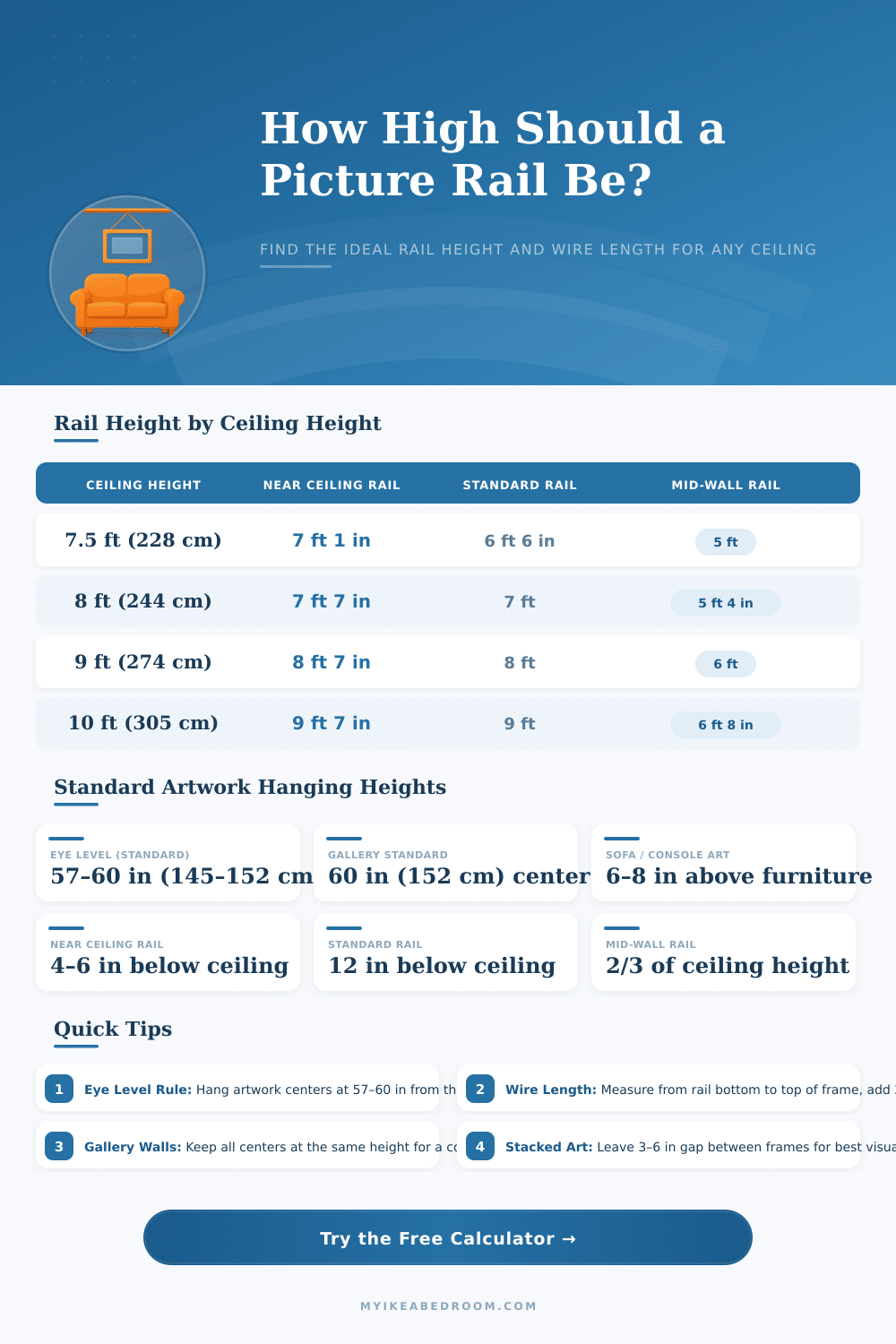
💡 Eye-Level Hanging Rule: The standard for galleries and interior designers is to hang artwork so its center sits at 57–60 inches from the floor — roughly average standing eye level. For sitting areas (sofas, desks), drop the center to around 48–54 inches.
Wire slack: Always add 2–3 inches of extra cord or wire beyond the calculated length to allow for knots, adjustments, and hook clearance. For adjustable-hook systems, the rod itself adds extra reach — factor in the rod length when measuring.
| Ceiling Height | Near Ceiling Rail (5 in gap) | Standard Rail (12 in gap) | Mid-Wall Rail (2/3 height) |
|---|---|---|---|
| 7 ft (84 in / 213 cm) | 6 ft 7 in (200 cm) | 6 ft (183 cm) | 4 ft 8 in (142 cm) |
| 7.5 ft (90 in / 229 cm) | 7 ft 1 in (216 cm) | 6 ft 6 in (198 cm) | 5 ft (152 cm) |
| 8 ft (96 in / 244 cm) | 7 ft 7 in (231 cm) | 7 ft (213 cm) | 5 ft 4 in (163 cm) |
| 9 ft (108 in / 274 cm) | 8 ft 7 in (262 cm) | 8 ft (244 cm) | 6 ft (183 cm) |
| 10 ft (120 in / 305 cm) | 9 ft 7 in (292 cm) | 9 ft (274 cm) | 6 ft 8 in (203 cm) |
| 11 ft (132 in / 335 cm) | 10 ft 7 in (323 cm) | 10 ft (305 cm) | 7 ft 4 in (224 cm) |
| 12 ft (144 in / 366 cm) | 11 ft 7 in (354 cm) | 11 ft (335 cm) | 8 ft (244 cm) |
| Artwork Height | Center at 57 in | Center at 58 in | Center at 60 in | Hardware Offset (2 in) |
|---|---|---|---|---|
| 12 in (30 cm) | 27 in (69 cm) | 26 in (66 cm) | 24 in (61 cm) | 29 in (74 cm) |
| 18 in (46 cm) | 24 in (61 cm) | 23 in (58 cm) | 21 in (53 cm) | 26 in (66 cm) |
| 24 in (61 cm) | 21 in (53 cm) | 20 in (51 cm) | 18 in (46 cm) | 23 in (58 cm) |
| 30 in (76 cm) | 18 in (46 cm) | 17 in (43 cm) | 15 in (38 cm) | 20 in (51 cm) |
| 36 in (91 cm) | 15 in (38 cm) | 14 in (36 cm) | 12 in (30 cm) | 17 in (43 cm) |
| 48 in (122 cm) | 9 in (23 cm) | 8 in (20 cm) | 6 in (15 cm) | 11 in (28 cm) |
| Room / Setting | Recommended Center Height | Notes |
|---|---|---|
| Living room — standing viewing | 57–60 in (145–152 cm) | Gallery standard; most versatile |
| Above sofa / console | 6–8 in above furniture top | Keep art within 2/3 of sofa width |
| Dining room | 55–58 in (140–147 cm) | Viewed seated; lower is better |
| Bedroom — above bed | Headboard top + 4–6 in | Scale to headboard width |
| Hallway / staircase | Follows stair angle, 57 in avg | Stagger art with step rise |
| Home office / desk area | 48–54 in (122–137 cm) | Seated eye level, not standing |
| Children's room | 42–50 in (107–127 cm) | Scaled to child's eye level |
| Gallery wall / feature wall | 60 in center anchor (153 cm) | Build layout from center anchor |
🔧 Adjustable Hook Systems: If you use an adjustable picture rail hook with a hanging rod and sliding S-clips, the effective wire starting point is at the bottom of the rod, not the rail itself. Measure rod length and subtract from total wire length. These systems var you reposition art without new holes, making them ideal for renters or frequently changed galleries.
📌 Stacked Artwork Tip: When hanging two frames vertically, calculate each center separately. The upper frame center should be the main height + half the gap + half the upper frame height. The lower frame center should be the main height - half the gap - half the lower frame height. Keeping a 3–6 in gap creates visual breathing room.
The height of picture rail depends on the room, the ceiling and the look you want to reach. Picture rail are horizontal molding installed near the ceiling to protect the walls. Usually, you lay it around 12 to 18 inches under the ceiling
When there is no picture rail, you usually position new ones between 30cm and 50cm (12 to 20 inches) under the ceiling. Generally, the higher the room, the lower is the distance of the rail from the ceiling. Before deciding the position, it helps to check the height carefully.
How high should a picture rail be
In old homes, picture rail are traditionally laid 30 to 50cm under the ceiling for better proportion and elegance. In modern interiors, it commonly sits in the upper two-thirds of the wall for a contemporary lkook.
For a standard ceiling height 8 feet, the rail should be 300mm away from the ceiling for the best result. Even so, that is not a strict rule, so you can choose what best fits your space and style.
Another guideline that you commonly mention is using a sixth of the wall height below the ceiling. That gives roughly 22 inches in some cases, which usually looks right. Another method is to place the rail 500mm under the ceiling and paint it in the same colour as the ceiling itself.
Because ceilings were lower in the 1930s, picture rail were commonly found less than an inch away from the ceiling. That pushed many folks to believe that it was some tiny version of crown molding. In some old homes, the original rail are about three-eighths of an inch under 9-foot ceilings.
That is the highest position they ever had. Regarding the lowest limit, they must be above the centre of gravity of the highest image that you will hang. Any place between those extremes that looks good will work.
In the living room, the rail must line up with the top of the main window. In the dining room, it could sit about 4 inches away from the ceiling. If the windows and doors have different heights and the top of a window is higher than the rail, then the rail touches the trim on each side.
Some folks laid picture rails about 6 inches away from the ceiling, although that can look a bit strange.
When you hang art, bigger images you can lay a bit higher, so that the top of the image is just over eye level. Little frames you can hang a bit lower, so that the bottom is under eyelevel. The most ideal solution is picture rail through the whole width of the wall, because then the height of every piece can range freely.