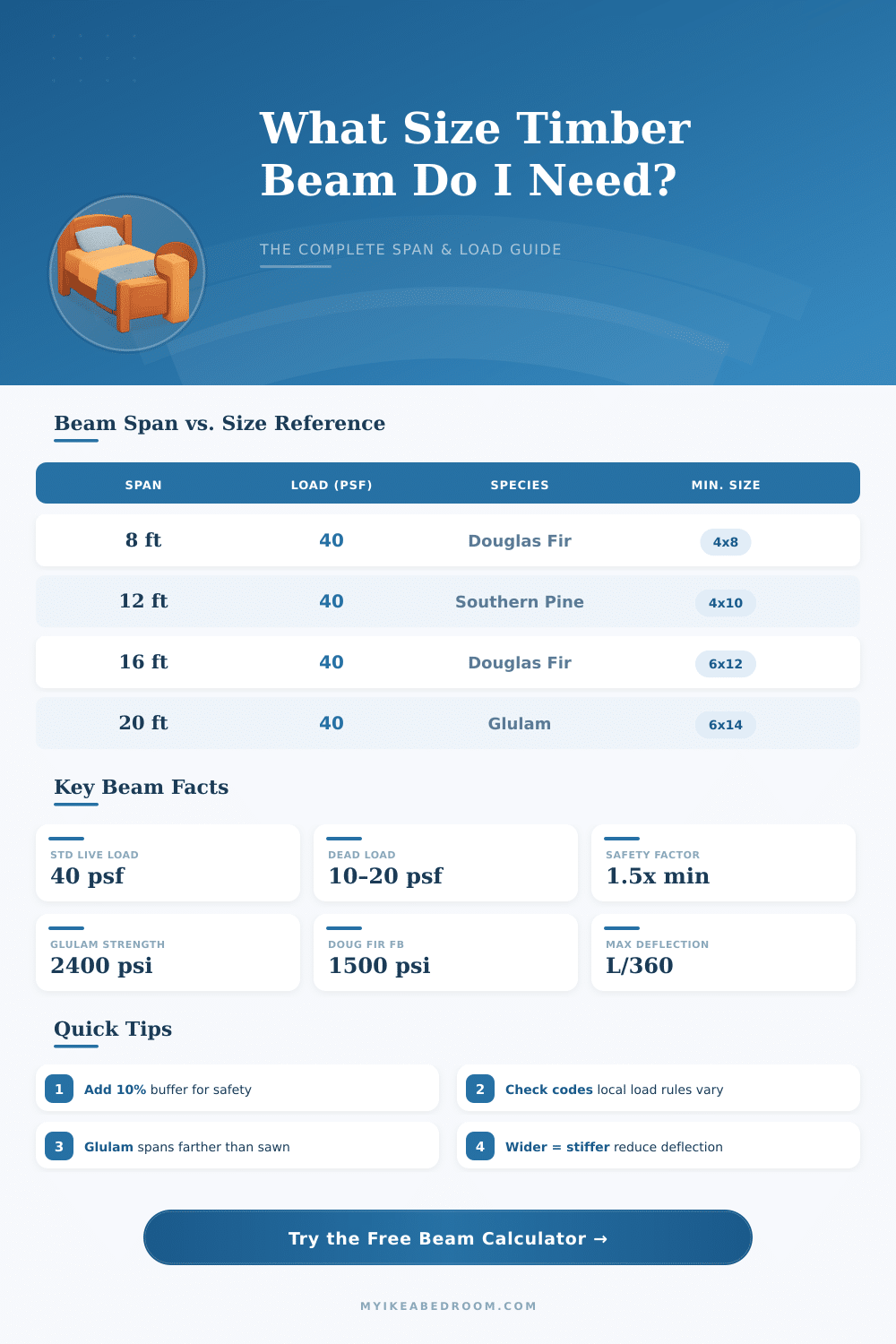
🪵 Timber Frame Beam Size Calculator
Find the correct beam dimensions for your span, load, and wood species — imperial & metric supported
| Span | Trib. Width | Total Load | Doug Fir | S. Pine | LVL | Glulam |
|---|---|---|---|---|---|---|
| 8 ft (2.4 m) | 8 ft | 55 psf | 4x8 | 4x8 | 3.5x7.25 | 3.125x6 |
| 10 ft (3 m) | 8 ft | 55 psf | 4x10 | 4x10 | 3.5x9.25 | 3.125x7.5 |
| 12 ft (3.7 m) | 8 ft | 55 psf | 4x12 | 4x12 | 3.5x11.25 | 3.125x9 |
| 14 ft (4.3 m) | 8 ft | 55 psf | 6x12 | 6x12 | 3.5x11.25 | 3.125x9 |
| 16 ft (4.9 m) | 8 ft | 55 psf | 6x14 | 6x12 | 5.25x11.25 | 3.125x12 |
| 20 ft (6.1 m) | 10 ft | 55 psf | 6x16 | 6x16 | 5.25x14 | 5x12 |
| 24 ft (7.3 m) | 10 ft | 55 psf | 8x18 | 8x18 | 7x14 | 5x15 |
| 30 ft (9.1 m) | 12 ft | 55 psf | Glulam req. | Glulam req. | 7x18 | 6.75x18 |
| Rule of Thumb | Formula | Example (12 ft span) | Notes |
|---|---|---|---|
| Depth estimate | Span (in) / 12 to 16 | 9–12 inches | Starting point only |
| Width minimum | Depth / 3 to Depth / 2 | 3–4 inches | Lateral stability |
| Sawn timber depth | Span (ft) x 0.75 in | 9 in | Floor beams, 40 psf |
| Glulam depth | Span (ft) x 0.6 in | 7.2 in | Same load |
| LVL depth | Span (ft) x 0.55 in | 6.6 in | Higher Fb value |
| Ridge beam depth | Span (ft) x 0.9 in | 10.8 in | 30 psf roof load |
| Nominal Size | Actual Size (in) | Section Mod. S (in³) | Moment of Inertia I (in⁴) | Weight (lbs/ft) |
|---|---|---|---|---|
| 4x8 | 3.5 x 7.25 | 30.7 | 111.1 | 7.0 |
| 4x10 | 3.5 x 9.25 | 49.9 | 230.8 | 8.9 |
| 4x12 | 3.5 x 11.25 | 73.8 | 415.3 | 10.8 |
| 6x10 | 5.5 x 9.25 | 82.7 | 393.0 | 14.0 |
| 6x12 | 5.5 x 11.25 | 121.2 | 697.1 | 17.0 |
| 6x14 | 5.5 x 13.25 | 167.1 | 1127.7 | 20.0 |
| 6x16 | 5.5 x 15.25 | 220.2 | 1706.8 | 23.0 |
| 8x12 | 7.5 x 11.25 | 165.3 | 950.5 | 23.1 |
| 8x16 | 7.5 x 15.25 | 300.3 | 2327.4 | 31.4 |
When you plan any project the size of the wooden beams is very important. Wooden frame structures work differently than usual houses, that you sometimes call “stick building”, where you use small timbers with fixed sizes as 2×4 or 2×6. These frame systems base on “point load“, which means that some strong vertical and horizontal elements bear the whole weight of the house. Actually, many such structures are made up of less than 200 main parts.
There is a simple rule for depth of heavy wooden beams: you need at least one inch for every foot of span. Like this, for distance of 20 feet, the beam must be at least 20 inches deep. The typical ratio between span and depth is 1/18, so for 10-meter distance, the minimal depth would be 56 cm.
How to Choose Wooden Beam Sizes
That however depends on that the distance between the centers of the beams is not too big, around 450 to 600 mm. The typical sapan to depth ratio of a timber beam is 1/18.
In the method of columns and beams, the vertical columns usually are square, for instance 8×8. Even so, every beam that spans space and bears weight is rectangular, as 12×8. If you would use 8×8 for distance longer than 12 feet, it would bend because of its own weight even before you would add something on top. Columns, cross beams and plates commonly measure 8×8. The rafters and floors are usually 4×6, laid with two feet between centers, while the ties between them are 4×4.
Regarding the materials, the architect must choose between natural structural wood or engineered wood, as Glulam or LVL (Laminated Veneer Lumber). The choice depends on the plan, the spans, the prices and personal tastes. A ridge beam could be for example a PSL beam of 5.25 x 11.25 inches.
If you do not know the precise kind of wood, the size looks normal for simple sawn wood.
A beam with nominal size of 8×12 actually measures 7.5 x 11.25 inches. To find the actual dimension of the wood, you usually subtract half an inch from the nominal measure. The lead time for timbers is widely two to three weeks after the order, but it can be longer for big amounts or special sizes.
For a little shed, 6×6 is big enough. One plan asked for 6×8 beams because that was the wood available, although it was possible to use even 6×10. A calculator showed that distance would work with 4×10, but not with 4×8. Commonly the limiting factor is the bending. Only because it is wood, that does not mean that it has infinite capacity.
Hence, an engineer usually controls the size of the timbers when you use nontraditional frames.