🪵 Timber Framing Calculator
Estimate board feet, beam counts & lumber quantities for your timber frame project
lbs / BF (green)
lbs / BF (green)
lbs / BF (green)
lbs / BF (green)
lbs / BF (green)
lbs / BF (green)
lbs / BF (green)
lbs / BF (green)
| Timber Size | 8 ft piece | 10 ft piece | 12 ft piece | 16 ft piece | 20 ft piece |
|---|---|---|---|---|---|
| 4x4 | 10.7 BF | 13.3 BF | 16 BF | 21.3 BF | 26.7 BF |
| 4x6 | 16 BF | 20 BF | 24 BF | 32 BF | 40 BF |
| 6x6 | 24 BF | 30 BF | 36 BF | 48 BF | 60 BF |
| 6x8 | 32 BF | 40 BF | 48 BF | 64 BF | 80 BF |
| 8x8 | 42.7 BF | 53.3 BF | 64 BF | 85.3 BF | 106.7 BF |
| 8x10 | 53.3 BF | 66.7 BF | 80 BF | 106.7 BF | 133.3 BF |
| 10x10 | 66.7 BF | 83.3 BF | 100 BF | 133.3 BF | 166.7 BF |
| 12x12 | 96 BF | 120 BF | 144 BF | 192 BF | 240 BF |
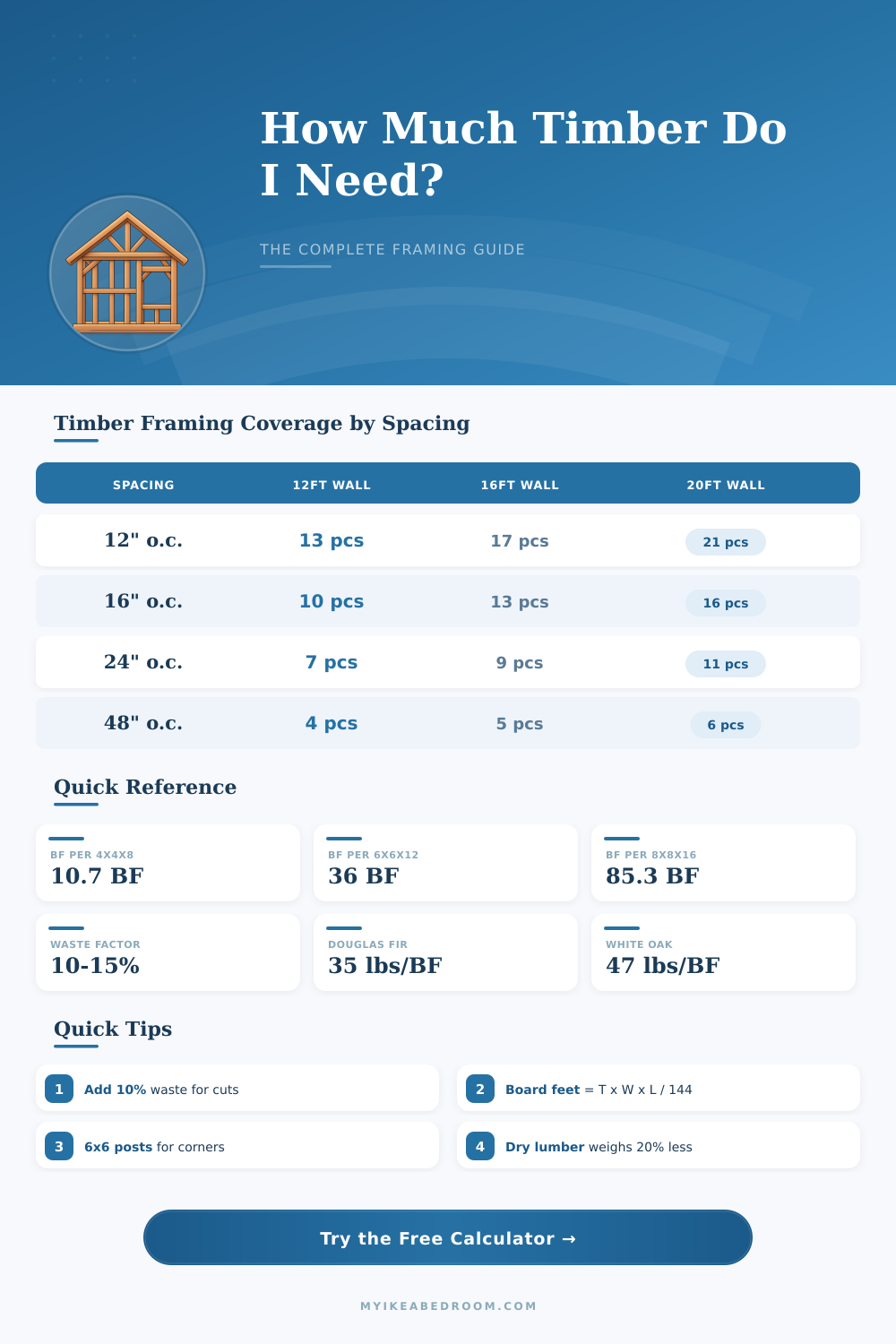
| Spacing | 12 ft span | 16 ft span | 20 ft span | 24 ft span | 32 ft span | 40 ft span |
|---|---|---|---|---|---|---|
| 12 in o.c. | 13 | 17 | 21 | 25 | 33 | 41 |
| 16 in o.c. | 10 | 13 | 16 | 19 | 25 | 31 |
| 24 in o.c. | 7 | 9 | 11 | 13 | 17 | 21 |
| 48 in o.c. | 4 | 5 | 6 | 7 | 9 | 11 |
| Project | Dimensions | Est. Board Feet | Pieces (12 ft) | Weight (lbs) |
|---|---|---|---|---|
| Garden Shed | 12x16 ft | 480 BF | 40 pcs | ~15,360 |
| Garage | 16x20 ft | 820 BF | 68 pcs | ~26,240 |
| Small Cabin | 20x24 ft | 1,440 BF | 120 pcs | ~46,080 |
| Workshop | 24x32 ft | 2,100 BF | 175 pcs | ~67,200 |
| Farmhouse | 28x40 ft | 3,200 BF | 267 pcs | ~102,400 |
| Large Barn | 40x60 ft | 6,500 BF | 542 pcs | ~208,000 |
Timber framing is traditional way to build that bases on big and heavy timbers to form the skeletal structure. Instead of depend on slim timbers as 2×6 this method uses squared timbers that suit exactly. What genuinely sets such framing is its distinctive combination…
The way those timbers connect to each other. Big wooden pegs keep everything safe, no nails or metal seals. Metal brackets?
What is timber framing?
You will not find them here, because the whole system bases on wood that suits directly against wood.
Timber framing and the method of post-and-beam are quite alike. Both create supporting structure that bears the whole weight of the house. Hence, internal load-bearing walls become unnecessary, what opens big possibilities for large and continuous rooms.
The roots of this are deep. Long before modern techniques appeared, you built houses from heavy wooden columns and beams that you combined by means of precise and complex joints. For more than thousand years, wooden frames were popular through large parts of Europe, where wood was easily found.
In those early, simple structures, the timbers were either laid on the ground or planted in it.
Use local wood is other advantage of this method. You can find or buy dead trees, cut them in logs, and later work them in beams by means of simple wooden techniques. Like this you preapre your material for the framing.
Really, it costs more than modern stick-framing and require much more time. Both the materials and the skill come with higher prices. Even so, you comparison showed interesting image: stick-framed house with real wood cost around 280k only for the framing, during red oak wooden framing cost around 80k. So, in the right circumstances, it indeed can be the cheaper choice.
Every part of wooden framing calls “bent”. When the frames are made and built, you can send them outside and later raise them by means of local team. You will require plan first, maybe of architect or engineer.
And also clever framer and reliable source of wood.
For insulate wooden framing without excessive thermal toll, you must roll it in protective shell. Panels well operate for that, although adding TJI-panels to the exterior framing is other opportunity. Some builders do exterior framing with 2×6 and pine boards instead of plywood, filling the holes by means of insulation.
The Timber Framers Guild exist to back and promote that craft. What is genuinely unique here are that the clients and homeowners can help cut the timbers and raise the framing… Practical work, that rarely happens in other constructions.