🪜 Stair Framing Calculator
Calculate rise, run, stringer length, step count & lumber needed for any staircase
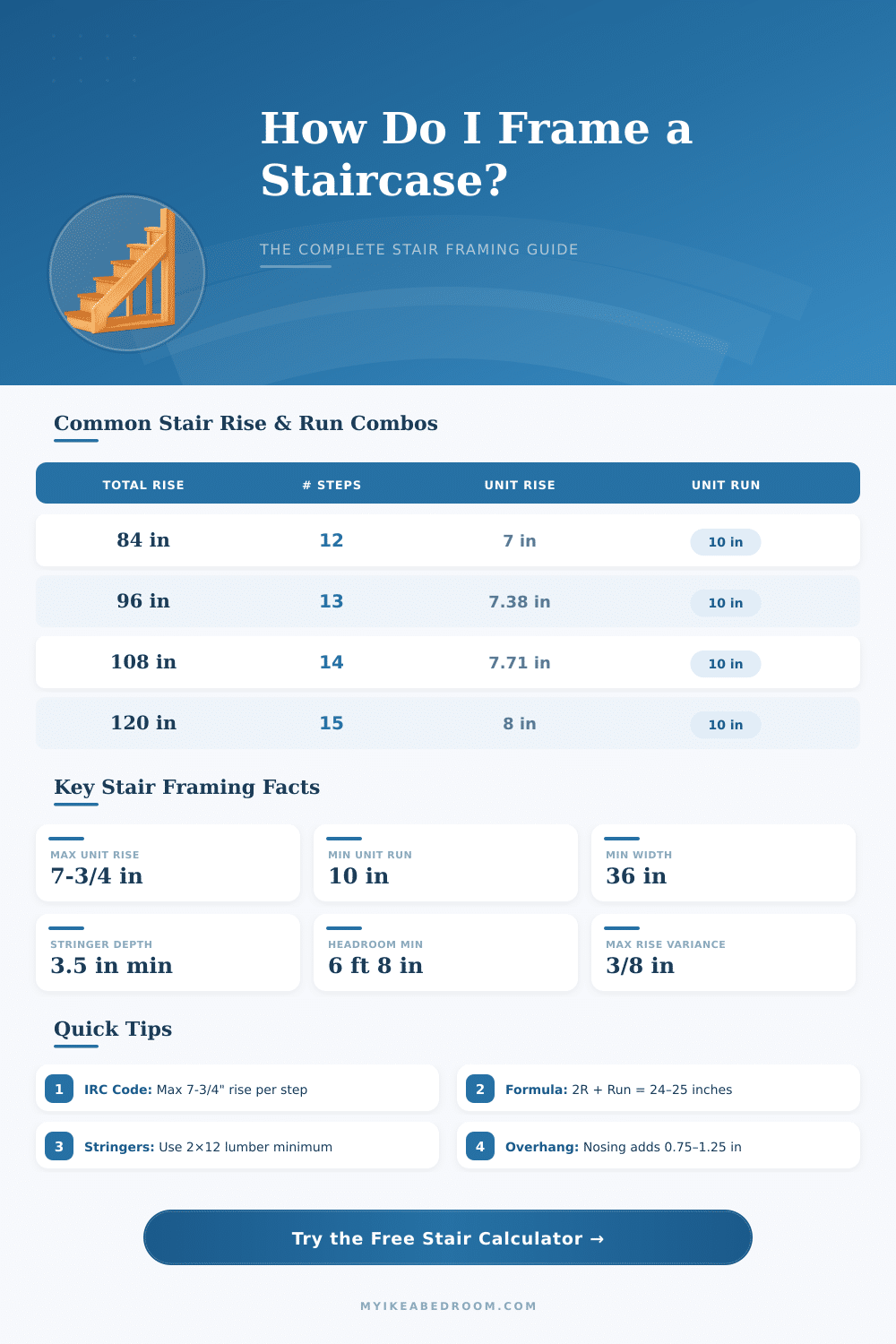
| Total Rise | No. of Risers | Unit Rise | Unit Run | Total Run | Stringer Length (approx) |
|---|---|---|---|---|---|
| 60 in (5 ft) | 8 | 7.50 in | 10 in | 70 in | 91 in (7.6 ft) |
| 72 in (6 ft) | 10 | 7.20 in | 10 in | 90 in | 114 in (9.5 ft) |
| 84 in (7 ft) | 12 | 7.00 in | 10 in | 110 in | 136 in (11.3 ft) |
| 96 in (8 ft) | 13 | 7.38 in | 10 in | 120 in | 150 in (12.5 ft) |
| 108 in (9 ft) | 15 | 7.20 in | 10 in | 140 in | 172 in (14.3 ft) |
| 120 in (10 ft) | 16 | 7.50 in | 10 in | 150 in | 184 in (15.3 ft) |
| 132 in (11 ft) | 18 | 7.33 in | 10 in | 170 in | 208 in (17.3 ft) |
| 144 in (12 ft) | 19 | 7.58 in | 10 in | 180 in | 220 in (18.3 ft) |
| Lumber Size | Nominal | Actual | Best For | Max Span |
|---|---|---|---|---|
| 2x10 | 2" x 10" | 1.5" x 9.25" | Short runs, light use | ~8 ft |
| 2x12 | 2" x 12" | 1.5" x 11.25" | Standard residential | ~12 ft |
| 4x12 | 4" x 12" | 3.5" x 11.25" | Heavy-duty / commercial | ~16 ft |
| LVL Beam | Varies | 1.75" x 9.5"+ | Long spans, engineered | 20 ft+ |
| Project | Total Rise | No. Steps | Stringers (3) | Total Run |
|---|---|---|---|---|
| Single-story deck | 36 in | 5 | 3 pcs @ 6 ft | 40 in |
| Raised deck (8 ft) | 96 in | 13 | 3 pcs @ 14 ft | 120 in |
| Basement stairs | 108 in | 15 | 3 pcs @ 15 ft | 140 in |
| Interior floor-to-floor | 120 in | 16 | 3 pcs @ 16 ft | 150 in |
| Attic pull-down | 84 in | 12 | 2 pcs @ 12 ft | 110 in |
| Grand entry exterior | 42 in | 6 | 4 pcs @ 8 ft | 50 in |
Stair framing maybe seem complex but when you understand the basics, everything becomes clearer. For build solid staircase, need three main elements. The stringer is the main sloping beam that backs the steps and the risers.
Usually you use 2×12 wood, but for longer distances you can use 2×14 stringers.
How to Frame a Simple Staircase
Build staircase by means of framing square follow systemtac and repeatable process. First you determine the height and length, count the number of steps, and cut template on the square, for later transport the outline to the wood and check everything. The framing square is entirely inherent tool when you build simple staircase with risers and steps.
Before start the construction, it is serious to find and frame the stairwell. In some drafts, you must cut opening through the floor beams to create way from the cellar to the first floor. That part can be a bit stressful.
When you install the staircase, the usual way is set the soleplate to the floor and bind the upper cover to the inside of the stringers.
Many rules require landing around every staircase that has more than 16 risers. The surface of the landing must be same height as the other steps. Remember frame the landing so that it allow various thicknesses of floors or floors.
When you address the landing as simple step, the rest of the math settles itself. L-shaped staircase is made up of three parts, but you share it in those sections only after the calculations are ready and the stringers marked.
Also the width of the staircase is important. It is well to measure the width up and below so that they be as most equal, and ensure that it measures at least 36 inches according to the rules. If the staircase has walls on both sides, you leave space of three quarter-inches on every side; that helps to install the drywall and stop the staircase from squeaking.
Those additional 1.5 inches allow to lay half-inch drywall and three-quarter-inch skirt with a bit of free space, that you end by means of caulk. One frames the walls, lay drywall, install the provisional risers and steps, lay the skirt, and ultimately cut the steps so that they seat perfectly and flatly.
After which the frame is ready, screw simple 2×4 provisional rail and mark by means of wooden crayon where the walls go on the floors and steps. It is worth considering support to the exterior stringer, for example 4×4 wooden post until the floor. The walls and drywall adds a lot of weight to the stringer that was not designed as wall beam.
On every jobsite are builders and later ultimately carpenters. Builder maybe can end the rough framing, but end the staircase is entirely other skill.