🏗 Floor Framing Calculator
Calculate floor joists, rim board, subfloor sheets, and blocking for any floor system
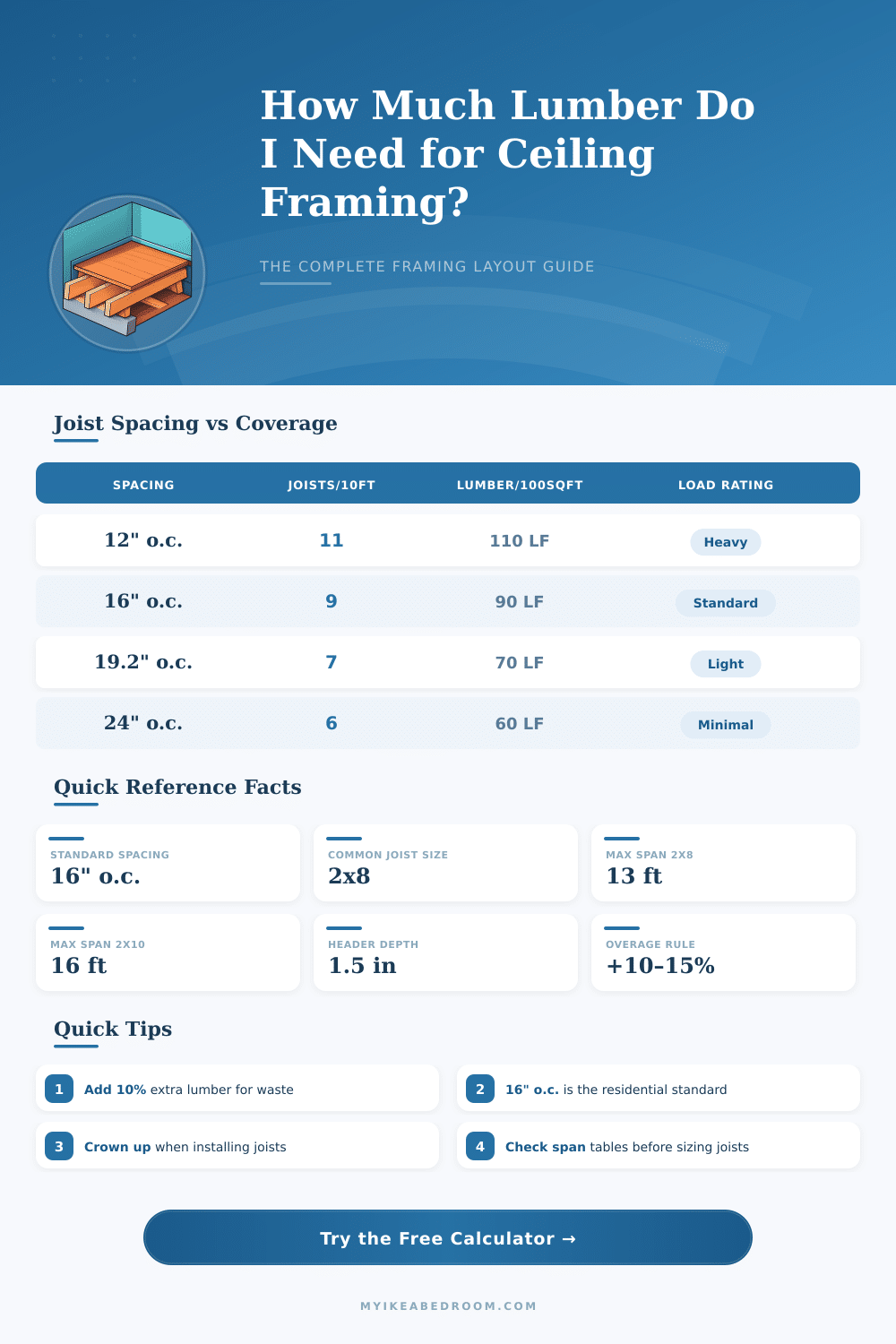
| Floor Width (ft) | 12" OC | 16" OC | 24" OC | Blocking Rows (16" OC) |
|---|---|---|---|---|
| 8 ft | 9 | 7 | 5 | 1 |
| 10 ft | 11 | 9 | 6 | 2 |
| 12 ft | 13 | 10 | 7 | 2 |
| 16 ft | 17 | 13 | 9 | 2 |
| 20 ft | 21 | 16 | 11 | 3 |
| 24 ft | 25 | 19 | 13 | 3 |
| 28 ft | 29 | 22 | 15 | 4 |
| 32 ft | 33 | 25 | 17 | 4 |
| Floor Area (sq ft) | Exact Sheets | With 10% Waste | With 15% Waste | Coverage per Sheet |
|---|---|---|---|---|
| 100 sq ft | 4 | 5 | 5 | 32 sq ft each |
| 192 sq ft (12x16) | 6 | 7 | 7 | 32 sq ft each |
| 320 sq ft (16x20) | 10 | 11 | 12 | 32 sq ft each |
| 480 sq ft (20x24) | 15 | 17 | 18 | 32 sq ft each |
| 576 sq ft (24x24) | 18 | 20 | 21 | 32 sq ft each |
| 768 sq ft (24x32) | 24 | 27 | 28 | 32 sq ft each |
| 960 sq ft (24x40) | 30 | 33 | 35 | 32 sq ft each |
| 1200 sq ft (30x40) | 38 | 42 | 44 | 32 sq ft each |
| Joist Size | 12" OC Max Span | 16" OC Max Span | 24" OC Max Span | Typical Use |
|---|---|---|---|---|
| 2x8 | 14 ft | 12 ft | 10 ft | Small bedrooms, closets |
| 2x10 | 18 ft | 16 ft | 13 ft | Standard residential floors |
| 2x12 | 22 ft | 20 ft | 17 ft | Open plans, garages, barns |
Build the floor framing to create the basic structure that everything else sits on. The traditional method is made of stacking wooden materials to form a platform at the base. You commonly call this process “stick framing” and you get a structure that is lightweight and cheap yet lasts long
The floor framework consists mostly of wooden joists that are slim wooden beams laid parallel to each other at regular intervals. For floor joists you usually use 2×8, 2×10 or 2×12, while ceiling joists are most commonly 2×6 or even smaller. After the basic plan of the new house is confirmed and the timbers are cut to the right measures, finishing the floor is simple: you only build a frame of the right shape and strengthen it with beams running in both directions.
How to Build a Floor Frame
The main parts of the floor framing are the sill, the rim joists and other joists. This wood occasionally needs fixxing to protect it against water or insects.
Wooden I-joists give a good balance between strength, price and ease of installation. The design of the framing for engineered lumber differs a bit from dimensional lumber, which is still the most common method. Even so, some folks dislike engineered joists because they feel a bit of deflection and hence advise using standard 2x12s.
Open web floor joists ease the installation of pipes, electrical cables and HVAC. Floor trusses also give a lot of room to run these systems.
Before starting any floor framing project, you should check the building codes of the particular region. Most states or territories have codes, which are basic demands that new homes and other buildings must meet.
To ensure that the frame is square, measure 12 feet from the 90-degree corner and make a mark on the outer edge. Later, measure 16 feet from the same corner along the side and make another mark. You can use a tusk tenon in timber-framed floors when you join one beam to another.
Traditional timber-framed floors include the sill plate and joists.
When the framing is ready, you cover the floor. The thickness of the subfloor also is important. For hardwood, the standard subfloor is three-quarter inch of plywood, but five-eighths is better for tile floors that require an underlayment.
Laying blocks between the beams, when possible, helps support any beam that was cut or damaged. In some situations, you also usually build a small frame above the existingfloor.