🏗 Gable Roof Framing Calculator
Calculate rafter lengths, ridge board size, lumber quantities & more for your gable roof project
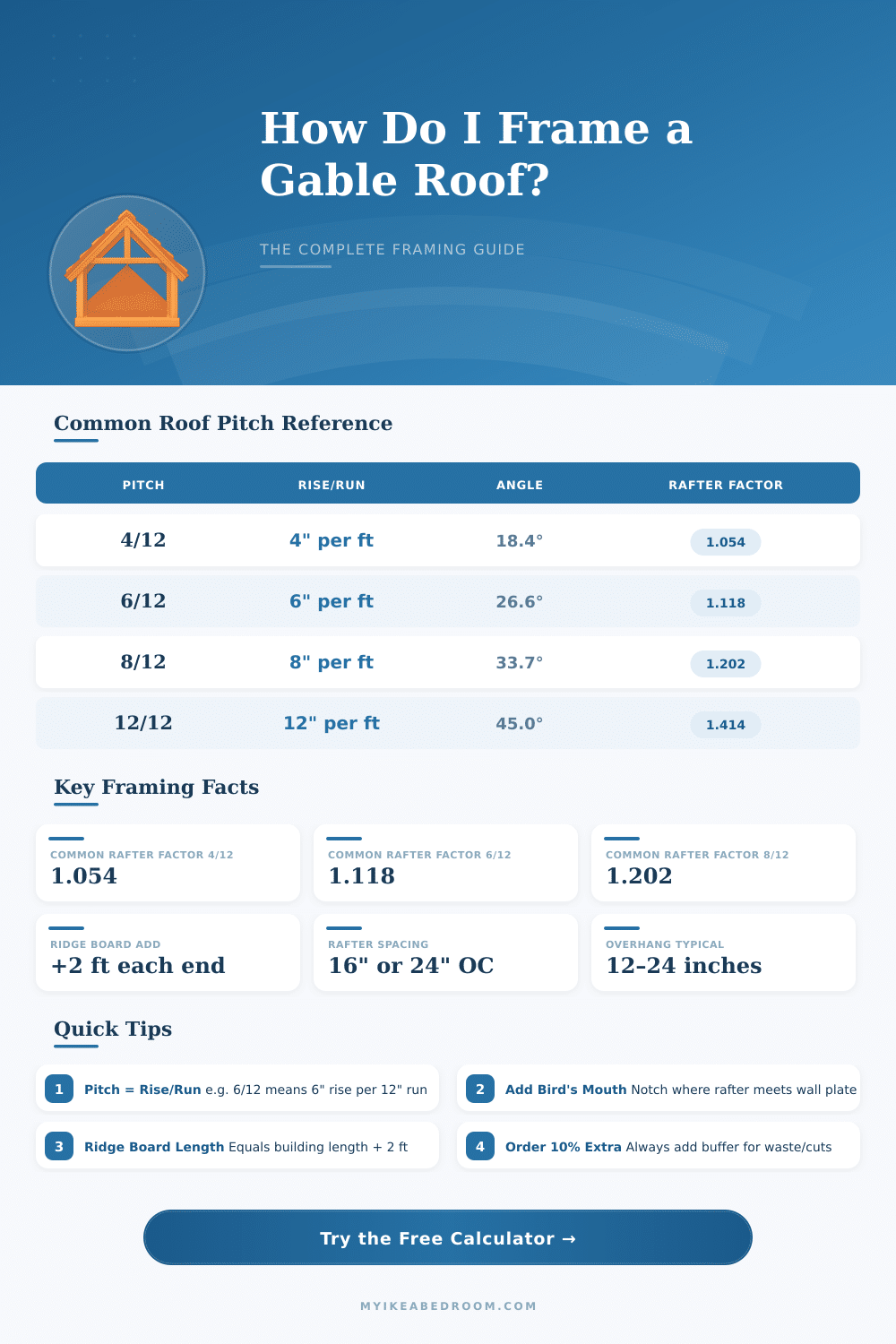
| Pitch | Rise per Foot | Angle (°) | Rafter Factor | Common Use |
|---|---|---|---|---|
| 3/12 | 3 inches | 14.0° | 1.031 | Low-slope porch, addition |
| 4/12 | 4 inches | 18.4° | 1.054 | Garage, shed |
| 5/12 | 5 inches | 22.6° | 1.083 | Ranch house |
| 6/12 | 6 inches | 26.6° | 1.118 | Standard residential |
| 7/12 | 7 inches | 30.3° | 1.158 | Two-story home |
| 8/12 | 8 inches | 33.7° | 1.202 | Steep residential |
| 9/12 | 9 inches | 36.9° | 1.250 | Cape Cod style |
| 10/12 | 10 inches | 39.8° | 1.302 | Steep/cottage |
| 12/12 | 12 inches | 45.0° | 1.414 | Full pitch cabin |
| Building | Span x Length | Pitch | Rafter Length | Rafter Count (16" OC) | Ridge Length |
|---|---|---|---|---|---|
| Small Shed | 10 x 12 ft | 6/12 | 6.7 ft | 18 | 14 ft |
| Standard Shed | 12 x 16 ft | 6/12 | 7.7 ft | 22 | 18 ft |
| Single Garage | 20 x 24 ft | 6/12 | 11.2 ft | 32 | 26 ft |
| Double Garage | 24 x 30 ft | 6/12 | 13.4 ft | 40 | 32 ft |
| Ranch House | 28 x 40 ft | 5/12 | 14.6 ft | 52 | 42 ft |
| Two-Story | 36 x 48 ft | 8/12 | 21.6 ft | 64 | 50 ft |
| Nominal Size | Actual Size | Span Rating | Weight (lbs/ft) | Typical Use |
|---|---|---|---|---|
| 2x4 | 1.5" x 3.5" | Up to 8 ft | 0.86 | Light sheds, small spans |
| 2x6 | 1.5" x 5.5" | Up to 14 ft | 1.35 | Garages, standard homes |
| 2x8 | 1.5" x 7.25" | Up to 18 ft | 1.78 | Wide-span residential |
| 2x10 | 1.5" x 9.25" | Up to 22 ft | 2.27 | Large homes, commercial |
| 2x12 | 1.5" x 11.25" | Up to 26 ft | 2.76 | Long span, heavy load |
A gable roof slopes down in two directions, as if two right triangles tied at vertical line The ridge board runs along the peak of the roof, parallel to the outside walls. The top part of the rafters is nailed to that ridge board and they slope down to the walls. Putting it together is quite simple, when you already know what goes where.
For building such roof, you need wooden boards cut in joists, rafters, supports and ridge board, together with sheathing, felt paper and shingles.
How to Build a Gable Roof
Typical gable roof on house is framed with wooden joists, then covered with plywood or OSB, then with a waterproof layer and finally with shingles. The walls are usually framed with 2×4 or 2×6 vertical boards with spacing of 16 to 24 inches.
Framing roof, you do more than only count the length of the rafters and the ridge. You also must install collar ties, add purlins and strut it so that the roof be strong. The ridge beam requires posts and it must be big enough to bear the weight of the roof.
You will not require that if you use right rafter ties. The cross member at the bottom of the truss serves to stabilize the structure. Those ties stop the rafters from raising and support the rige.
Gable roof with prefabricated trusses are almost as easy as it look. Use such trusses mean, that the engineer already did the calculations for you. Usually you first set the gable-end trusses, that keep vertical 2×4 boards bound to the frame of the house.
Spacers between the trusses help to keep them correctly spaced and give a bit of support. The gable-end truss or rafter is commonly notched to leave place to “outlookers”, that run back to the prior framing members.
For the overhangs, bind the assembly to the wall frame using metal screws with washers every 6 inches. Later, set at least 2×6 fascia board along the edge of the overhang. Install the roof decking, that covers the framing and extend at least 24 inches away from the wall above the trusses or rafters.
Some favor framing the gable-walls first, because you have square space for work and more place for mark the lines of the right pitch. You can do the upper trusses on flat surface, as the other members, and later frame them outside for the internal wall. If the wall is platform-framed, it must be supported horizontally at the hinge spot.
If there is no ceiling, you must lay diagonal supports from the center of the final wall to one of the side walls. The side walls support the bottom half and the roof the upper, to avoid folding. Widely, “balloon” framing are stronger for such walls.