🔨 2x4 Wall Framing Calculator
Calculate studs, plates, and total 2x4 boards needed for your wall framing project
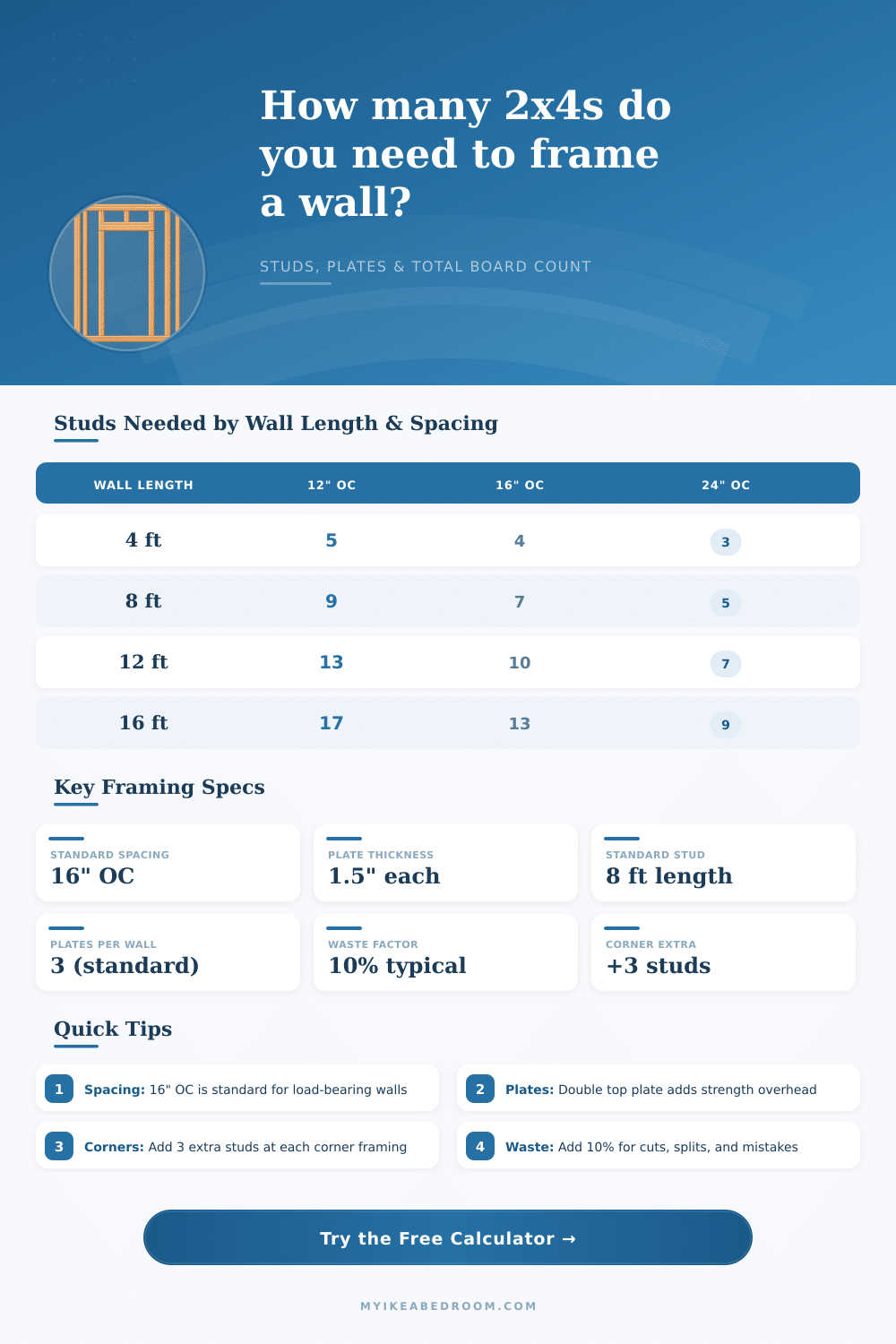
| Wall Length | 12" OC | 16" OC | 24" OC | Board Feet (16"OC, 8ft) |
|---|---|---|---|---|
| 4 ft (48") | 5 | 4 | 3 | ~32 bf |
| 6 ft (72") | 7 | 6 | 4 | ~48 bf |
| 8 ft (96") | 9 | 7 | 5 | ~64 bf |
| 10 ft (120") | 11 | 9 | 6 | ~80 bf |
| 12 ft (144") | 13 | 10 | 7 | ~96 bf |
| 16 ft (192") | 17 | 13 | 9 | ~128 bf |
| 20 ft (240") | 21 | 16 | 11 | ~160 bf |
| 24 ft (288") | 25 | 19 | 13 | ~192 bf |
| Wall Length | 8 ft Boards | 10 ft Boards | 12 ft Boards | 16 ft Boards |
|---|---|---|---|---|
| 4 ft | 1 | 1 | 1 | 1 |
| 8 ft | 1 | 1 | 1 | 1 |
| 10 ft | 2 | 1 | 1 | 1 |
| 12 ft | 2 | 2 | 1 | 1 |
| 16 ft | 2 | 2 | 2 | 1 |
| 20 ft | 3 | 2 | 2 | 2 |
| 24 ft | 3 | 3 | 2 | 2 |
| 32 ft | 4 | 4 | 3 | 2 |
| Wall Length | 0% Waste | 5% Waste | 10% Waste | 15% Waste |
|---|---|---|---|---|
| 4 ft | 7 | 8 | 8 | 9 |
| 8 ft | 10 | 11 | 11 | 12 |
| 12 ft | 16 | 17 | 18 | 19 |
| 16 ft | 19 | 20 | 21 | 22 |
| 20 ft | 25 | 27 | 28 | 29 |
| 24 ft | 28 | 30 | 31 | 33 |
Wall with 2×4 framing are quite standard for many building projects It is structurally sufficient for small garages and sheds. When the height of bearing wall do not pass 10 feet, 2×4 framing widely follow the code. The studs are usually laid with interval of 16 inches between the centres for such small buildings.
Internal walls that bear load should be framed with at least 2×4. It is standard practice use such dimensions for internal walls, unless it is plumbing. For walls that do not bear load, you occasionally use smaller timbers, but the gain is litle. Change of 2×4 to something smaller save only around 4 inches of space in the room.
How to Build Walls with 2x4s
Usually you use one 2×4 for form the bottom plate. For load-bearing walls, two 2x4s are stacked for form the top plate. In old buildings, internal walls that do not belong to the support system commonly have only one piece top plate.
Walls stack two timbers up, with different lengths so that the joints be not at the same place. The bottom plate is not that much important, because it is anchored to the floor or slab.
The top plate helps to distribute the load on several studs. If it lacks, when one stud fails, also the member above it will fall. It also helps to provide side stability.
8-foot 2×4 SPF stud has almost the same force as 10-foot 2×6 SPF stud when deal about vertical load. Section R602 of the 2021 International Residential Code define the rules for walls framed by means of wooden studs.
Warping and bowing is common problems with 2×4 timbers. Use long 2×4 straightedge help to check whether they are straight. If you jump this step, that can cause problems, for instance door that does not close because of twist, what becomes big problem and costs a lot of money.
Little extra care with string saves the whole building. Straighten wall can be difficult task, especially for big walls. Buy better 2x4s from the store help, because they are much more straight.
Because of the mode of framing, some folks build walls with the 3½-inch side of the 2×4 out instead of the 1½-inch side. When you do that, you should take extra measures for ensure that everything is safe and the wood does not curve. In south climates, exterior walls of 2×4 are more common, because foam insulation gives good R-value in such wall.
In colder regions, 2×6 walls are more typical for better insulation. One mode for better thermal protection is build 2×4 load-bearing exterior wall and another 2×4 wall before it, with interval of 3 inches and without thermal bridge between them.