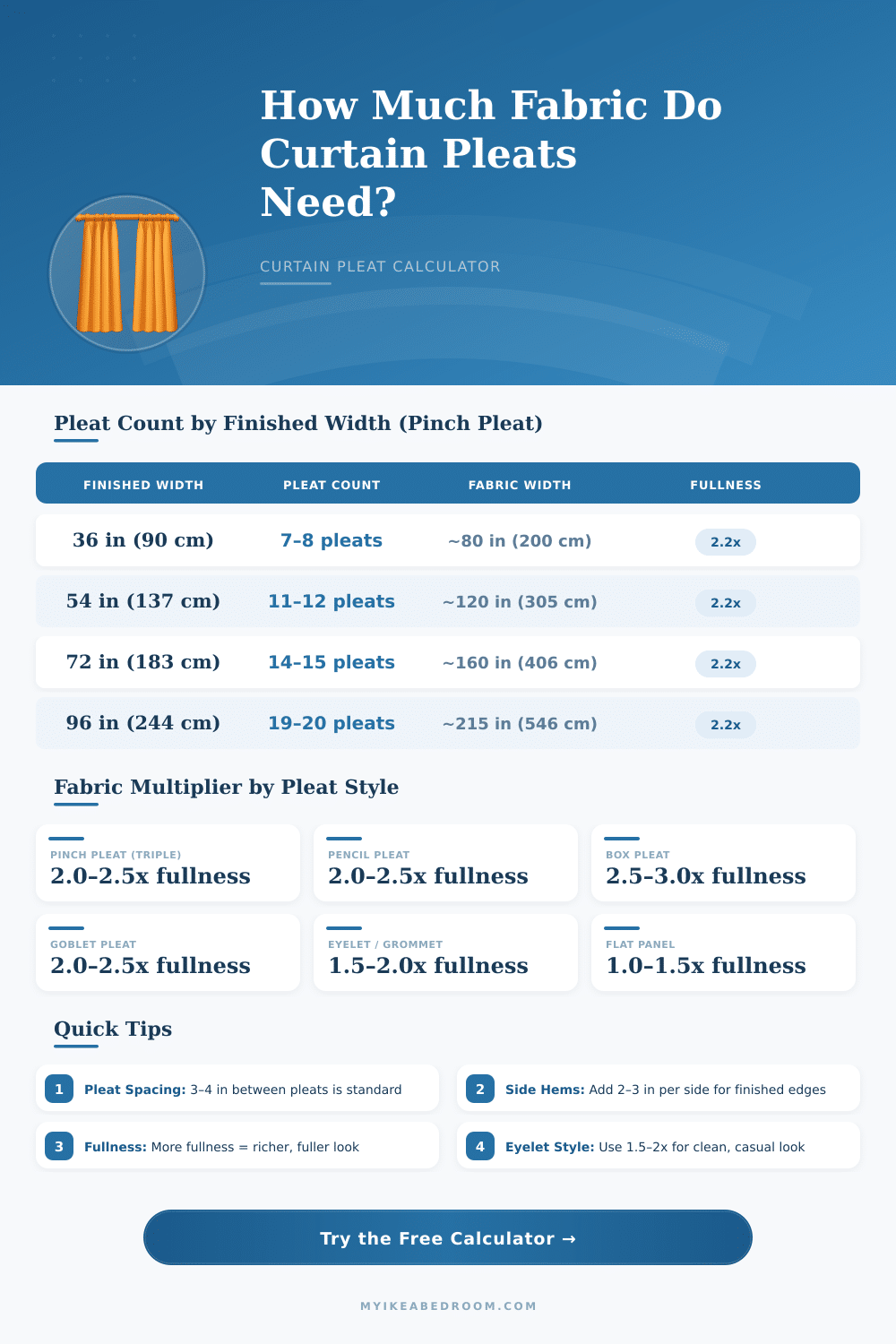
🪟 Curtain Pleat Calculator
Find the exact fabric width, pleat count, and spacing for any pleat style
3.5 in spacing
0.5 in spacing
6–8 in spacing
Grommet rings
| Finished Width | Pinch Pleat Count | Pencil Pleat Count | Box Pleat Count |
|---|---|---|---|
| 24 in (61 cm) | 4–5 pleats | 22–24 pleats | 2–3 pleats |
| 36 in (91 cm) | 7–8 pleats | 34–36 pleats | 3–4 pleats |
| 48 in (122 cm) | 9–10 pleats | 45–48 pleats | 4–5 pleats |
| 54 in (137 cm) | 11–12 pleats | 51–54 pleats | 5–6 pleats |
| 60 in (152 cm) | 12–13 pleats | 57–60 pleats | 6–7 pleats |
| 72 in (183 cm) | 14–16 pleats | 68–72 pleats | 7–8 pleats |
| 84 in (213 cm) | 17–18 pleats | 79–84 pleats | 8–9 pleats |
| 96 in (244 cm) | 19–21 pleats | 91–96 pleats | 10–11 pleats |
| Pleat Style | Fullness Range | Typical Multiplier | Best Application |
|---|---|---|---|
| Pinch Pleat (Triple) | 2.0x – 2.5x | 2.2x | Bedroom, living room |
| Pencil Pleat | 2.0x – 2.5x | 2.3x | Versatile, all rooms |
| Box Pleat | 2.5x – 3.0x | 2.8x | Formal, structured look |
| Goblet Pleat | 2.0x – 2.5x | 2.2x | Elegant, formal rooms |
| Eyelet / Grommet | 1.5x – 2.0x | 1.75x | Modern, casual spaces |
| Flat Panel | 1.0x – 1.5x | 1.2x | Minimalist, sheers |
| Pleat Style | Pleat Depth / Size | Spacing Between | Notes |
|---|---|---|---|
| Pinch Pleat | 4–5 in (10–13 cm) | 3–4 in (8–10 cm) | Triple-finger standard |
| Pencil Pleat | 0.5 in (1.3 cm) | 0.5 in (1.3 cm) | Tight, uniform rows |
| Box Pleat | 2–4 in depth (5–10 cm) | 6–10 in (15–25 cm) | Fabric = 3x pleat depth |
| Goblet Pleat | 4–5 in (10–13 cm) | 3.5–4.5 in (9–11 cm) | Cylindrical top shape |
| Eyelet | N/A (ring diameter) | 3–5 in (8–13 cm) | No fabric pleat, ring fold |
Curtain pleats can be quite confusing because most pleat types have several names for the same thing. The top style determines if the curtain is pleated or flat at the top. This simple detail changes the look and feel of the window treatment
What are pinch pleat drapes? Basically, they are curtains that are sewn and gathered at the top, which creates fuller folds in the fabric itself. If a non-pleated curtain is spread, it would be flat.
What are pinch pleat curtains?
A pinch pleat is pinched up, which allows the fabric to flow down and look elegant. These, which you also call tailored pleats, range from two-finger to five-finger styles. More pleats make the appearance fuller.
You commonly find this style in formal rooms or in master bedrooms.
Every pleat is usually secured with hooks on a track or rod, which works for various fabrics, especially heavier materials. Pinch pleat curtains hang on a flat rod with pins that enter the pleats and hook over the rod. There are special curtain hooks sold for this style.
Heading tape eases the creation of pleats by using hooks, for instance as IKEA’s RIKTIG curtain hooks.
Also there are other types. Goblet pleats look like a glass or cup. The gathered fabric forms a round, full cup at the top, then tapers down like a stem.
That shape gives fancy and unique visual interest. Then there is the rod pocket style, which is simple and cheap. At the top of the curtain is a sewn pocket, through which the rod is directly inserted.
The fabric is either looped or enclosed to create a non-pleated, flowy effect.
Every type of pleat not only changes the visual look, but also the function, affecting movement and light control. French pleat curtains are available in various choices to filter light, from light filtering to blackout, so you can rule the feel of the room.
Making pinch pleat curtains is not a too difficult sewing task… Only straight lines and some simple stitches. And you can do that by hand.
Although they are not entirely simple, there are many help materials, like books and tutorials. DIY pinch pleat drapes are an easy and cheap way to make panels look high end, even without much sewing. One popular IKEA hack cost only around twenty-five dollars per panel.
Pinch pleat curtains are more easily styled in nice folds. Cotton material is lighter, so it is more difficult to style and requires more ironing and careful folding. If you train the fabric to pleat correctly, the curtains will hang well when you drawthem.