🪢 Macrame Cord Calculator
Calculate exactly how much macrame cord you need for any project — wall hangings, plant hangers, table runners & more
| Knot Type | Cord Factor | Notes | Best For |
|---|---|---|---|
| Square Knot | 4 in per knot | Most common macrame knot | Wall hangings, bags |
| Half Hitch | 2 in per knot | Uses less cord | Lines, outlines |
| Spiral / Half Square | 5 in per knot | More cord per knot | Plant hangers |
| Lark's Head | 2x fold + 1 in | Mounting knot | Starting all projects |
| Gathering Knot | ~6 in wrap | Decorative wrap | Plant hangers, ends |
| Overhand Knot | 1–2 in | Very minimal cord | Finishing, fringe |
| Josephine Knot | 8–10 in | Decorative, uses more | Focal points |
| Berry Knot | 6–8 in | 3D decorative knot | Wall art accents |
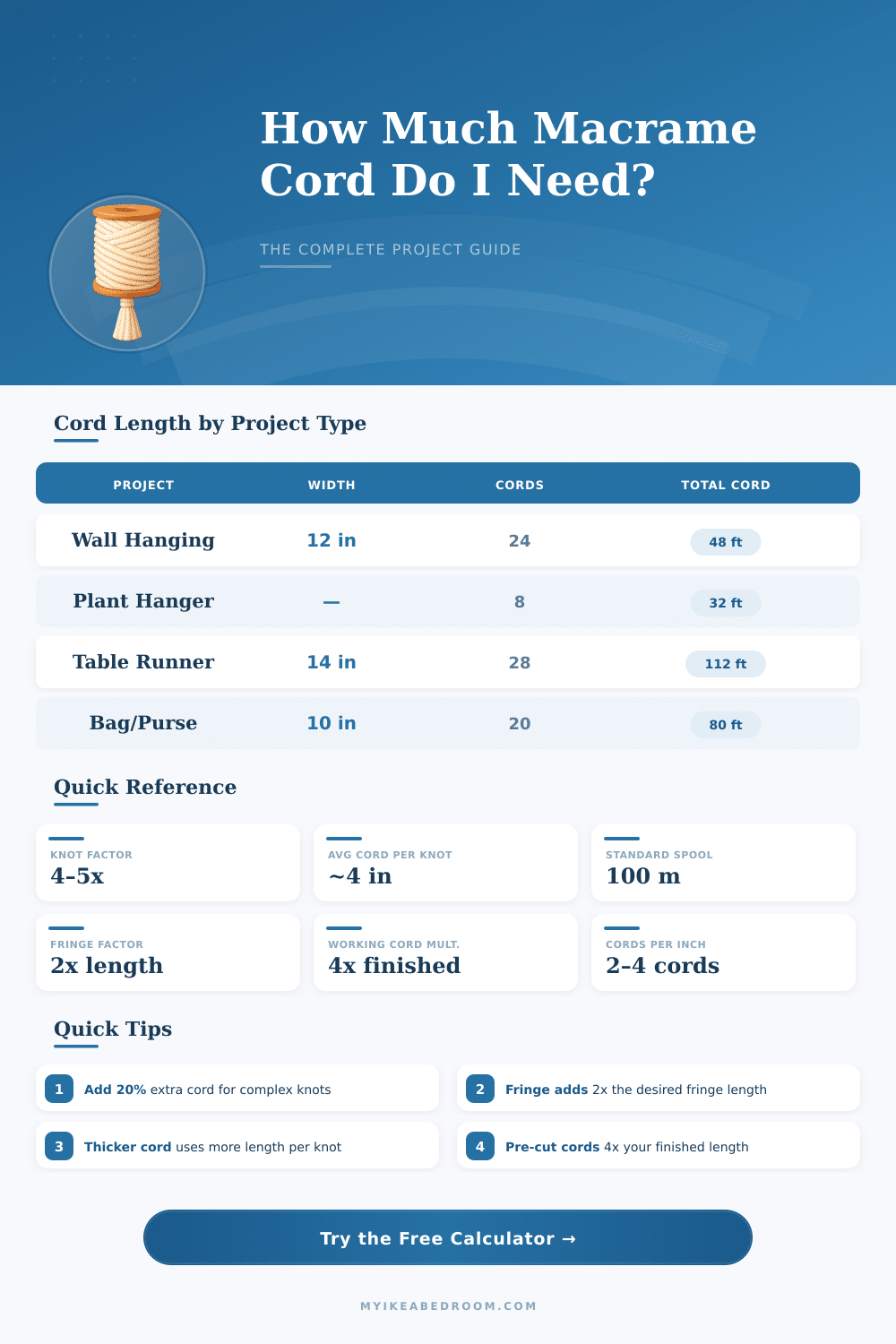
| Project | Finished Size | Cords Needed | Total Cord (ft) |
|---|---|---|---|
| Small Wall Hanging | 8 x 12 in | 16 cords | ~32 ft (9.8 m) |
| Medium Wall Hanging | 12 x 24 in | 24 cords | ~96 ft (29 m) |
| Large Wall Hanging | 24 x 36 in | 48 cords | ~384 ft (117 m) |
| Plant Hanger (single) | — x 30 in | 8 cords | ~32 ft (9.8 m) |
| Table Runner | 14 x 72 in | 28 cords | ~448 ft (137 m) |
| Macrame Bag | 10 x 12 in | 20 cords | ~120 ft (37 m) |
| Coaster (single) | 4 x 4 in | 8 cords | ~12 ft (3.7 m) |
| Hammock | 4 ft x 6 ft | 80+ cords | ~1,200 ft (366 m) |
| Spool Size | Metric | Imperial | Typical Use |
|---|---|---|---|
| Small spool | 50 m | 164 ft | Small wall hanging, 1–2 coasters |
| Standard spool | 100 m | 328 ft | Medium wall hanging, plant hanger |
| Large spool | 200 m | 656 ft | Large wall hanging, table runner |
| Bulk cone | 500 m | 1,640 ft | Multiple projects, hammock |
| Jumbo cone | 1,000 m | 3,280 ft | Commercial / large batch work |
| Pre-cut pack | varies | varies | Beginner kits, single projects |
| Feet | Meters | Yards | Typical Projects |
|---|---|---|---|
| 10 ft | 3.05 m | 3.3 yd | Small coaster, fringe |
| 25 ft | 7.6 m | 8.3 yd | Keychain, small hanging |
| 50 ft | 15.2 m | 16.7 yd | Plant hanger, small bag |
| 100 ft | 30.5 m | 33.3 yd | Medium wall hanging |
| 200 ft | 61 m | 66.7 yd | Large hanging, runner |
| 500 ft | 152 m | 167 yd | Hammock section, curtain |
| 1,000 ft | 305 m | 333 yd | Large curtain, hammock |
macrame cord is simply a common name for any material that one uses to do macrame works. It includes various kinds of thread types. One makes cord from several fibers that one twists together to create thicker thread.
Some cords are made up of many slim fibers, twisted in one single thread. One sometimes calls this type single-thread macrame cord although it really is not real cord.
Types and Uses of Macrame Cord
One can choose between various kinds of cords. Simple twisted macrame cord comes in sizes like 1,5 mm, 2 mm, 3 mm, 4 mm and 6 mm. Triple twisted cotton cord comes in 2 mm, 3 mm, 4 mm, 5 mm, 6 mm and 7 mm.
The thickness that you choose really matters a lot. For instance, 3 mm cord works well for plant hangers. 3 mm and 4 mm cord or thread work well for curtains, coasters and table mats.
For jewlery, 2 mm cord works well and is quite cheap.
Cotton, jute, hemp and sisal thread are among the best materials for macrame. Cotton cord is seen as friendly to nature and soft. Hemp cord forms another good option.
There also exist waxed polyester cord from brands like Linhasita and Settanyl, that almost matches it. This kind resists damage and loss of colour, and one usually sells it in rolls.
Nylon cord is strong, but it slips a bit, so loose knots do not fully hold, unless one pulls it tightly. Nylon also easily tightens. Cotton thread one can use to create nice jewelry.
Jute stays the classic choice. Every thread that does not tighten too much will work well four macrame.
Finding good quality large amounts of cord can seem like searching for a needle in a haystack. Buying in bulk helps to save money. Some stores offer up to 30 percent discount for big orders.
Cord comes in many colours, not only white. Green cord adds a happy touch of colour, while black cord gives a more mysterious look. Some cords have a soft feel and are easy to work with, while they stay tough.
Braided cotton cord from a home store can work, but it combines more hard with others and costs more for weight. Special stores that serve weavers sometimes offer macrame materials. When buying online, checking reviews is a wise step.
Some reviews mention cord that smells bad, so mind that check.
Cord is also used for tasks outside the usual macrame. It works for weaving, especially for the warp. Wrapping a bench chair with cotton cord gives nice texture to furniture.
Macrame cord is used even for crocheted bags and nets. Choosing the right cord depends in the end on yourown taste, and any project waits on the table.