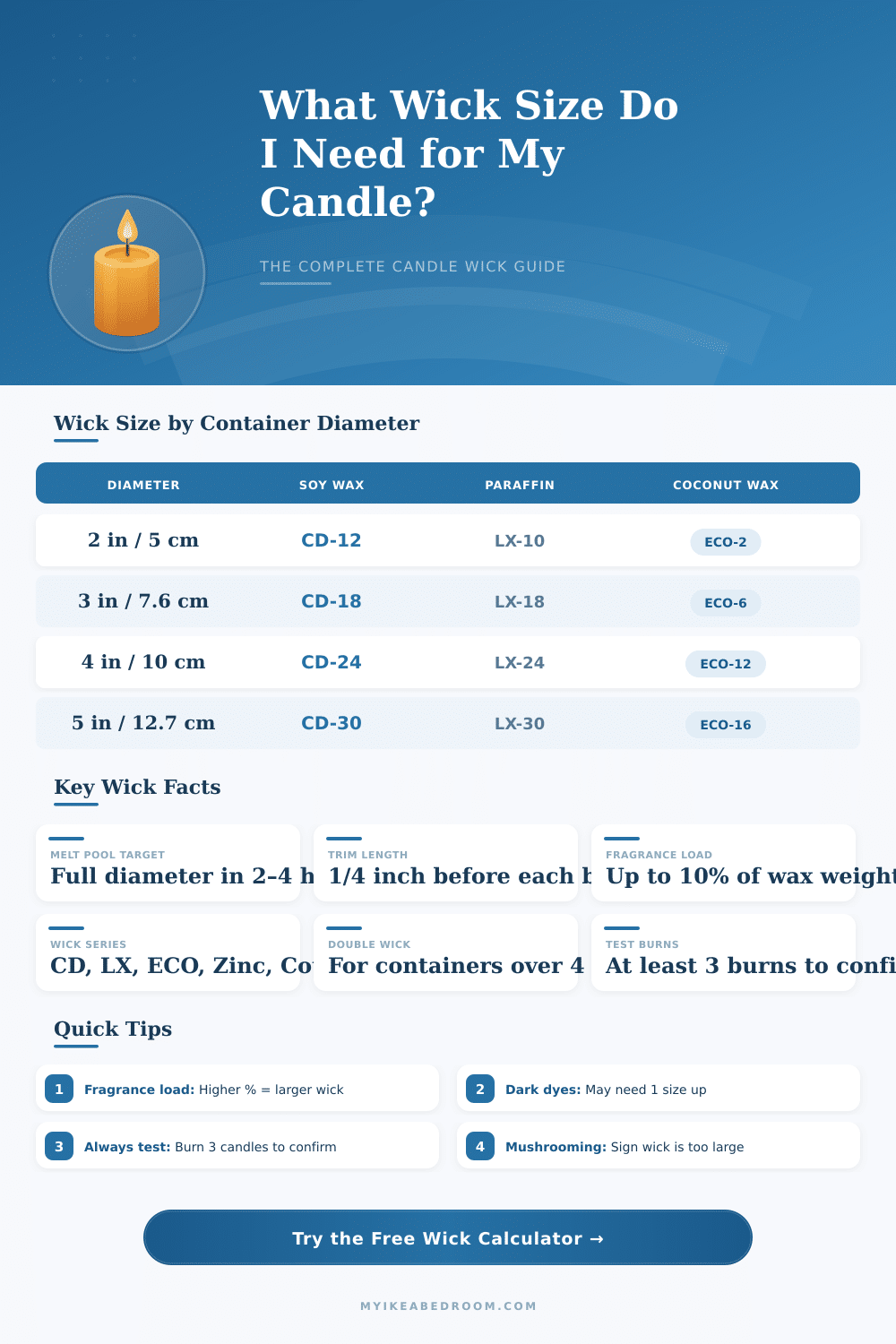
🕯️ Candle Wick Size Calculator
Find the perfect wick series and size for your candle—based on container diameter, wax type, and fragrance load
Base reference
Burns hotter
Dense, burns slow
Low melt point
Balanced blend
Needs special wick
Standard sizing
Similar to soy
Modifier values shown are size adjustments relative to base soy calculation (e.g. +1 means go one size up).
| Diameter (in) | Diameter (cm) | CD Series | ECO Series | LX Series | HTP Series |
|---|---|---|---|---|---|
| 1.5 – 2.0" | 3.8 – 5.1 cm | CD-8 | ECO-1 | LX-6 | HTP-31 |
| 2.0 – 2.5" | 5.1 – 6.4 cm | CD-12 | ECO-2 | LX-10 | HTP-41 |
| 2.5 – 3.0" | 6.4 – 7.6 cm | CD-16 | ECO-4 | LX-14 | HTP-52 |
| 3.0 – 3.5" | 7.6 – 8.9 cm | CD-18 | ECO-6 | LX-18 | HTP-62 |
| 3.5 – 4.0" | 8.9 – 10.2 cm | CD-22 | ECO-10 | LX-22 | HTP-73 |
| 4.0 – 4.5" | 10.2 – 11.4 cm | CD-24 | ECO-12 | LX-24 | HTP-83 |
| 4.5 – 5.0" | 11.4 – 12.7 cm | CD-28 | ECO-14 | LX-28 | HTP-93 |
| 5.0 – 6.0" | 12.7 – 15.2 cm | CD-30 | ECO-16 | LX-30 | HTP-104 |
| Fragrance % | Scent Level | Wick Adjustment | Reason |
|---|---|---|---|
| 0% | Unscented | Base size | No additive interference |
| 1–5% | Light | No change | Minimal effect on burn |
| 6–8% | Moderate | +1 size up | FO thickens wax pool |
| 9–10% | Strong | +1 to +2 sizes up | Heavier oil load |
| 11–12% | Maximum | +2 sizes up | Risk of poor burn pool |
| Observation | Likely Cause | Fix |
|---|---|---|
| Tunneling (no full melt pool) | Wick too small | Go 1–2 sizes up |
| Mushrooming / large flame | Wick too large | Go 1–2 sizes down |
| Excessive soot | Wick too large or FO% too high | Reduce wick or FO |
| Flame flicker / drowning | Wick too small for FO load | Size up one step |
| Uneven melt pool | Wick off-center | Re-center wick in mold |
| Short burn time | Wick pulling too much wax | Size down one step |
| Full melt in < 1 hour | Wick too large for container | Size down or double-wick smaller |
| Candle Type | Diameter | Wax Type | Recommended Wick (CD) | Wick Count |
|---|---|---|---|---|
| Votive | 1.5" / 3.8 cm | Paraffin | CD-8 | 1 |
| Tealight | 1.5" / 3.8 cm | Paraffin / Soy | CD-8 | 1 |
| Mason Jar 4 oz | 2.5" / 6.4 cm | Soy | CD-16 | 1 |
| Mason Jar 8 oz | 3.0" / 7.6 cm | Soy | CD-18 | 1 |
| Apothecary Jar 12 oz | 3.5" / 8.9 cm | Soy Blend | CD-22 | 1 |
| Tumbler 16 oz | 4.0" / 10.2 cm | Soy | CD-24 | 1 or 2 |
| Bowl / Crock 20 oz | 4.5" / 11.4 cm | Soy / Coconut | CD-28 | 2 |
| Pillar Candle | 3.0" / 7.6 cm | Paraffin | LX-18 | 1 |
| Luxury Vessel 24 oz | 5.0" / 12.7 cm | Coconut-Paraffin | CD-30 | 2–3 |
Choosing the right size of candle wick for candle matters a lot, and it truly matters for safety and for good look of the candle. Size of candle wick clearly affects things because different wicks give different levels of heat. Thicker wicks pull more fuel to the flame and make more heat.
Such bigger wicks work better for wider candles or for those made from hard waxes like beeswax or pillar wax.
How to Choose the Right Candle Wick Size
Sizes of wicks usually depend on the width or diameter of the candle that they are meant for. For instance candle wick size one normally works for candles with one-inch diameter. But those sizes are not the same at all makers and can differ.
The size number on a candle wick simply helps to guess its thickness… A higher number means a bigger wick.
Smaller wicks sometimes carry a thick coating of wax, what can make them look almost bigger. But in finished candles they burn differently. To burn well, candles need a candle wick of right size according to diameter of the candle.
Choice of candle wick should happen according to diameter of the tin, not according to volume.
When a candle wick is too small, tunneling happens. Here the wax melts down only through the centre, while lot of wax stays untouched around the edges. Usually one fixes that using a candle wick a bit bigger.
When a candle wick is too big, the candle maybe burns evenly but uses itself more quickly than it should. A candle too strong has a flame too hi that waves a lot. The melted wax forms a pool deeper then half an inch up, and the candle wick leaves extra carbon that builds on the top.
Some kinds of wicks are exactly set. Change of diameter of tin in only quarter of an inch needs a step up or down in one size of candle wick. Candles with diameter of four inches or more need several wicks, because one alone thick candle wick would cause too much smoke and flare up.
Two wicks help to burn the candle evenly over the whole surface, give more light and spread scent more well.
Testing matters a lot. A basic burn test starts by cutting the candle wick to quarter of an inch. If one tests more than one candle wick, mark every candle clearly.
Knowing the type of wax is important, because different waxes have different melting points and that affects what candle wick works best. Size and form of the mold also play a role. Wicks with flat braid from cotton, like the Upper 700 Series, work in tealight candles, jars, pillars and container candles, and they work for both paraffin wax and soy wax.
Use beeswax and soy charts as a starting point for matching size of candle wick to diameter of tin is a good guess, but always test the real mix of wax, tin and scent. Smoking canhappen when size of candle wick is wrong or when one uses too much scent or dye.