🧵 Cross Stitch Thread Count Calculator
Calculate exactly how many strands and skeins of floss you need for your cross stitch project
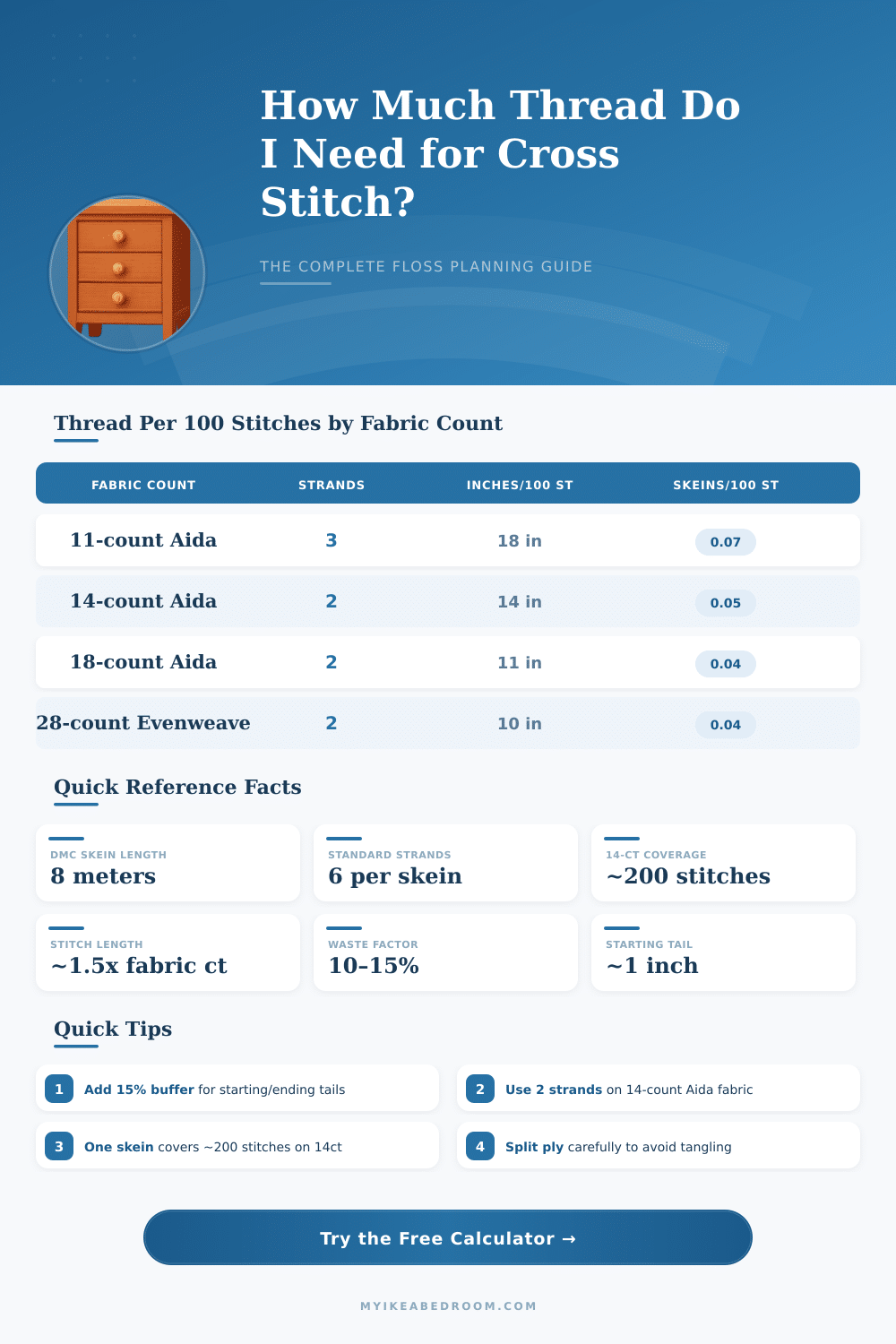
| Fabric Count | Strands Typical | Stitches per Skein | Sq In per Skein | Sq Cm per Skein |
|---|---|---|---|---|
| 11-count Aida | 3 | ~160 | ~1.32 | ~8.5 |
| 14-count Aida | 2 | ~210 | ~1.07 | ~6.9 |
| 16-count Aida | 2 | ~240 | ~0.94 | ~6.1 |
| 18-count Aida | 2 | ~270 | ~0.83 | ~5.4 |
| 22-count Hardanger | 1 | ~350 | ~0.72 | ~4.7 |
| 28-count Evenweave | 2 | ~340 | ~0.43 | ~2.8 |
| 32-count Evenweave | 2 | ~390 | ~0.38 | ~2.5 |
| 36-count Evenweave | 1 | ~500 | ~0.39 | ~2.5 |
| Brand | Skein Length (m) | Skein Length (yds) | Skein Length (in) | Strands |
|---|---|---|---|---|
| DMC Mouline | 8 m | 8.7 yds | 314.9 in | 6 |
| Anchor | 8 m | 8.7 yds | 314.9 in | 6 |
| Cosmo | 8 m | 8.7 yds | 314.9 in | 6 |
| Sullivans | 8 m | 8.7 yds | 314.9 in | 6 |
| Madeira | 8 m | 8.7 yds | 314.9 in | 6 |
| Weeks Dye Works | 5 m | 5.5 yds | 196.8 in | 6 |
| Gloriana Silk | 5.5 m | 6 yds | 216.5 in | 6 |
| Kreinik Metallic | 5 m | 5.5 yds | 196.8 in | 6 |
| Project | Design Size | Total Stitches | Thread Needed (in) | Skeins per Color |
|---|---|---|---|---|
| Small Ornament | 3x3 in | ~1,587 | ~1,058 in | ~3.4 |
| Bookmark | 2x8 in | ~2,509 | ~1,674 in | ~5.3 |
| Greeting Card | 4x4 in | ~3,136 | ~2,091 in | ~6.6 |
| Small Sampler | 5x5 in | ~4,900 | ~3,267 in | ~10.4 |
| Portrait (8x10) | 8x10 in | ~12,544 | ~8,363 in | ~26.6 |
| Medium Sampler | 10x12 in | ~16,128 | ~10,752 in | ~34.1 |
| Large Sampler | 16x20 in | ~40,320 | ~26,880 in | ~85.3 |
Different kinds of thread used in Cross Stitch, and choosing the right type seriously affect the result of your work. The most common thread for this type of embroidery is embroidery floss. It usually is made up of cotton although also wool, polyester or other materials are possible.
Many stitchers like to add shining effect by means of threads with sparkle or various textures to their work.
Which Thread to Use for Cross Stitch
Cotton thread of this kind allows you to form subtle shades and effects during the sewing. It is made up of whole 100-percent cotton. Moreover there exist bright, multi-strand floss from 100-percent rayon fibers.
The rayon provides strong gloss and silky feeling, that slips flat through the fabric. For something sparkly, there are threads with metallic light, pearly gloss or prints, that shine in darkness. They are made from 100-percent polyester.
Besides that, soft cotton thread with lurex sparkle forms another option. Brands like Kreinik offer metallic threads, that are popular for Cross Stitch, needle arts, quilts, dolls, cards and pages of scrapbook. One can use them alone or mix with others for more artistry.
For metallic or smooth threads, use more short bits, because they work more well. One single thread commonly works for such materials. Add beeswax or special thread conditioners to help reduce the fraying.
Know how many threads to use, is key for good result. Patterns for Cross Stitch normally point the number of strands. Usually one takes two threads from the floss for the work.
The Thread Count ranges according to the density of the fabric. On 10- or 11-count fabric, four threads for full crossings and two for back stitch work well. At 14-, 16- or 18-count, two for full crossings and one for back stitch are standard.
For 20-count, one thread suffices for both. The most many guides and pages explain that in the center.
Before starting to sew, separate the threads from the floss. Keep every one alone and then combine the wanted amount. A bit dangling the thread during working now and then is useful.
The moves twist it, but hanging helps untwirl, so it covers bigger surface. Embroidery hoops help too preserve the tension.
Also the care of threads matters. Keep them away from light and in dust-free place for good state. Group the threads according to colours and enclose in little plastic bags (this is a simple way).
A knotless start allows you to start new thread without hiding the tail in nearby stitches. At the end of a section, fold the tails under so that they stay fixed after finishing of the bit. A moresmall needle eases the folding of those finishes.