🧵 Thread Count Calculator
Calculate exactly how much thread you need for sewing, quilting, embroidery & serging projects
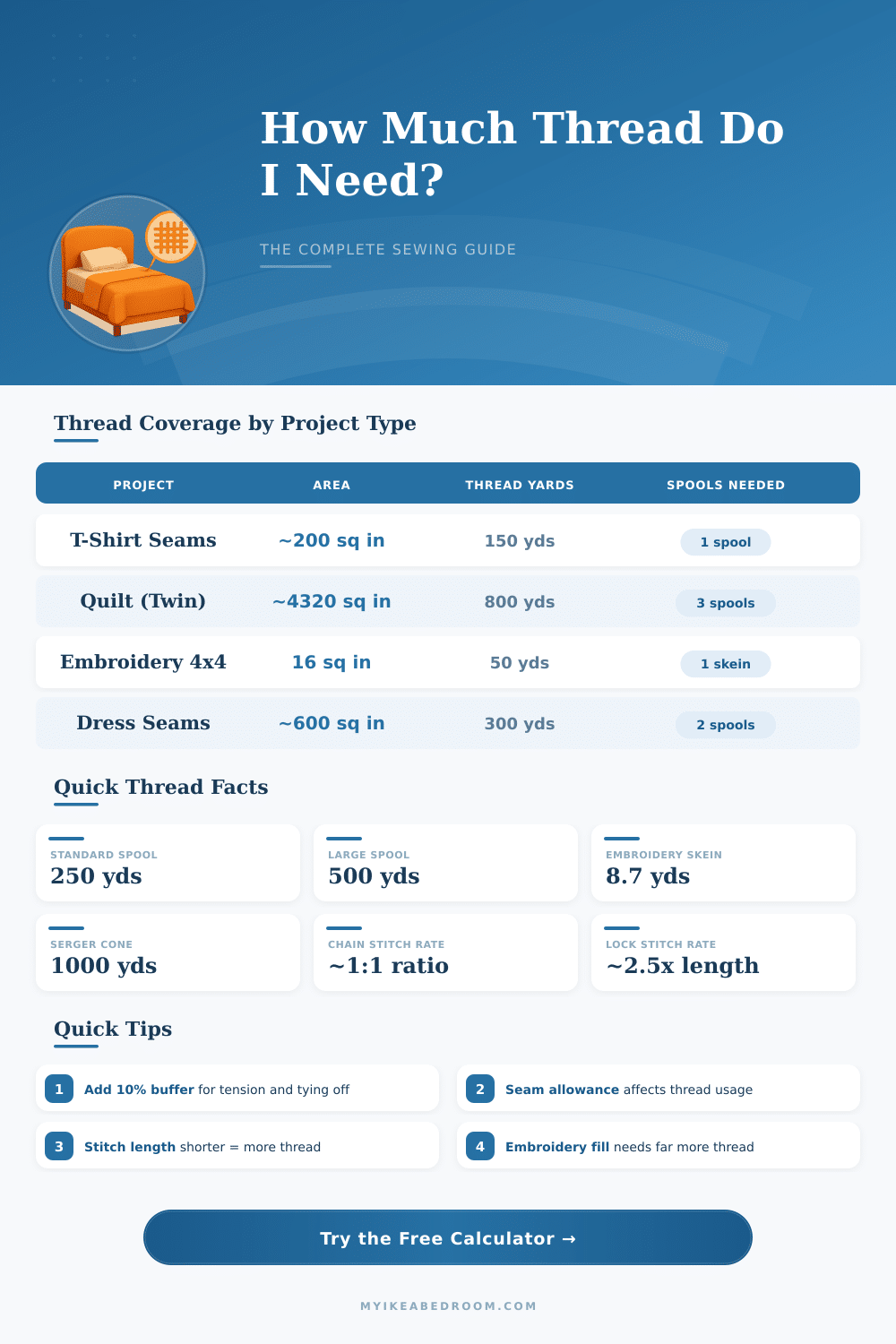
| Project | Seam Length | Thread Yards | Spools Needed (250 yd) |
|---|---|---|---|
| T-Shirt (basic seams) | ~90 in | ~100 yds | 1 spool |
| Pillowcase | ~80 in | ~90 yds | 1 spool |
| Tote Bag | ~70 in | ~80 yds | 1 spool |
| Simple Dress | ~200 in | ~220 yds | 1 spool |
| Trousers/Pants | ~250 in | ~280 yds | 2 spools |
| Twin Quilt (quilting lines) | ~1,200 in | ~450 yds | 2 spools |
| Queen Quilt (quilting lines) | ~1,800 in | ~670 yds | 3 spools |
| Curtain Panel (2 panels) | ~160 in | ~180 yds | 1 spool |
| Serged Hem (per meter) | 39.4 in | ~10–14 yds | 1 cone / project |
| Embroidery 4x4 (fill) | — | ~40–60 yds | 5–7 skeins |
| Stitch Type | Thread Ratio | Notes | Typical Stitch Length |
|---|---|---|---|
| Lock Stitch (standard) | 2.5x seam length | Top + bobbin threads | 2.5 mm |
| Chain Stitch | 1.5x seam length | No bobbin thread | 2.5–3.5 mm |
| Overlock / Serge (3-thread) | ~14x seam length | 3 thread cones | 2.0–3.0 mm |
| Overlock / Serge (4-thread) | ~18x seam length | 4 thread cones | 2.0–3.0 mm |
| Zigzag Stitch | 3.0–3.5x length | Wider = more thread | 2.0–4.0 mm |
| Satin / Fill Stitch | 4.0–6.0x length | Dense coverage | 0.2–0.5 mm |
| Running Stitch | 1.5x seam length | Simple in-out stitch | 3.0–6.0 mm |
| Cross Stitch | 2.0x length (per arm) | 4 passes per cross | Fabric count dependent |
| Spool Type | Thread Yards | Thread Meters | Suitable Projects |
|---|---|---|---|
| Bobbin / Mini | 100 yds | 91 m | Small repairs, patches |
| Standard Spool | 250 yds | 229 m | T-shirt, pillowcase, tote |
| Large Spool | 500 yds | 457 m | Dress, trousers, multi-garment |
| Serger Cone (small) | 1,000 yds | 914 m | Multiple serged garments |
| Serger Cone (large) | 2,500 yds | 2,286 m | Production sewing, quilts |
| Embroidery Skein | 8.7 yds | 8 m | Small motifs, accents |
| Embroidery 25m Ball | 27.3 yds | 25 m | Medium embroidery designs |
| Project | Typical Dimensions | Thread Needed (yds) | Spool Recommendation |
|---|---|---|---|
| Pillowcase (standard) | 20x26 in | 80–100 yds | 1x 250 yd spool |
| T-Shirt | Size M adult | 80–120 yds | 1x 250 yd spool |
| Simple Dress | Size 10 adult | 180–250 yds | 1x 250 yd spool |
| Jeans/Trousers | Size 32 adult | 240–320 yds | 2x 250 yd spools |
| Twin Quilt | 60x80 in | 400–600 yds | 2x 250 yd spools |
| Queen Quilt | 90x108 in | 600–900 yds | 1x 500 + 1x 250 yd |
| Curtain (per panel) | 54x84 in | 80–100 yds | 1x 250 yd spool |
| Embroidery 4x4 | 4x4 in design | 40–80 yds | 5–9 skeins |
A standard lock stitch sewing machine uses roughly 2.5 times the seam length in thread (combined top thread + bobbin). A 10-inch seam uses about 25 inches of thread. Always measure or estimate total seam length first for accurate calculations.
Sergers use dramatically more thread than regular machines — typically 10–18x the seam length across all cones. For a 3-thread overlock at 2.5 mm stitch length, each cone uses about 4–5x the seam length. Always buy extra serger thread cones for any project.
Thread Count shows how many threads lie together in one square inch of fabric. It counts both the horizontal and the vertical ones. While weaving, one calls the vertical standing threads, and the horizontal are crossing threads.
They both seriously affect the structure of the fabric. To find the Thread Count one adds the number of standing and crossing threads in that space. Like this, if the fabric has 100 horizontal and 100 vertical threads per inch, that results in a total of 200.
What Thread Count Means for Bed Sheets
In short, the Thread Count shows the density or tightness of the fabric. High density makes it more tight. Low density gives a more loose feel.
Also, higher density commonly results in thikcer fabric, that feels more crisp and lasts more long.
The Thread Count usually ranges between 200 and 1,000. In typical bed sheets, the standard amount of threads is around 120 per square inch. Choosing at least 200 is wise, because here it starts to be truly good quality.
For most fabrics, a range of 200 to 600 works well. Commonly, bigger densities give a fancier touch.
But here is the main point. Many believe that bed sheets with high Thread Count always have the best quality, but the reality is a bit more complex. A bed sheet with 400 threads, made from good, single-ply thread of long-fiber cotton, will feel much more comfortable and will last more time than one with 1,000 threads from less good multi-ply yarn.
Cloths from better fiber, even with low density, will be softer and will resist more well the washes then those from cheap fibers with bigger density. The density truly matters only for 100-percent cotton bed sheets. Between 300 and 500 lies the ideal, but even in that range not all are automatically excellent.
The Thread Count is also a matter of personal taste. Some prefer more crisp and stiff bed sheets, that come with higher densities. For many, the good place is around 500 to 800.
Bed sheets under that range can feel rough or hard. Above that, they can become too warm and cause sweat. For satin cotton bed sheets, the best range is 300 to 600.
If one goes higher, makers commonly use multi-ply threads instead of single ones, which can fail. Some companies already were criticized for claiming too high densities.
Most folks ultimately choose bed sheets with 200 threads, because they cost less. A density of 500 to 700 will please those that want something fancier. Bed sheets with bigger density cost more, because they need more fibers.
Also, important to note, that Thread Count one does notuse for linen fabrics. For linen, one checks the weight in grams per square metre.